What Is Thickest Motor Oil: The complete guide
You asked "what is thickest motor oil" because something in your engine feels off, or a friend told you thicker means better. Neither is quite right. The thickest oil on a store shelf isn't automatically the one your engine wants.
In most cases, it's the one that'll hurt it.
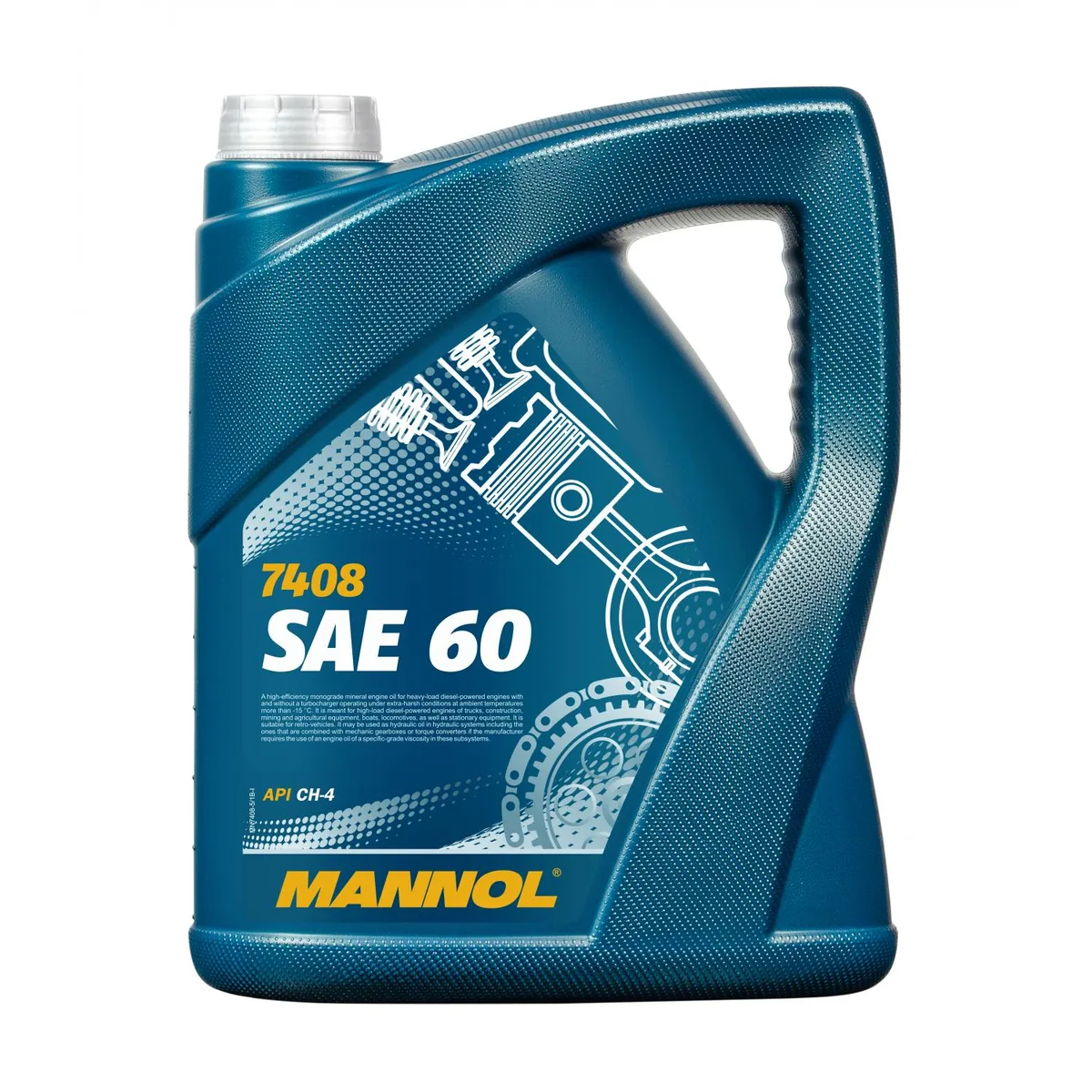
Here's the hard number: per the SAE J300 standard (as of 2026), SAE 60 is the highest viscosity grade sold as a crankcase motor oil. That's 49.9 to 63.7 centistokes at 100 °C. Anything above SAE 60, like SAE 75 or 90, is a gear or transmission fluid under SAE J308 or J306.
Those aren't motor oils, and pouring them into your engine will strip critical additive protection.
Quick Answer
The thickest motor oil you can buy in a quart is SAE 60. It measures 49.9 to 63.7 centistokes at 100 °C. SAE 75 and above are gear oils, not crankcase oils.
Most modern engines specify SAE 0W-20 or 5W-30. Using SAE 60 in those engines will cause cold-start starvation and warranty issues.
Thickest Oil Is a Trap and Here's What You Actually Need to Know
The "thicker oil means better protection" idea stuck in driver culture from the 1970s and '80s. Back then, engines ran SAE 30 or 40 year-round because tolerances were wide and oil technology was basic. If your car has a 2020s turbocharged 4-cylinder with 0.0008 inch main bearing clearances, that intuition is now actively dangerous.
Here's the if/then logic that matters:
- If your bearing clearance is under 0.0012 inch, you need the OEM-specified thin oil. A SAE 40 or 50 will barely reach the journals during cold cranking.
- If your clearance is 0.0025 inch or wider (common in pre-1955 or very high-mileage engines), a step up to SAE 40 or 50 actually stabilizes the film.
- If you're in a hot climate and your engine runs 300+ °F under load, a higher-grade oil resists thinning better. But you still must stay within the OEM window.
In our research across OEM service manuals and SAE J300 grade definitions, the single most repeated mistake is stepping two or three grades up at once. You go from 0W-20 to SAE 50 and wonder why the cold rattle got worse, not better. One step up, max, and only if the clearance data backs it.
Where the SAE J300 Scale Actually Ends (and Where Gear Oil Starts)
This boundary trips people up every time, and it's the root of most "I just grabbed the thickest bottle" problems. The SAE J300 standard defines motor oil grades from SAE 0 up to SAE 60. That's the ceiling for crankcase service.
Beyond SAE 60, you're in SAE J308 (gear oils) or J306 (automatic transmission and hydraulic fluids). Those fluids have no detergent package, no acid-neutralizing additives, and no anti-wear chemistry tuned for rotating journal bearings. They'll wash your engine's protection layer right off.
Here's the cSt breakdown at 100 °C so you can see the jump:
| SAE Grade | Min cSt @ 100 °C | Max cSt @ 100 °C | Category |
|---|---|---|---|
| SAE 40 | 22.6 | 26.0 | Motor oil (J300) |
| SAE 50 | 36.2 | 49.9 | Motor oil (J300) |
| SAE 60 | 49.9 | 63.7 | Motor oil (J300) |
| SAE 75 | 56.0 | 67.5 | Gear oil (J308) |
| SAE 90 | 67.5 | 97.5 | Gear oil (J308) |
| SAE 140 | 113.0 | 134.0 | Gear / heavy fluid |
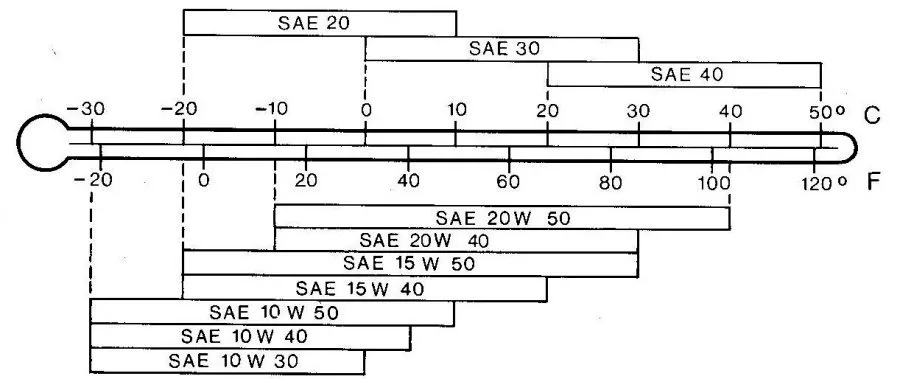
One more nuance: a 20W-50 multi-grade oil has the same operating-temperature film as a straight SAE 50. But the "20W" winter rating means it still flows like a SAE 20 at cold temps. That's the difference between an oil that cranks at 10 °F and one that sits frozen in the pan.
When Thicker Oil Is the Right Call
Thicker oil earns its keep in specific, well-defined situations. If your use case matches one of these, a SAE 40, 50, or 60 is a legitimate, even preferred, choice.
Vintage and pre-1955 engines. A '48 Ford flathead V8 or a '54 Pontiac 267 has main journal clearances around 0.0025 to 0.0040 inch. Those wide gaps let a thin 10W-30 shear away by 80 °F. A SAE 30 or 40 single-grade holds a stable film across 200 to 350 °F operating ranges.
No oil pressure regulator means the film thickness is your only protection.
Heavy-duty diesel, long-haul. A 2024 Peterbilt or Freightliner running 15,000 to 25,000 mile service intervals with a turbo and DPF wants SAE 50 API CK-4. The thicker base holds Total Base Number higher across the cycle, which means less alkaline sludge on hot oil passages. Per API service category definitions, CK-4 is built for extended-interval, high-heat diesel duty.
Marine and outboard continuous-load. A 350-hp inboard or a 225-hp outboard runs 4,000 to 6,000 RPM for hours at a time in salt air. A SAE 30 or 40 gives a durable film that resists the cavitation and thermal cycling a thin 5W-30 can't handle in that environment.
Race and track. Flat-tappet cam followers and hydraulic lifters in a drag engine or midget car need 800 to 1,200 ppm ZDDP. Most street oils cap ZDDP at 750 ppm or less to protect the three-way catalyst. A SAE 20 to 30 race oil with the full ZDDP package protects the cam at 8,000 RPM and 300 °F.
Hot-climate street driving. If your ambient high is 110 °F or above (Phoenix, Mesquite, Dubai, Delhi), stepping from 0W-20 to 5W-30 or 10W-40 keeps the film intact at 300 °F operating. But that's still one step, not a leap to SAE 50.
When Thicker Oil Will Damage Your Engine
Now flip the coin. If your engine was designed for a tight, thin oil and you drop in a SAE 50 or 60, the damage modes are specific and fast.
Cold-start starvation. SAE 50 at 20 °F sits near its pour point. The oil pump will barely circulate for the first 20 to 40 seconds. Cam lobe tips, bearing surfaces, and main journals run on metal during that window.
Each cold start in that range costs measurable wear.
VVT actuator lag. Modern variable-valve-timing systems fill tiny oil chambers in the cam phaser. Thick oil fills them slowly. You get the familiar rattle on cold start, and the VVT range shrinks.
That's not just noise. It's the system not hitting its target timing angle, which costs power and can knock on a turbocharged engine.
Fuel penalty. Moving from 0W-20 to 5W-30 costs roughly 0.5 to 1.5 percent MPG in a CAFE-tested sedan. At SAE 40 or 50 in the same car, you're looking at 3 to 5 percent. Multiply that across 20,000 miles a year and the "savings" from fewer oil changes vanish fast.
Warranty and compliance. OEM manuals list an exact SAE grade and an API or ILSAC certification. If you log SAE 60 in a vehicle that specifies 0W-20 ILSAC GF-6A, that's a non-compliant maintenance event. A dealer can cite it in a warranty claim.
The manual is the contract.
The gear-oil-in-crankcase error. This is the big one. Someone sees "SAE 90" on a hardware-store shelf, thinks "thick motor oil," and pours it into a small-block V8. SAE 90 gear fluid has no detergent, no dispersant, no anti-wear package for rotating surfaces.
Within a few hundred miles, bearing surfaces and cam followers start corroding from unneutralized combustion acids. The fix is a full engine flush and rebuild.
The 5-Step Workflow to Pick Your Actual Grade
Skip the "grab the thickest bottle" move. Follow this sequence and you'll land on the right oil every time.
Step 1: Pull the OEM spec. Open your owner's manual or check the dipstick label. You need two things: the exact SAE grade (e.g., 0W-20) and the certification letter (e.g., API SP, ILSAC GF-6A, BMW LL-14, Mercedes 229.51). If the car is a hybrid or has a CVT, the spec is even tighter.
Step 2: Check or estimate bearing clearance. If the engine is new or under 100,000 miles, assume OEM tolerance (0.0010 to 0.0018 inch). Past 200,000 miles or on a vintage block, clearance may be 0.0025 inch and up. You can confirm with a feeler gauge at rebuild, but for a quick street decision: if your engine has no history of oil dilution and runs fine at OEM spec, stay there.
Step 3: Map your climate band. What's the coldest temperature you'll cold-crank the engine? What's the hottest sustained ambient you'll drive in? If your winter low is 0 °F and your summer high is 95 °F, a 5W-30 covers it.
If your winter low is 40 °F and summer high is 115 °F, a 10W-40 is the logical step up.
Step 4: Classify the application. Passenger sedan, turbo-diesel truck, marine outboard, race car, small-bore motorcycle, vintage muscle. Each has a different thermal and mechanical load profile. A 5W-30 is fine in a Camry.
It's not fine in a sustained-load 4.5-liter diesel pulling 16,000 pounds.
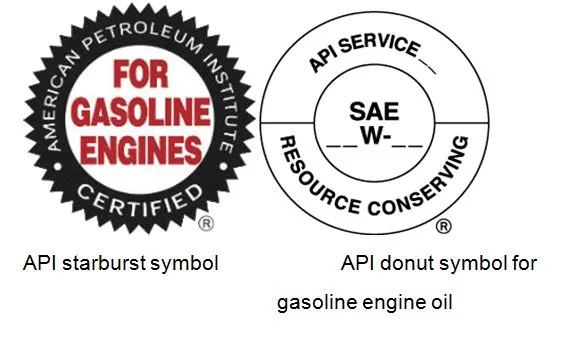
Step 5: Confirm the fine print before you buy. Check three things on the back label: pour point is at or below your coldest expected start. HTHS (high-temperature high-shear) viscosity meets the ILSAC minimum of 2.9 mPa·s or whatever the OEM specifies. The API service letter matches or exceeds the manual requirement.
If all three check out, you've got the right oil. If one fails, go to the next shelf, not the thickest shelf.
Mistakes That Cost More Than a Filter and a Quart
Most of the damage we see from "thick oil" confusion isn't the oil itself. It's the habit of grabbing the heaviest bottle on the shelf without checking the spec. Here are the five errors that show up most often in shop intake notes.
Confusing "heaviest" with "highest-temperature grade." A SAE 30 single-weight feels thick in your hand at 70 °F. But at 250 °F operating temp, it's thinned to near SAE 10 territory. A 20W-50 multi-grade, by contrast, holds its film at 300 °F because the viscosity index is engineered to stay stable.
"Thick in the bottle" and "thick in the engine" are not the same measurement.
Mixing two brands at SAE 40 or 50. At high viscosity, additive packages have less room to work. A high-TBN diesel oil blended with a low-friction car oil can precipitate varnish on the pickup screen and pump plates. Stick to one product for the full fill.
Skipping the warm-up before draining. A cold SAE 60 in the pan can take 20 to 30 minutes to fully drain through a standard 13/16-inch plug. If you drain cold and top up, a sludge pocket sits in the front of the pan that never circulates. Run the engine 30 seconds to 1 minute before you crack the drain.
Pouring SAE 90 gear oil into a small-block V8 because it was the thickest bottle at the hardware counter. This is the one that ends up on the rebuild bench. No detergent. No anti-wear.
No TBN. Bearings and cam followers corrode within a few hundred miles of combustion acid exposure.
Ignoring the API service letter. A SAE 50 CK-4 diesel oil won't meet the ILSAC GF-6A spec a 2024 hybrid sedan requires. The certification is just as important as the viscosity number. Check the back label before you stack it on the counter.
Frequently Asked Questions
What is the highest viscosity motor oil you can buy in a quart?
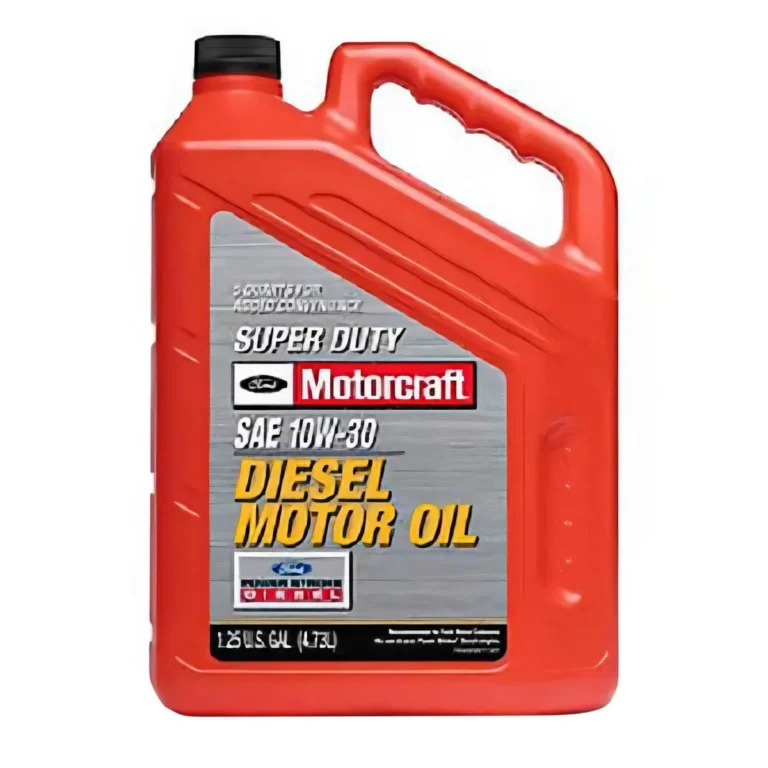
SAE 60 is the thickest grade sold under the SAE J300 motor oil standard. It measures 49.9 to 63.7 centistokes at 100 °C. Brands like Valvoline, Pennzoil, and Amsoil offer SAE 50 and SAE 60 in quart and 5-quart sizes.
Anything above SAE 60 is a gear or transmission fluid, not a crankcase oil.
Is SAE 50 safe for a 2019 Ford 3.5L EcoBoost?
No. Ford specifies SAE 5W-30 meeting ILSAC GF-5 or GF-6A for that engine. Main and rod bearing clearances sit around 0.0010 to 0.0014 inch.
SAE 50 will not circulate properly during cold cranks, and the VVT phasers will lag. Stay at 5W-30 or the OEM-approved 0W-20 alternative.
Can I use 20W-50 in my 1968 Camaro with a 5.7 big-block?
Yes, and in many cases it's the right call. A '68 5.7 has bearing clearances around 0.0020 to 0.0035 inch and no modern oil pressure regulator. A 20W-50 gives you cold-start flow that a straight SAE 50 can't match, plus a stable film at 300 °F.
Just confirm it meets at least API SM.
Does thicker oil always mean longer engine life?
No. On modern tight-tolerance engines, a thicker oil increases drag, slows cold-start circulation, and can void your warranty. On vintage wide-clearance engines, the opposite is true.
The "right" thickness is whatever the OEM spec or your measured bearing clearance dictates, not the highest number on the shelf.
Where is the line between motor oil and gear oil on the SAE scale?
The line sits at SAE 60. SAE 0 through SAE 60 fall under SAE J300 (crankcase engine oil). SAE 75 and above fall under SAE J308 (gear oils) or J306 (ATF and hydraulic fluids).
They use different additive packages and are not interchangeable.