Yes, some engine oil additives can work, but most drivers do not need extra additives when they already use the correct motor oil.
If you drive to work in Texas heat, face freezing mornings in Minnesota, or spend hours in stop-and-go traffic in Los Angeles, your engine oil has a tough job. It must reduce friction, carry away heat, limit deposits, and protect moving parts. That is why the oil you choose matters so much.
When an engine starts making noise or an older car begins to use more oil, an additive may seem like a simple fix. These products claim to reduce wear, quiet lifters, clean dirty engines, or slow oil leaks. Some contain ingredients that can help under specific conditions, but a bold label does not prove that a product will improve your engine.
Modern engine oil already contains a carefully balanced blend of additives. These include detergents, dispersants, anti-wear agents, antioxidants, and viscosity modifiers. Adding another product can change that balance, and the result may be helpful, neutral, or harmful depending on the oil, engine, additive, and problem.
The practical answer is to start with your vehicle owner’s manual and the oil specification it requires. Extra additives should solvea clear, specific problem, not replace routine maintenance or proper repairs. This guide explains what the products do, what their claims mean, and how to decide whether one is worth using.
Source: storage.googleapis.com
What Are Engine Oil Additives?
Engine oil additives are chemical ingredients that change or support the performance of motor oil. They help the oil protect metal parts, manage contaminants, resist oxidation, and perform across a range of temperatures. Some additives are blended into motor oil at the factory, while others are sold in separate bottles for drivers to pour into an engine.
The difference matters. Factory-blended additives are selected to work as a complete system. A separate treatment introduces another chemical mixture into that system, and its effect depends on the existing oil formulation and the treatment’s concentration.
The term engine oil additive can refer to several different products. One may focus on reducing friction, another may claim to clean deposits, and a third may aim to reduce oil consumption. These are different goals, so one product cannot be assumed to deliver every benefit.
Source: kcklubricants.com.au
Factory-blended additives
These are part of the motor oil formulation. They help the oil meet its intended performance requirements and are generally the first choice for routine engine protection.
Aftermarket oil treatments
These are sold separately and added to existing oil. Their usefulness depends on the formula, the engine’s condition, and compatibility with the required oil.
Special-purpose treatments
Some products target a narrow issue, such as certain deposits or noise in an older engine. A claimed benefit should be checked against the actual cause of the problem.
Why Does Engine Oil Need Additives?
Base oil alone cannot meet every demand inside a modern engine. The oil must work during cold starts, high-temperature operation, heavy loads, and repeated trips. Additives help the oil manage these changing conditions.
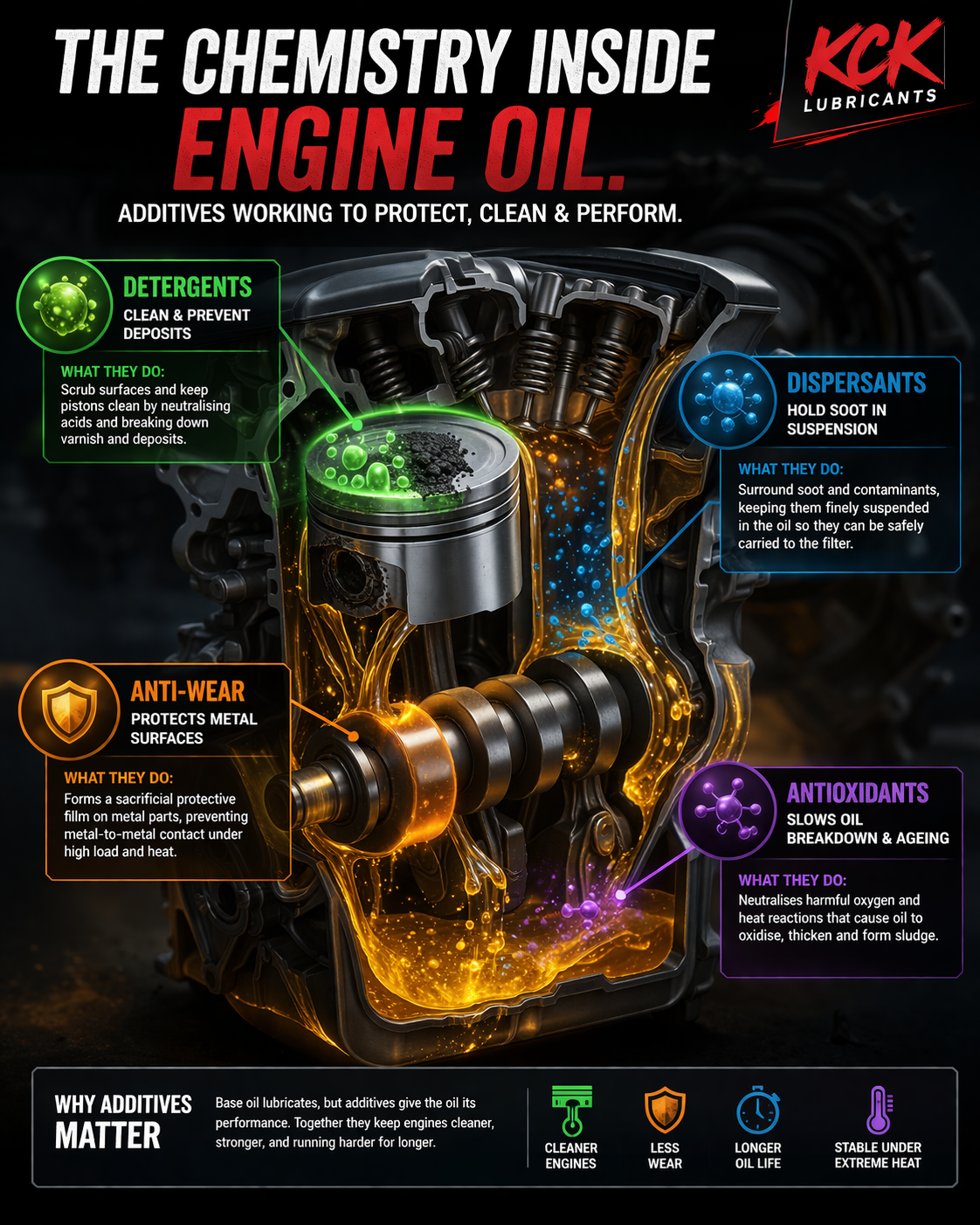
Detergents help control certain deposits, while dispersants keep fine contaminants suspended so the oil filter and oil changes can help remove them. Anti-wear agents form protective films under some operating conditions, and antioxidants slow chemical breakdown. Other ingredients help limit foam or improve how oil flows as temperatures change.
These ingredients are not magic. They support the oil’s intended job, but they cannot prevent every form of wear or correct mechanical damage. The goal is balanced protection, not the highest possible concentration of one ingredient.
Detergents and dispersants
Help control deposits and keep contaminants from joining into larger, harmful masses.
Anti-wear agents
Help protect surfaces when normal oil-film protection is reduced, such as under some high-pressure conditions.
Antioxidants
Slow oil oxidation, which can otherwise contribute to thickening and deposit formation.
Viscosity modifiers
Help an oil maintain useful flow characteristics across its intended temperature range.
Do Engine Oil Additives Actually Work?
Yes, an engine oil additive can produce a real chemical or physical effect. The harder question is whether that effect improves performance in your particular vehicle. A change in friction, for example, does not automatically mean better fuel economy, longer engine life, or lower repair costs.
An additive may perform well in a controlled test yet offer little noticeable benefit in everyday driving. The result can change with engine design, oil grade, temperature, load, mileage, and the amount of treatment used. A product that helps one engine may be unnecessary or unsuitable for another.
To judge an additive fairly, look for evidence tied to its intended purpose. A claim about reduced wear should have relevant wear testing. A claim about fuel savings should have measured fuel-use results under stated conditions. A claim about cleaning should distinguish the removal of deposits from simply changing the appearance of used oil.
The most useful conclusion is that additives are not all alike. Some ingredients have established roles in engine oil, but that does not prove every aftermarket bottle improves an engine that already uses suitable, specification-compliant oil.
Source: rislone.com
What may work
A compatible treatment may alter friction, support deposit control, or help address a narrow oil-related issue when the formula and conditions are appropriate.
What is not guaranteed
Lower fuel use, more horsepower, quieter operation, reduced oil consumption, or a longer engine life cannot be assumed from a product label alone.
What should raise concern
Claims that one additive can repair almost any engine problem or restore severely worn parts without mechanical work are not credible substitutes for diagnosis.
How Can You Tell Whether an Additive Works?
Start by defining the problem the product claims to solve. If the engine consumes oil, measure the consumption over a known distance and check for leaks. If the engine is noisy, record when the sound occurs and have the cause assessed. Without a baseline, it is easy to mistake normal variation for an improvement.
Next, look for a clear test method. Useful evidence identifies the oil and engine tested, the operating conditions, the comparison product, and the measured outcome. Independent testing is especially valuable when a company sells the treatment being evaluated.
Finally, consider whether the result matters in normal use. A small change in a laboratory measurement may not be noticeable to a driver, and a short test cannot establish that an engine will last longer over many years. Do not treat a testimonial or a demonstration video as proof of long-term engine protection.
Check the claim
Look for a specific outcome rather than broad promises such as smoother operation or maximum protection.
Check the comparison
Results are more meaningful when the treatment is compared with the same approved oil without the treatment.
Check the limits
A result from one engine, oil grade, or test condition may not apply to your vehicle.
Types of Engine Oil Additives and Their Benefits
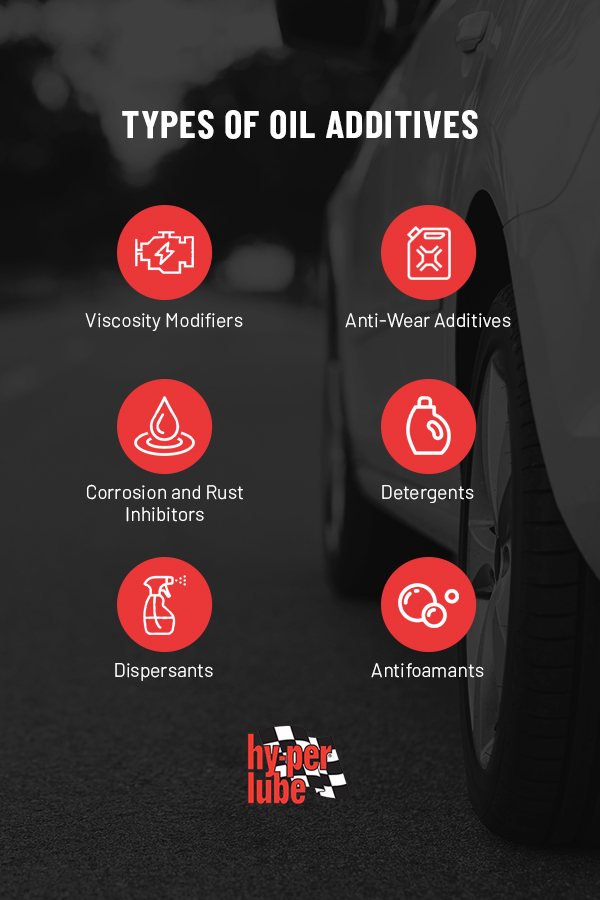
Different additives target different parts of engine oil performance. Understanding the type helps you separate a plausible benefit from a claim that needs more proof. It also helps you avoid buying a product for a problem it cannot solve.
The ingredients used in factory oil are often similar in broad purpose to ingredients promoted in aftermarket treatments. However, a separately sold product may have a different concentration or formulation, so the ingredient name alone does not establish how well the final product works.
Source: motorist.org
Friction modifiers
These ingredients aim to reduce friction between moving surfaces. Any real-world benefit depends on the formula, engine design, oil, and operating conditions.
Anti-wear treatments
These products aim to support protective films on metal surfaces. Adding more anti-wear chemistry is not automatically better because the existing oil already has a designed additive balance.
Detergent and cleaning treatments
These aim to manage certain deposits or contaminants. Heavy deposits may require diagnosis and a controlled repair plan rather than a strong chemical treatment.
Viscosity modifiers and thickening treatments
These aim to change how thick the oil is at certain temperatures or conditions. They may affect oil flow and must not be used to override the engine maker’s viscosity requirements.
Seal conditioners
Some products claim to help certain aged seals remain flexible. They cannot reliably repair a split, hardened, displaced, or mechanically damaged seal.
Do Friction-Reducing Additives Improve Fuel Economy?
Reducing friction can reduce one source of energy loss, so the idea has a sound physical basis. Yet the effect on fuel economy depends on how much friction changes compared with all the other energy losses in a vehicle.
A driver should not expect a dramatic mileage increase from an aftermarket treatment without strong, relevant test data. Tire pressure, driving speed, traffic, trip length, vehicle condition, and weather can all affect fuel use. These factors can hide a small change or make a claimed improvement appear larger than it is.
If fuel economy is the goal, first check tire pressure, air filters where service is due, driving habits, brake drag, and engine maintenance. Use the oil grade and specification listed in the owner’s manual. A treatment that changes the oil beyond its intended properties may create more risk than benefit.
Look for measured fuel use
Prefer repeatable comparisons with the same vehicle and similar driving conditions over broad marketing claims.
Keep the oil specification intact
Do not trade the required oil grade or approval for an unverified promise of better mileage.
Can Oil Additives Reduce Engine Noise?
Some treatments change oil viscosity or friction behavior, and that can change certain engine sounds. A quieter engine, however, is not proof that wear has stopped or that a damaged component has been repaired.
Noise can come from low oil pressure, worn bearings, valve-train parts, an exhaust leak, a loose accessory, or other faults. The sound’s timing and location matter. A new knock, a loud tapping sound, or a warning light calls for diagnosis rather than an attempt to mask the symptom.
If the engine becomes noisy after an oil change, check the oil level and verify that the correct grade and filter were installed. If the sound continues, seek professional help before adding a treatment.
Possible temporary change
A viscosity change may reduce some sounds in certain engines without fixing the underlying cause.
Important warning
Do not use quiet operation as the only measure of engine health, especially when a warning light or loss of power is present.
Are Engine Oil Additives Necessary for Modern Cars?
For most modern passenger cars, extra engine oil additives are not necessary when the owner uses the correct oil and follows the maintenance schedule. Automakers specify oil grades and performance standards to help ensure that the lubricant suits the engine’s design and operating needs.
Modern engines may use turbochargers, direct fuel injection, variable valve timing, tight bearing clearances, and emission-control systems. These systems can place specific demands on oil performance. The correct oil is designed to meet those demands, while an unapproved treatment may change the finished lubricant in ways that have not been validated for that engine.
Many drivers already buy synthetic or synthetic-blend oil that meets the required specification. Synthetic oil is not automatically better for every engine simply because of its label, but the correct product can provide the performance required by the manufacturer. Adding another bottle does not automatically improve it.
The owner’s manual is the best starting point. Some manufacturers expressly warn against supplemental oil additives, while others may allow certain products in defined circumstances. Follow the guidance for the exact engine rather than relying on a general claim that an additive is safe for every vehicle.
Source: liqui-moly.com
Newer daily drivers
Use oil that meets the required grade and performance standard. Extra treatments usually add complexity without a demonstrated need.
Turbocharged engines
Follow the specified oil requirements closely because heat and turbocharger lubrication needs can make oil choice especially important.
Vehicles under warranty
Check the owner’s manual and warranty terms before adding anything that could affect the approved lubricant or complicate a repair claim.
Older vehicles
Consider the actual condition of the engine first. Age alone does not prove that an additive is needed.
Is Synthetic Oil Better Than an Oil Additive?
Synthetic motor oil and an aftermarket additive serve different roles. Synthetic oil is a complete lubricant formulated from base oils and an additive system. An oil treatment is an extra product intended to change or supplement the lubricant already in the crankcase.
If an engine calls for a particular oil specification, selecting a suitable oil that meets it is generally more important than buying an extra treatment. A synthetic oil that does not meet the required specification is not automatically a good choice just because it costs more.
Check both the viscosity grade and the required performance standard. If the manual specifies an approved oil for a turbocharged engine or a vehicle with particular emissions equipment, choose accordingly. Do not assume a separate additive can make an unsuitable oil compliant.
Choose the right complete oil
Verify the viscosity grade and the performance specification listed in the owner’s manual.
Avoid stacking products
Do not combine multiple treatments in an effort to gain extra protection unless the vehicle maker and product instructions support that use.
When Might an Engine Oil Additive Help?
An additive may be worth considering when it has a clear purpose, fits the engine maker’s guidance, and has evidence that supports the intended result. That is a narrower standard than simply buying a product because the engine is old or sounds rough.
For example, an older engine might have a minor oil-related symptom that a suitable product claims to address. Before using it, check whether the symptom comes from a leak, incorrect oil, excessive oil consumption, low oil pressure, or internal wear. The cause determines whether a chemical treatment has any realistic role.
Some products are designed for specific maintenance situations, but no single treatment should be viewed as a universal fix. A compatible additive might help manage a narrow issue, yet the best response may still be an oil change, a filter replacement, a repair, or simply continued use of the correct oil.
Source: autoglasslocator.com
A clearly defined oil-related concern
A product may be considered when its purpose matches the diagnosed issue and the instructions permit use in the vehicle.
An older engine with mild symptoms
A treatment may be considered after checking oil level, viscosity, leaks, service history, and likely mechanical causes.
A manufacturer-approved use
A product supported by the vehicle maker’s guidance is a stronger candidate than one that conflicts with the manual.
Do High-Mileage Engines Need Oil Additives?
High-mileage engines do not automatically need extra additives. A well-maintained engine with substantial mileage may still run properly on the oil grade and specification it was designed to use.
Oil consumption, small leaks, deposits, and noise can become more common as an engine ages, but mileage alone does not identify the cause. A worn valve seal, damaged piston ring, leaking gasket, or external seal can create symptoms that a bottle of treatment cannot reliably correct.
High-mileage motor oils may include formulation choices aimed at the needs of older engines. They can be a reasonable option when they meet the vehicle’s required specification, but they are not a substitute for diagnosis. Compare the oil label with the owner’s manual before switching.
If an older engine uses oil, track the amount added and the distance driven. Check for visible leaks and exhaust smoke, and arrange an inspection if consumption rises quickly. Do not simply use thicker oil or add a treatment without understanding the engine’s requirements.
Check oil consumption
Record the oil level under consistent checking conditions and note how much oil is added over a known distance.
Inspect for leaks
Look for fresh oil around the engine and beneath the vehicle, while avoiding hot or moving parts.
Choose compatible oil
Consider a high-mileage formulation only if it meets the required grade and performance specification.
Can an Additive Stop an Oil Leak?
Some seal conditioners claim to reduce minor leaks caused by certain aging seals. They may affect seal behavior in limited cases, but results are not guaranteed and depend on the material, product, and type of damage.
A treatment cannot reliably repair a cracked housing, loose filter, damaged oil pan, failed gasket, or seal that has torn or moved out of place. These faults may require tightening, replacement, or other mechanical work.
First identify the source of the leak. Check the area around the oil filter, drain plug, valve cover, and other accessible points, but do not crawl under a vehicle supported only by a jack. If oil is reaching the exhaust, the leak is severe, or the oil level drops rapidly, stop driving and arrange safe inspection or towing.
Minor seal seepage
A compatible seal-conditioning product might help in limited cases, but inspect the leak and monitor the oil level.
Active or heavy leakage
Repair the source rather than relying on an additive, especially when oil can reach hot components or the engine can run low.
Can Engine Oil Additives Damage Your Engine?
Yes, an unsuitable additive can create risks, although the outcome depends on its formula, amount, compatibility, and engine design. The main concern is that adding a treatment can change a lubricant that was already balanced to meet a defined set of requirements.
Motor oil is not simply a fluid that needs to be as slippery or thick as possible. It must flow through narrow passages, form protective films, manage heat, and work with seals and engine components. Changing one property can affect another, so an apparent benefit may come with a trade-off.
An additive can also create a false sense of security. If it quiets an engine temporarily, the driver may delay repairs for low oil pressure or internal wear. That delay can be more costly than the product itself.
Avoid pouring in extra treatments without checking compatibility. Never exceed the product’s stated dose, and do not use a treatment to ignore a warning light, abnormal oil pressure, overheating, or a serious mechanical noise.
Source: www.youtube.com > Diamond Nanolube by BestLine Racing
Altered viscosity
A thickening treatment may change oil flow, especially during cold starts or in an engine designed for a specific viscosity.
Additive interaction
An extra chemical package may interfere with the intended balance of detergents, anti-wear agents, friction modifiers, or other ingredients.
Catalytic converter concerns
Certain oil additives contain elements or compounds that may affect emissions-system durability if oil is burned and contaminants reach the exhaust after-treatment system.
Delayed repairs
A temporary change in noise or oil use may hide a symptom without correcting its underlying cause.
Can Too Much Oil Additive Cause Problems?
Yes. Adding more than the stated amount can change the lubricant’s composition beyond what the product maker intended. It can also push the crankcase above its specified fill level if you add treatment without removing an equivalent amount of oil.
An overfilled engine can suffer from oil aeration or other lubrication problems in some designs. Air mixed into the oil can interfere with reliable lubrication, and excess oil may contribute to leaks or oil entering places it should not. The exact risk varies by engine.
If you have already added too much treatment, check the product instructions and the engine’s oil level using the procedure in the owner’s manual. Do not assume that driving will safely correct the issue. If the crankcase is overfilled, the oil looks unusual, or the engine develops symptoms, ask a qualified technician how to correct it.
Measure the amount
Compare the quantity added with the product directions and the engine’s specified oil capacity.
Check the dipstick or electronic level
Use the manufacturer’s procedure and correct any confirmed overfill before normal driving.
Avoid mixing treatments
Do not add a second product to counteract the first. Seek advice based on the exact products and engine.
Engine Oil Additives Compared With Regular Maintenance
Routine maintenance is usually the better investment because it addresses known engine needs rather than relying on an uncertain extra treatment. The correct oil, a suitable filter, proper oil level, and timely service support lubrication in ways that are directly tied to the vehicle’s design.
An additive may cost less than a repair, but that does not make it a good substitute for one. If the engine has low oil pressure, a major leak, or internal wear, delaying diagnosis can turn a manageable fault into a much larger problem.
The table below compares common actions by their purpose and practical limits. It is a decision aid, not a claim that one action is always best for every engine.
Source: furo-oil.com
Use the correct motor oil
This is the first priority because the required grade and performance specification define the lubricant the engine is intended to use.
Replace the oil filter as required
A suitable filter helps capture contaminants and supports the intended oil-change service.
Investigate abnormal symptoms
Diagnosis can identify leaks, pressure problems, mechanical wear, or other faults that additives cannot reliably repair.
Consider a treatment only for a clear reason
A product should have a specific, plausible purpose and be compatible with the engine and oil.
Which Option Should You Choose?
If your car runs normally and has no unusual oil use, leaks, or warning lights, the best option is usually to keep following the maintenance schedule. You do not need to add a treatment simply because one is available at an auto parts store.
If you notice a new symptom, check the oil level and service history first. Use the correct oil for any required top-up, then investigate the cause rather than adding several products at once.
If a treatment appears useful for a specific issue, check the manual, product instructions, and evidence before buying it. A mechanic can help determine whether the symptom is likely to respond to a lubricant treatment or needs a repair.
Normal engine operation
Keep using the specified oil and filter, and follow the recommended service interval.
Minor, diagnosed oil-related issue
Evaluate a compatible treatment only if the expected benefit is supported and the vehicle maker’s guidance permits it.
Serious engine symptoms
Prioritize diagnosis and repair. Do not use an additive as the sole response to low oil pressure, heavy knocking, overheating, or rapid oil loss.
How to Decide Whether to Use an Engine Oil Additive
You can make a better decision by following a simple process before buying or pouring in a treatment. The aim is to identify the actual need, protect the engine’s required oil properties, and avoid spending money on an unproven fix.
Begin with the vehicle’s maintenance information. Confirm the oil grade, required performance standard, capacity, and service interval. If the manufacturer advises against supplemental additives, follow that guidance.
Next, describe the problem in measurable terms. A complaint such as the engine feels rough is too broad to guide a purchase. A documented oil leak, a known consumption rate, or a specific symptom that a mechanic has assessed gives you a more useful starting point.
Then check the treatment’s technical information. Look for the intended use, compatibility limits, dosage, cautions, and evidence that relates to the claimed outcome. If the product offers only broad promises and no clear test details, there is little reason to assume it will help.
Source: hardaiarmnd.com
Step 1: Read the owner’s manual
Confirm the required oil grade and specification and look for any warning against supplemental additives.
Step 2: Identify the actual symptom
Check oil level, service history, leaks, warning lights, and any change in noise or engine behavior.
Step 3: Assess the product evidence
Look for relevant tests, clear instructions, and limits that match your engine and intended use.
Step 4: Check the total cost
Compare the price of the treatment with the cost of the proper oil, filter, inspection, or repair that may address the problem.
Step 5: Monitor the result safely
If use is appropriate, follow the directions and watch for changes. Stop relying on the treatment if symptoms persist or worsen.
What Should You Do If the Additive Does Not Work?
Do not keep increasing the dose or combining more products. If the symptom remains, the treatment may be unsuitable, the problem may be mechanical, or the expected benefit may have been overstated.
For oil consumption, record how much oil the engine uses and over what distance, then arrange an inspection if the rate is excessive or rising. For noise, note whether it occurs at startup, when the engine is warm, or under load. That information can help a technician narrow down the cause.
If the oil-pressure warning light comes on while the engine is running, pull over safely and shut off the engine as soon as it is safe to do so. Check the owner’s manual and arrange professional assistance. Do not continue driving in the hope that an additive will restore pressure.
Stop experimenting
Avoid adding more treatments when the first one has not produced the expected result.
Gather useful details
Record the oil grade, product used, amount added, mileage, and symptoms.
Get professional help when needed
Seek a qualified mechanic for persistent symptoms, rapid oil loss, abnormal engine noise, or warning lights.
Common Myths About Engine Oil Additives
Many additive claims sound convincing because they promise an easy fix for an expensive problem. The best way to evaluate them is to separate what the chemistry may do from what the product can prove in an actual engine.
An ingredient can have a useful function without proving that every product containing it delivers a meaningful benefit. The dose, full formulation, base oil, and operating conditions all matter.
Source: www.youtube.com
Myth: Every engine needs extra additives
Reality: Suitable motor oil already contains a planned additive package. Extra treatment is not automatically needed.
Myth: An additive can rebuild a worn engine
Reality: Chemical treatments cannot reliably restore missing metal, repair broken parts, or replace worn bearings.
Myth: Thicker oil always protects better
Reality: Oil viscosity must suit the engine. Excessive thickness can affect flow and lubrication, especially at startup.
Myth: A quieter engine is a healthier engine
Reality: A change in noise may mask a symptom without correcting its cause.
Myth: More additive means more protection
Reality: Excess treatment can change the intended oil balance and may introduce compatibility problems.
Myth: Every additive saves fuel
Reality: Fuel savings depend on measurable changes under relevant conditions. A marketing claim alone does not establish a real-world benefit.
Why Testimonials Are Not Enough
A driver may report that an engine became quieter or used less oil after adding a product. That report can describe a genuine experience, but it cannot show by itself that the additive caused the change.
The driver may also have changed the oil, replaced a filter, adjusted driving habits, or corrected another issue. Without a suitable comparison, the effect of the treatment remains uncertain.
Independent tests and clear methods provide stronger evidence than a single story. Even then, check whether the tested engine and conditions resemble your own vehicle.
Look for repeatable results
Evidence is more useful when independent tests reach similar findings under clearly described conditions.
Check for conflicts of interest
A seller’s demonstration may be informative, but commercial interest is a reason to seek independent confirmation.
Research Notes and Next Questions for Drivers
A useful guide to engine oil additives should answer more than whether the products work in theory. Drivers also need to know whether a treatment suits a particular engine, whether it can affect warranty or emissions equipment, and what to do when a symptom points to a mechanical fault.
The main editorial distinction is between established additive functions and unproven claims about individual aftermarket products. The role of detergents, dispersants, anti-wear agents, and antioxidants is part of lubricant formulation. The performance of a particular treatment requires evidence about its complete formula and the conditions in which it is used.
The following next-question map separates practical questions inferred from the main query from verified demand data. No Search Console records, customer support records, live search-question results, or competitor-page audit data were supplied for this article, so the questions below should not be treated as confirmed search trends. They are included because the answers can affect a driver’s next decision.
Source: kcklubricants.com.au
Question: Can I add a treatment to synthetic oil?
Reader stage: Before use. Basis: Inferred next need. Competitor coverage status: Not checked. Benefit: Helps prevent incompatible mixing. Answer basis: The owner’s manual, oil specification, and product instructions. Priority: High. Placement: Modern oil and compatibility sections.
Question: Will an additive stop an oil leak?
Reader stage: Troubleshooting. Basis: Inferred next need. Competitor coverage status: Not checked. Benefit: Helps distinguish a possible seal-related treatment from a leak requiring repair. Answer basis: Product instructions and mechanical diagnosis. Priority: High. Placement: Oil leak section.
Question: Can additives harm an engine?
Reader stage: Before purchase or after use. Basis: Inferred next need. Competitor coverage status: Not checked. Benefit: Clarifies the risks of altered viscosity, compatibility issues, and excess dosage. Answer basis: Vehicle guidance and lubricant formulation principles. Priority: High. Placement: Safety section.
Question: Should I use additives in a high-mileage engine?
Reader stage: Product selection. Basis: Inferred next need. Competitor coverage status: Not checked. Benefit: Prevents mileage alone from becoming the reason for a treatment. Answer basis: Oil specifications, maintenance history, and diagnosis. Priority: High. Placement: High-mileage section.
Question: What should I do if a treatment does not help?
Reader stage: After use. Basis: Inferred next need. Competitor coverage status: Not checked. Benefit: Encourages diagnosis rather than repeated dosing. Answer basis: Symptom assessment and safe maintenance practice. Priority: High. Placement: Troubleshooting section.
Evidence Limits and Editorial Scope
This guide explains general lubricant chemistry and practical maintenance decisions. It does not claim that a specific aftermarket additive was tested in a vehicle or laboratory, and it does not rank products based on hands-on performance.
The supplied image list includes commercial and informational images, but image availability does not establish that the associated product claims are accurate. No numerical fuel-saving, wear-reduction, or engine-life figures are presented because no suitable, product-specific test results were established for those claims.
Before publishing a product-specific recommendation, an editor should inspect current manufacturer instructions, the exact vehicle manual, applicable oil standards, and independent test evidence. A competitor audit should also be completed on live pages before making claims about what competing articles cover or omit.
Documented general principles
Motor oil contains formulated additives, and lubricant performance depends on the complete formulation and the conditions of use.
Not established here
The effectiveness of any particular aftermarket treatment, a universal fuel-saving amount, and a guaranteed increase in engine life are not established by this guide.
Recommended verification
Check the exact vehicle and product documentation before making a treatment recommendation or using one in a vehicle with special lubrication needs.
Frequently Asked Questions
Q
Do engine oil additives really work?
Some engine oil additives can change friction, deposit control, or other oil properties. Whether an aftermarket product delivers a useful benefit depends on its formulation, the engine, the existing oil, and the condition being treated. A proven ingredient does not guarantee that every product containing it improves engine performance.
For most drivers, the best starting point is the correct motor oil and filter. Use an extra treatment only when there is a clear purpose, suitable evidence, and no conflict with the vehicle maker’s instructions.
Q
Should I add an oil additive at every oil change?
No. Routine use of an extra oil treatment is generally unnecessary when you use the correct motor oil and follow the service schedule. Modern engine oils already contain additive packages designed for their intended use.
Adding a treatment at every oil change may increase costs without delivering a measurable benefit. Check your owner’s manual before using any supplemental product.
Q
Can engine oil additives improve gas mileage?
Some ingredients aim to reduce friction, which can affect energy losses inside an engine. However, the effect of a specific aftermarket product on fuel economy must be demonstrated under relevant test conditions.
Do not expect a reliable mileage increase from a product label alone. Correct tire pressure, suitable oil, sound engine maintenance, and steady driving habits are more practical starting points.
Q
Are engine oil additives safe for older cars?
An additive may be suitable for some older engines, but age and mileage alone do not establish a need for one. First check the oil level, service history, leaks, oil consumption, and the manufacturer’s oil requirements.
A high-mileage oil that meets the required specification may be worth considering in some cases. If the engine has a leak, low oil pressure, or abnormal noise, find the cause instead of relying on an additive to fix it.
Q
Can I mix an engine oil additive with synthetic oil?
Compatibility depends on the exact treatment and oil formulation. Synthetic oil is already a complete lubricant with its own additive system, so mixing in another product is not automatically beneficial.
Check the owner’s manual and the treatment’s instructions before combining them. If the vehicle maker advises against supplemental additives, do not add one.
Q
Can oil additives fix engine knocking or ticking?
An additive may change some sounds in certain conditions, but it cannot reliably repair worn bearings, damaged valve-train parts, or other mechanical faults. Noise can also be linked to low oil pressure or the wrong oil grade.
Check the oil level and verify the correct oil was used. If the noise is new, loud, persistent, or paired with an oil-pressure warning, stop driving when safe and seek professional help.
Q
Do engine oil additives extend engine life?
Some additive ingredients are designed to support wear control and oil stability, but that does not prove that a separate treatment will extend the life of an engine already using suitable oil. Long-term benefits require relevant evidence under conditions that match the vehicle’s use.
Regular maintenance, the correct oil, a suitable filter, and prompt attention to faults are more dependable ways to support engine life than relying on an unverified treatment.
✦ Wrapping Up
Conclusion
Engine oil additives can work, but their effects are not the same across all products and vehicles. Some ingredients have clear roles in lubricant chemistry, while claims about extra fuel savings, longer engine life, quieter operation, or repaired leaks need evidence tied to the exact product and problem.
For most drivers in the United States, an extra additive is not the first thing to buy. Use the correct oil grade and performance specification, replace the filter as required, check the oil level, and follow the maintenance schedule in the owner’s manual.
If you notice oil loss, abnormal noise, or a warning light, find the cause before trying a treatment. An additive may have a limited role in a suitable situation, but it should never replace proper diagnosis or necessary repairs.
💡 Key Takeaway
Before buying an engine oil additive, check your owner’s manual, identify the problem you want to solve, verify product compatibility, and look for evidence of a real benefit. If your engine runs normally on the correct oil, skip the extra treatment and spend your time on routine maintenance.
You’ve got the car jacked up, drain plug out, fresh filter in hand, and now you’re staring at a quart bottle wondering how many quarts of motor oil you…
You’re searching how to refill motor oil made for your exact engine, and every answer you find is a flat eightstep list that ignores which path you actually…