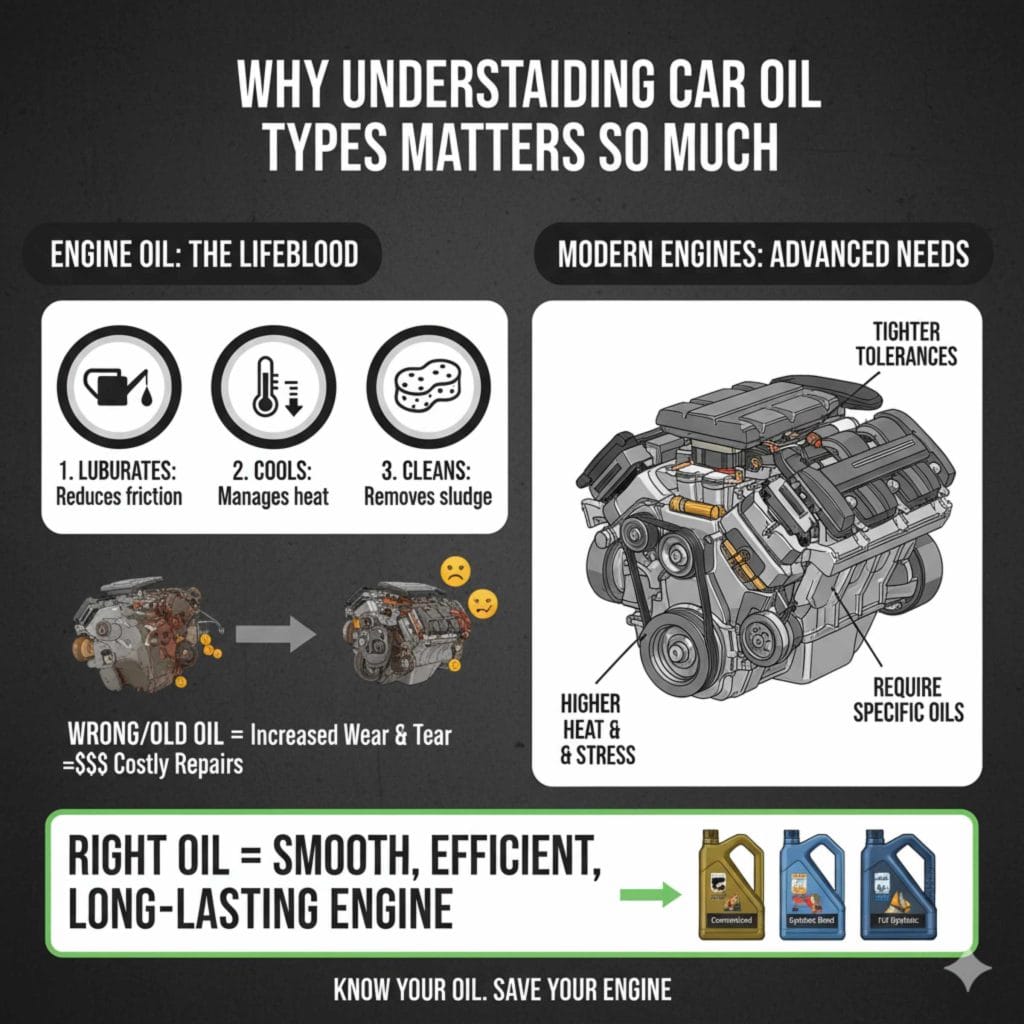
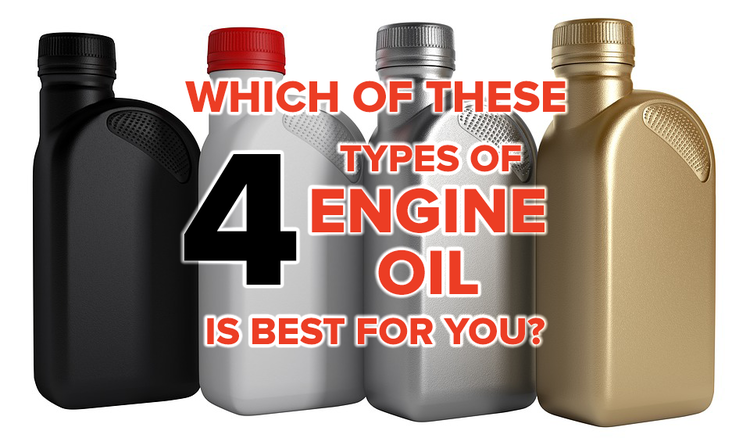
The three main types of engine oil are conventional oil, synthetic blend oil, and full synthetic oil. Each offers different levels of protection, performance, and cost.
If you drive to work in Texas heat, sit in New York traffic, or take long road trips across the United States, your engine needs the right oil to stay in good shape. Engine oil reduces friction, carries heat away from moving parts, and helps protect metal surfaces from wear. Choosing the correct type can help your car run as intended and may prevent costly damage caused by poor lubrication.
The three common types of engine oil are conventional, synthetic blend, and full synthetic. They differ in how their base oils are made and refined, how they perform under changing conditions, and how much they usually cost. However, the most expensive oil is not always the right choice for every vehicle.
Your owner’s manual should guide your choice. It lists the required viscosity grade, such as 0W-20 or 5W-30, along with any required performance standards or manufacturer approvals. Once you understand the three oil types and these specifications, you can make a better choice for your car, driving habits, and budget.
Source: infoupdate.org
What Are the 3 Types of Engine Oil?
The three main types of engine oil commonly discussed for passenger cars and light trucks are conventional oil, synthetic blend oil, and full synthetic oil. All three lubricate engine parts, help control heat, and carry contaminants toward the oil filter. Their main differences involve their base oils, formulation, performance characteristics, and typical cost.
Think of engine oil as a thin protective layer between moving metal parts. Without that layer, friction and heat can cause rapid wear. The right oil helps keep that layer working under the temperatures and loads your engine faces.
No single type is automatically best for every car. An older vehicle designed for conventional oil may work well with an appropriate conventional product, while a newer turbocharged engine may require a specific full synthetic formulation. The manufacturer’s requirements decide which oils are suitable.
Source: engineauditor.com
Conventional oil
A traditional engine oil made from refined petroleum base stocks and additives. It can be suitable for engines whose specifications permit it.
Synthetic blend oil
A mixture of conventional and synthetic base oils. Its performance and cost depend on the formulation and the specifications it meets.
Full synthetic oil
An oil formulated with synthetic base stocks and additives to meet particular performance goals. It is often used in engines that require demanding lubrication performance.
Are These the Only Three Types of Engine Oil?
These are the three main categories often used in basic consumer guides, but engine oil products come in other forms. High-mileage oils target the needs of engines with substantial use, while racing oils and diesel engine oils serve more specific applications. Some oils are also marketed for particular vehicle makes or engine designs.
These labels do not always create separate, mutually exclusive categories. A high-mileage oil, for example, may use conventional, synthetic blend, or full synthetic base oils. Diesel oils also have their own performance classifications, and some are suitable for certain gasoline engines only when the required specifications are met.
High-mileage oil
Formulated for the needs of many older or high-mileage engines. It may include additives intended to help manage seals, deposits, and wear, but it cannot repair worn engine parts.
Diesel engine oil
Designed to meet the lubrication and performance requirements of diesel engines. Check the engine maker’s required specifications before using it in a gasoline vehicle.
Racing oil
Designed for particular high-load or motorsport conditions. It may not meet the requirements for normal road use, emissions equipment, or extended service intervals.
1. Conventional Engine Oil
Conventional engine oil is the traditional petroleum-based option. Manufacturers refine crude oil into base stocks and combine them with additives that help the finished oil resist oxidation, control deposits, reduce wear, and perform within its intended operating range.
Conventional oil can be a practical choice for vehicles whose manufacturers allow it. It is often less expensive per quart than comparable synthetic products, which can make routine oil changes more affordable. Still, the lowest purchase price should not outweigh the engine’s lubrication needs.
Older cars with simple engine designs may use conventional oil successfully when the oil meets the required grade and performance standards. However, an older vehicle does not always need conventional oil, and a newer vehicle does not always need full synthetic oil. The manual provides the deciding rule.
Source: engineoilpro.com
Typical advantages
Conventional oil is widely used, often costs less than comparable synthetic products, and can work well in engines designed for its performance level.
Possible limitations
Depending on its formulation, conventional oil may offer less resistance to oxidation or less stable performance across extreme temperatures than some synthetic oils.
Best fit
Vehicles whose manufacturers permit conventional oil and whose driving conditions and maintenance schedules suit the selected product.
When Should You Use Conventional Oil?
Consider conventional oil if your owner’s manual allows it, the product meets the required specifications, and your driving conditions do not call for a different formulation. For example, an older naturally aspirated engine may be approved for conventional 5W-30, depending on its design and market requirements.
Short trips, repeated cold starts, long periods of idling, towing, and extreme heat can make engine operation more demanding. These conditions may affect the oil and its service life. If your vehicle faces them often, check the severe-service guidance in the owner’s manual rather than assuming a standard interval is suitable.
Check compatibility first
Confirm both the viscosity grade and the required performance category before buying conventional oil.
Follow the service schedule
Use the manufacturer’s oil change interval and any shorter interval required for severe driving conditions.
Does Conventional Oil Wear Out Faster?
Conventional oil can lose its useful properties as it faces heat, oxidation, contamination, and mechanical stress. Some synthetic formulations resist these effects better under certain conditions, but the actual difference depends on the products being compared and how the vehicle is used.
You cannot judge remaining oil life by color alone. Oil can darken as it collects contaminants, and oil that still looks clean may have lost some of its useful properties. Follow the maintenance schedule, monitor the oil level, and investigate warning lights or unusual oil consumption.
2. Synthetic Blend Engine Oil
Synthetic blend engine oil combines conventional and synthetic base oils with an additive package. It is designed to offer a balance between cost and performance, although the exact benefits depend on the product’s formulation and its stated specifications.
A blend may provide better resistance to heat or oxidation than a conventional oil of a different formulation. However, the word blend alone does not establish how well an oil performs. Two products with the same label can differ in viscosity, approvals, additive chemistry, and test results.
Synthetic blend oil is often priced between conventional and full synthetic products, but that is not a fixed rule. Brand, bottle size, viscosity grade, performance rating, and retailer can all affect the price. Compare the specifications rather than choosing by price position alone.
Source: gendgimotive.blogspot.com
Typical advantages
A synthetic blend may provide a useful balance of cost and performance for vehicles that permit it.
Possible limitations
It may not offer all the performance characteristics of a particular full synthetic oil, and the blend label does not guarantee a specific service interval.
Best fit
Drivers seeking a middle-ground product when a synthetic blend meets the engine’s required specifications.
Is Synthetic Blend Oil Good for Daily Driving?
Yes, synthetic blend oil can be suitable for daily driving when the manufacturer permits it. A car used for commuting, errands, and occasional highway trips may work well with an approved blend, provided the oil meets the correct viscosity and performance requirements.
Daily driving varies widely. A short trip through stop-and-go traffic can be harder on engine oil than a longer drive that allows the engine to reach its normal operating temperature. Drivers who make many short trips should review the severe-service schedule in the manual.
For regular commutes
Choose a blend that meets the engine’s required grade and performance standards.
For demanding use
Check whether towing, heavy loads, extreme temperatures, or frequent short trips change the recommended oil or service interval.
Can You Mix Conventional and Synthetic Blend Oil?
Many conventional and synthetic blend oils can mix physically because they use compatible base oils, but that does not mean every combination is recommended. Mixing products can change the finished mixture’s overall performance characteristics, and the result may not carry all the approvals or claims of either original oil.
If you need to top off the engine, use oil that matches the manufacturer’s required viscosity and specifications. If the exact product is unavailable, consult the manual or a qualified service professional. Do not intentionally mix oils to create a custom formulation or extend the oil change interval.
For an emergency top-off
Prioritize the correct viscosity and performance requirements, then return to the recommended oil at the next service if needed.
For a planned oil change
Use one suitable product rather than mixing leftovers in an attempt to improve performance.
3. Full Synthetic Engine Oil
Full synthetic engine oil uses synthetic base stocks and additives formulated to meet specific performance goals. Depending on its chemistry, it may offer strong resistance to oxidation, stable viscosity behavior, and reliable lubrication across a broad range of operating temperatures.
Full synthetic oils are common in many modern passenger vehicles, especially engines with turbochargers, tight internal clearances, or manufacturer requirements for specific oil performance. Some vehicles require full synthetic oil, while others allow several types. The vehicle maker’s specifications matter more than the vehicle’s age or price.
Full synthetic oil often costs more than conventional oil, although actual prices vary. The extra cost may be worthwhile when the engine requires it or when the product offers performance benefits suited to the vehicle’s use. It does not automatically mean that every car can safely go longer between oil changes.
Source: icarsoft-us.com
Typical advantages
Depending on the formulation, full synthetic oil may offer good low-temperature flow, strong oxidation resistance, and stable performance under demanding operating conditions.
Possible limitations
It often costs more, and its use does not eliminate routine maintenance or guarantee a longer oil change interval.
Best fit
Vehicles that require full synthetic oil or drivers whose approved oil choice benefits from the product’s performance characteristics.
Why Is Full Synthetic Oil Often Recommended for Modern Engines?
Modern engines can place demanding requirements on lubricants. Turbochargers operate at high temperatures, fuel-saving designs may use lower-viscosity oils, and some engines rely on carefully controlled lubrication to protect internal components and emissions systems.
A suitable full synthetic oil can help meet these needs when it carries the required specifications. The phrase full synthetic on the bottle is not enough by itself, because an engine may require a specific viscosity, performance category, or manufacturer approval.
Cold starts
An approved low-viscosity synthetic oil may flow well during cold starts, helping deliver lubrication as the engine begins to run.
High operating temperatures
A well-formulated synthetic oil may resist oxidation and viscosity changes under heat, subject to its formulation and the conditions of use.
Turbocharged engines
Use the oil specification required for the turbocharged engine, including any stated manufacturer approval.
Does Full Synthetic Oil Last Longer?
Some full synthetic oils are designed to support longer service intervals than conventional products, but there is no universal interval for all synthetic oils. The approved oil, engine design, driving conditions, and vehicle maintenance system determine when an oil change is due.
For example, a vehicle with an oil-life monitoring system may calculate service needs using operating conditions. Follow the system and owner’s manual rather than choosing an interval based only on the oil label. If the vehicle has a fixed service schedule, follow that schedule.
Do not assume every synthetic oil lasts the same length of time
Products differ, and an extended drain interval is appropriate only when supported by the vehicle maker and oil specifications.
Check the oil level between changes
Even a high-quality synthetic oil can be consumed or leak. Top up with a suitable oil when needed and investigate repeated drops in level.
Conventional vs. Synthetic Blend vs. Full Synthetic Oil
The main difference between the three types of engine oil is their base oil formulation and the performance characteristics of the finished product. Conventional oil is the traditional petroleum-based option, synthetic blend oil combines conventional and synthetic base stocks, and full synthetic oil uses synthetic base stocks.
The table below provides a general comparison. It describes typical product positioning rather than a guarantee that every oil in one category will outperform every oil in another. Actual performance depends on formulation, testing, viscosity, and the standards the oil meets.
Source: yetafholdings.com
Use cost as one factor, not the only factor
A lower-cost oil is not a bargain if it fails to meet the engine’s requirements.
Compare the actual specifications
Two oils in different price categories may both be suitable, or one may be unsuitable, depending on the vehicle.
Quick Comparison of the Three Engine Oil Types
Use this table as a starting point when comparing oil labels. It does not replace the owner’s manual, which determines the oil grades and approvals that are suitable for a specific engine.
Conventional oil
Base oil: refined petroleum. Typical cost: lower. Performance: suitable for approved applications and normal service needs. Main consideration: confirm the required specifications and change interval.
Synthetic blend oil
Base oil: a blend of conventional and synthetic base stocks. Typical cost: moderate, though prices vary. Performance: depends on formulation and specifications. Main consideration: do not assume every blend offers the same benefits.
Full synthetic oil
Base oil: synthetic base stocks. Typical cost: often higher. Performance: may provide strong temperature and oxidation performance. Main consideration: choose the correct grade and approvals, and follow the manufacturer’s interval.
Which Type of Engine Oil Offers the Best Value?
The best value is the least costly suitable oil when total maintenance needs are considered. If your vehicle permits conventional oil and its service schedule suits your driving, a more expensive product may not provide enough practical benefit to justify the additional cost.
If your engine requires full synthetic oil, choosing conventional oil simply to save money is not a sensible trade-off. Likewise, a synthetic blend is not automatically the best middle ground if the engine requires a particular full synthetic formulation or manufacturer approval.
For budget-conscious maintenance
Compare oils that all meet the vehicle’s requirements, including the total amount needed for an oil change.
For demanding driving
Consider the approved oils suited to your operating conditions and the manufacturer’s service guidance.
For a newer vehicle
Check warranty requirements and the exact specifications before selecting an oil category.
Engine Oil Type vs. Viscosity Grade
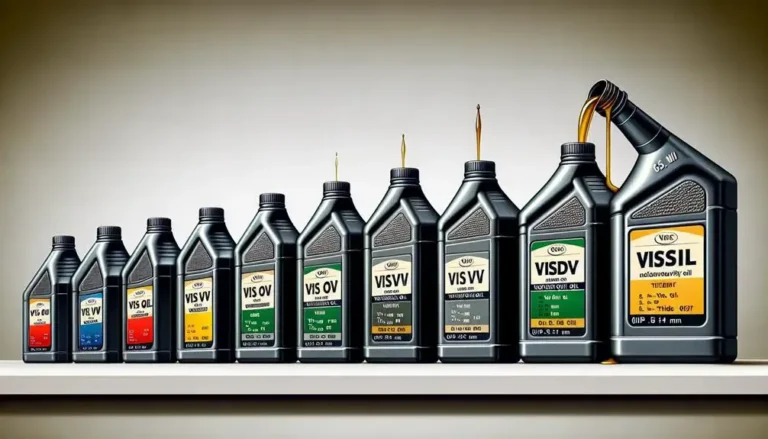
Engine oil type and viscosity grade describe different things. Conventional, synthetic blend, and full synthetic refer to broad oil categories, while grades such as 0W-20, 5W-30, and 10W-40 describe how the oil behaves under specified temperature conditions.
The Society of Automotive Engineers, or SAE, sets the viscosity grading system used on engine oil labels. In a grade such as 5W-30, the W refers to winter performance, and the first number relates to the oil’s cold-temperature viscosity requirements. The second number describes its viscosity at higher operating temperatures under the relevant test conditions.
The numbers do not tell you whether the oil is conventional or synthetic. You can find multiple oil types in the same viscosity grade. You must check both the grade and the performance requirements before choosing a product.
Source: motorist.vn
0W-20
A multigrade oil that meets the specified 0W cold-temperature requirements and SAE 20 operating-temperature grade. Use it only when approved for your engine.
5W-30
A common multigrade viscosity in many applications, but it is not suitable for every vehicle. Check the manual.
10W-40
A different viscosity grade that may suit certain engines and conditions. Do not switch to it simply because the vehicle has high mileage.
Why Does Viscosity Matter?
Oil needs to flow during startup and maintain a protective film while the engine runs. The required viscosity helps the oil move through passages and provide lubrication within the clearances and operating conditions for which the engine was designed.
Using an oil that is too thick or too thin for the application can affect lubrication and engine operation. Colder weather can make oil harder to flow, while high operating temperatures can reduce viscosity. Multigrade oils are designed to meet specified viscosity requirements across different temperature conditions.
Do not choose by weather alone
Climate matters, but the manufacturer’s approved viscosity grades set the boundaries for a suitable choice.
Do not assume thicker oil is better
A thicker oil is not a universal fix for noise, leaks, or high oil consumption.
What Do API and Other Oil Standards Mean?
The American Petroleum Institute, or API, maintains engine oil service categories and related licensing programs. These standards help identify oils that meet defined performance requirements for particular engine applications. The API service category appears on many oil containers sold in the United States.
Some vehicles also require specifications or approvals from the automaker, and other standards may apply depending on the engine. An oil can have the correct viscosity and still fail to meet a required performance specification. Read the whole label rather than relying on the large viscosity numbers alone.
API service category
Check that the oil meets the gasoline or diesel engine category required by the vehicle manufacturer.
ILSAC standard
Some gasoline passenger vehicles specify an International Lubricant Specification Advisory Committee standard. Confirm the required version in the manual.
Manufacturer approval
Some engines require an automaker-specific specification or formal approval. Verify the exact requirement before buying.
How to Choose the Right Engine Oil for Your Car
Choose engine oil by starting with the vehicle manufacturer’s requirements, then compare products that meet them. This process is more reliable than choosing by brand, price, mileage, or the words synthetic and premium on the bottle.
You can usually find the required viscosity and performance standards in the owner’s manual. Some automakers also provide maintenance information through an official owner website or vehicle-specific service guide. If you cannot confirm the correct specification, ask a qualified mechanic or the vehicle manufacturer before buying oil.
Step 1: Identify your engine
Confirm the model year, make, model, engine type, and any relevant engine code. A single vehicle model may use different engines that require different oils.
Step 2: Find the required viscosity
Look for the approved SAE grade or grades listed in the owner’s manual.
Step 3: Check performance standards
Match the API, ILSAC, ACEA, or manufacturer-specific requirements that apply to your vehicle.
Step 4: Select the oil type
Choose conventional, synthetic blend, or full synthetic only from products that meet all the required specifications.
Step 5: Confirm the maintenance interval
Follow the manual or oil-life monitoring system, including any severe-service guidance.
Example: Choosing Oil for a Daily Driver
Imagine that a hypothetical compact sedan requires SAE 0W-20 oil meeting a specific API service category and an automaker approval. The manual also states that full synthetic oil is required. In that case, the correct choice is a full synthetic 0W-20 product that meets every stated requirement.
A conventional 0W-20 product would not be an acceptable substitute if it fails the required specification. A full synthetic 5W-30 would not automatically be suitable either, because its viscosity differs from the stated requirement. The matching grade, performance category, and approval all matter.
The key lesson
Select an oil by its complete specification, not by one label or a general claim that it is suitable for cars.
What If the Manual Lists More Than One Viscosity?
Some manuals permit more than one viscosity grade under stated conditions. If so, use the guidance for your expected temperatures, driving conditions, and engine variant. Do not assume every listed grade is interchangeable in all climates or for every engine option.
When the manual is unclear or the vehicle has been modified, confirm the correct specification with the manufacturer or a qualified service professional. This is especially important for engines with turbochargers, emissions-control equipment, or specific oil requirements.
Does Your Driving Style Affect the Best Oil Choice?
Driving conditions can affect oil stress and the maintenance interval, but they do not replace the manufacturer’s oil requirements. Frequent cold starts, repeated short trips, heavy traffic, long periods of idling, towing, dusty roads, and extreme temperatures may qualify as severe service under a vehicle’s maintenance plan.
A driver who spends hours on a highway may place different demands on an engine than a driver who makes several short trips each day. The short-trip engine may not reach its normal operating temperature for long, allowing moisture and fuel-related contamination to affect the oil. The right response is to follow the vehicle’s specific service guidance, not to guess at an oil change interval.
Drivers in hot parts of the United States should still use an approved viscosity rather than selecting a thicker oil solely because summer temperatures are high. Likewise, drivers in cold northern states should not choose a lower winter grade unless the manufacturer permits it.
Frequent short trips
Check whether the manufacturer classifies repeated short drives as severe service and whether a shorter oil change interval applies.
Towing or carrying heavy loads
Use the oil specifications and maintenance schedule for the vehicle’s rated towing or load conditions.
Extreme heat or cold
Follow the approved viscosity guidance for the expected temperature range.
Dusty roads
Follow the maintenance plan for dusty conditions and inspect related service items as directed by the manufacturer.
Does High Mileage Mean You Need a Different Oil?
Not necessarily. High mileage alone does not require a switch from conventional to synthetic oil, or from a lower viscosity to a higher one. A well-maintained high-mileage engine may continue to use the same approved oil grade throughout its service life.
High-mileage oil may help address certain age-related needs, depending on its formulation. However, it cannot repair damaged seals, worn bearings, or other mechanical problems. If an older engine begins to lose oil, smoke, or make new noises, identify the cause before treating a different oil as the solution.
For a healthy older engine
Continue using an oil that meets the manufacturer’s requirements unless the manufacturer or a qualified mechanic advises otherwise.
For oil leaks or consumption
Check the oil level, inspect for leaks, and seek a diagnosis if consumption is frequent or increases.
Common Engine Oil Mistakes to Avoid
Most oil selection mistakes begin with a reasonable goal, such as saving money or helping an older engine. Problems arise when a general rule replaces the exact requirements of the vehicle. A quick label check can prevent a costly mismatch.
Choosing oil by price alone
The cheapest oil is not suitable if it fails to meet the required viscosity, performance category, or manufacturer approval.
Assuming full synthetic is always better
A full synthetic oil with the wrong viscosity or specification may be unsuitable, even if its base oil is advanced.
Changing viscosity without checking
Do not switch to thicker oil to reduce noise or consumption without confirming the approved grades and diagnosing the cause.
Extending oil changes without approval
A synthetic label does not guarantee that the oil can stay in service beyond the vehicle’s recommended interval.
Mixing products to improve performance
Do not assume that combining oils creates a better formulation or preserves every original product claim.
Ignoring low-oil warnings
A low oil level or oil pressure warning can signal a serious problem. Follow the vehicle’s warning instructions and stop the engine when the manual directs you to do so.
Can the Wrong Engine Oil Damage Your Car?
Using an unsuitable oil can contribute to poor lubrication, excessive wear, deposits, or other engine problems. The risk depends on the mismatch, the engine design, and how long the vehicle operates under those conditions. An oil that does not meet a required specification may also fail to provide the protection intended by the manufacturer.
If you discover that the wrong oil was added, check the amount and exact product used. If the oil has the wrong viscosity or does not meet a required specification, contact the manufacturer or a qualified mechanic for guidance on whether the engine should be drained and refilled before further driving. If the oil pressure warning appears, stop safely and follow the manual rather than continuing to drive.
A small top-off
The response depends on the oil used, how much was added, and the vehicle requirements. Verify compatibility instead of assuming the addition is harmless.
A complete fill with unsuitable oil
Seek prompt guidance on the correct corrective action, especially if the vehicle requires a specific viscosity or manufacturer approval.
How to Check Engine Oil and Maintain It Properly
Correct oil selection is only part of engine care. Checking the level and following the maintenance schedule help keep the oil system working as intended. Some vehicles use a dipstick, while others display the oil level electronically.
Before checking oil, park on level ground and follow the owner’s manual for the required engine temperature and waiting period. Some vehicles call for a check after the engine has been off for a set time, while others use a specific electronic procedure. Do not assume every model follows the same steps.
Step 1: Park safely
Use level ground, switch off the engine when the manual directs, and allow the required time for oil to settle.
Step 2: Check the level
Use the dipstick or the vehicle’s electronic oil-level procedure. Follow the manual for the correct reading.
Step 3: Add oil only when needed
Use an approved oil and add small amounts at a time, checking the level again to avoid overfilling.
Step 4: Watch for repeated changes
If the level keeps dropping, check for leaks or excessive consumption instead of repeatedly topping off without investigation.
Step 5: Record maintenance
Keep the date, mileage, oil specification, and service details so you can track changes and follow the recommended schedule.
What Do Oil Color and Texture Tell You?
Oil color alone cannot tell you whether the oil is still fit for service. New oil often starts with a clear amber appearance, but it can darken as it collects normal combustion-related contaminants and deposits. Color also varies by formulation.
Milky oil, a strong fuel smell, unusual sludge, or a sudden change in oil level may indicate a problem, although no single sign proves a specific fault. If you notice these symptoms, check the owner’s manual and arrange an inspection when appropriate. Do not rely on appearance to extend an oil change interval.
Dark oil
Dark color alone is not a reliable reason to change oil early or proof that the oil is damaged.
Milky residue or unusual contamination
Seek a diagnosis if the oil itself appears milky or shows signs of contamination, especially with coolant loss or engine overheating.
Low oil level
Top up with the correct oil as directed and investigate recurring losses.
Environmental and Cost Considerations
Engine oil choice affects routine maintenance costs, but the purchase price is only one part of the picture. Oil capacity, filter cost, labor, service interval, and the vehicle’s requirements all affect the total cost of ownership. A suitable oil that meets the manufacturer’s service plan is more useful than a cheap oil that creates a specification mismatch.
Used motor oil can pollute soil and water when poured onto the ground, into a storm drain, or into household trash where local rules prohibit it. Many U.S. communities and auto service facilities offer used-oil collection or recycling programs, though accepted materials and drop-off rules vary by location.
If you change your own oil, collect used oil in a clean, leakproof container and keep it separate from coolant, fuel, solvents, and other fluids. Contamination can make recycling more difficult. Check your local waste authority or recycling center for instructions on oil filters and other service waste.
Compare total service costs
Consider the required oil quantity, filter, labor, and approved change interval instead of comparing bottle prices alone.
Prevent spills
Use a suitable drain pan and secure containers when handling used oil.
Recycle responsibly
Use an authorized collection site and follow local requirements for used oil and filters.
A Simple Decision Guide for Choosing Engine Oil
The easiest way to select oil is to begin with the manual, remove any products that do not meet the requirements, and compare the remaining options. Only then should you weigh price, driving conditions, and the benefits offered by different formulations.
The following guide summarizes the decision. It is not a substitute for checking the exact engine specifications, because two vehicles of the same model name may have different oil requirements.
The manufacturer allows it, the oil meets all required specifications, and its use fits the recommended maintenance schedule.
Choose synthetic blend oil when
A blend meets the engine’s requirements and offers a cost and performance balance that suits your needs.
Choose full synthetic oil when
The manufacturer requires it or an approved full synthetic product suits the engine’s operating demands.
Ask for help when
The manual is unclear, the vehicle has been modified, the wrong oil has been used, or the engine shows signs of an oil pressure problem.
The Most Important Rule
Do not buy oil until you know the required viscosity grade and performance specification. Those details determine which conventional, blend, or full synthetic products are suitable for your engine.
If more than one oil type meets every requirement, compare the products’ stated performance, cost, and compatibility with your driving conditions. That approach helps you avoid paying for features you do not need while still protecting the engine.
Frequently Asked Questions
Q
What are the 3 types of engine oil?
The three main types commonly discussed for passenger vehicles are conventional oil, synthetic blend oil, and full synthetic oil. They differ in their base oil formulations and typical performance characteristics. The right choice depends on the engine manufacturer’s viscosity and performance requirements.
Q
Which type of engine oil is best for most cars?
There is no single oil type that is best for every car. Many modern vehicles require full synthetic oil, while some allow conventional oil or a synthetic blend. Check the owner’s manual for the correct viscosity, performance category, and any required manufacturer approval.
Q
Is synthetic blend oil the same as full synthetic oil?
No. Synthetic blend oil combines conventional and synthetic base oils, while full synthetic oil uses synthetic base stocks. Their performance depends on the finished formulation and the standards each product meets, so compare the label and technical specifications rather than the category name alone.
Q
Can I switch from conventional oil to full synthetic oil?
In many vehicles, switching is acceptable when the full synthetic product meets the required viscosity and performance specifications. The change does not normally require a special engine flush just because the oil type changes. If the engine has serious sludge, leaks, or other problems, ask a qualified mechanic about the correct service procedure.
Q
Can I use synthetic blend oil in an older car?
Often, yes, if the blend meets the vehicle’s required viscosity and performance standards. Vehicle age alone does not determine whether a blend is suitable. If the engine has high mileage, oil leaks, or unusual consumption, address those conditions separately instead of assuming a different oil will fix them.
Q
Does full synthetic oil improve gas mileage?
Some approved synthetic oils may help reduce friction compared with certain alternative formulations, and the correct low-viscosity oil can support fuel efficiency in engines designed for it. However, any real-world difference depends on the vehicle, the oils compared, and driving conditions. Do not use a viscosity that the manufacturer has not approved just to seek better gas mileage.
Q
How often should I change engine oil?
Follow the interval in your owner’s manual or the vehicle’s oil-life monitoring system. The correct schedule can depend on the engine, oil specification, mileage, time, and driving conditions. Synthetic oil does not automatically permit a longer interval than the manufacturer recommends.
Q
Is thicker engine oil better for a high-mileage engine?
Not always. A thicker oil can change how the lubricant flows and reaches engine parts, particularly during cold starts. Use only viscosity grades approved for your engine and investigate leaks, oil consumption, or unusual engine noise instead of changing viscosity without guidance.
✦ Wrapping Up
Conclusion
The three main types of engine oil are conventional, synthetic blend, and full synthetic. Conventional oil can be an affordable option for engines that permit it, synthetic blends offer a middle-ground formulation, and full synthetic oils may provide useful performance benefits under demanding conditions. None is automatically the best choice for every vehicle.
The most reliable way to choose oil is to start with your owner’s manual. Confirm the SAE viscosity grade, API or other required performance category, and any manufacturer-specific approval. Then compare suitable products based on cost, driving conditions, and the maintenance schedule.
Good oil care also means checking the level, watching for leaks, following the correct service interval, and disposing of used oil responsibly. These simple habits can help protect your engine and make routine vehicle maintenance easier to manage.
💡 Key Takeaway
Before your next oil change, check your owner’s manual and write down the required viscosity grade and performance specifications. Choose a conventional, synthetic blend, or full synthetic oil that meets every requirement, then follow the recommended service interval.
You pick up a 0W40 and a 5W30 off the shelf, and you’re not sure which one is actually thicker. That’s the core question behind what motor oil is thicker, and…