What Is Conventional Motor Oil: Easy guide
What is conventional motor oil, and does it actually protect your engine? It's the petroleum-derived lubricant you see in every gas-station cooler. For a 1998 four-banger, it's the OEM-blessed answer.
For a 2022 turbocharged 2.0L, it's the wrong can.
Per SAE J183, conventional oil carries Group I or Group II base stock and an API service letter like SP or SN. As of 2026, the price gap between conventional and full synthetic is still $20 to $40 per 5-quart fill. The rest of this guide breaks down what's in the jug, when to use it, and where it quietly fails.
Quick Answer
Conventional motor oil is petroleum-based lubricant made from Group I refined-crude base stocks. It sits below synthetic blends and full synthetics on the quality spectrum. The API service letter, like SP or SN, is printed on the label.
It fits simple naturally aspirated engines doing under 5,000 miles a year. As of 2026, a 5-quart jug costs $12 to $28 at U.S. retailers.
Conventional Motor Oil, Stripped Down to What It Actually Is
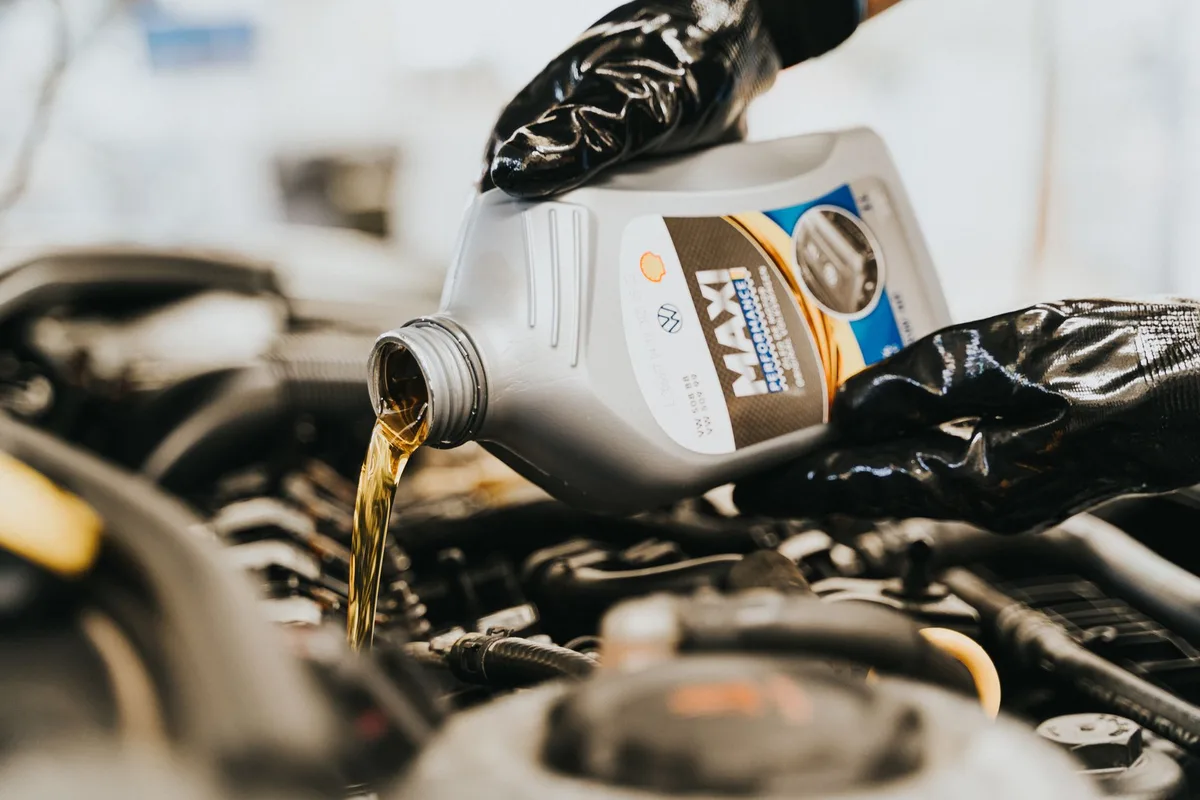
Conventional motor oil is a lubricant whose base stock comes from petroleum refining. The crude goes through atmospheric distillation, then vacuum distillation, then hydrotreating. What's left is a Group I or Group II base fluid per the API Base Stock Definition.
Here's the part that trips people up. "Conventional" is not a quality tier. It's a chemical classification.
The American Petroleum Institute sorts base stocks into five groups.
Group I is the most saturated (90% or less saturation). Group II sits at 90 to 99%. Group III and above crosses the line into "synthetic." That's the entire taxonomy.
So when you grab a jug labeled "conventional 10W-30," you're holding a refined mineral fluid with an additive package. The additive package does a lot of the heavy lifting. Detergents keep sludge off the piston.
Dispersants hold soot in suspension. Anti-wear agents, usually zinc dialkyldithiophosphate (ZDDP), form a protective film on metal surfaces.
The SAE viscosity grade (the "10W-30" part) tells you how the oil behaves at cold start and at operating temperature. Per SAE J300, the "W" number is measured at 0°C and the second number at 100°C. That's the entire specification architecture.
Everything else is additive chemistry layered on top.
In plain terms: conventional oil is the workhorse fluid that most engines from the 1980s through the mid-2000s were designed around. It's not fancy. It's not fragile.
It's the default.
What's Inside the Jug: Group I Base Stock, Additives, and the Group II Gray Zone

Open up the API Base Stock Definition and you'll see the taxonomy laid out by carbon saturation and hydrocarbon structure. Group I is the classic mineral oil. It's the residue from a refinery's vacuum tower, stripped of sulfur and nitrogen compounds.
The base fluid carries a viscosity index (VI) of roughly 100 to 110.
Group II is where things get murky. It's produced by a more severe hydrotreating step. The result is 90 to 99% saturated molecules, closer to a PAO structure.
Many brands market Group II as "performance conventional." Technically it's still conventional by API rules. Functionally, it outperforms Group I on oxidative stability and shear resistance.
The additive package is where the real engineering lives. Here's what you're looking at in a typical conventional 5W-30:
- Detergents and dispersants: Calcium, magnesium, or phosphorus-based salts that neutralize acids and keep soot suspended. Typical TBN (Total Base Number) runs 7 to 12 mg KOH/g.
- ZDDP (anti-wear): The zinc phosphate film that prevents metal-on-metal contact at the cam and bearing surfaces. Pre-2000 engines often wanted 1,400+ ppm. The SP spec caps it lower to protect catalytic converters.
- Viscosity index improvers: Polyisobutylene (PIB) or olefin copolymers that keep the oil from getting too thin at heat. These are the weakest link. They shear over time, shifting the oil toward a thinner viscosity.
- Antioxidants and rust inhibitors: Phenolic and amine compounds that slow oxidative breakdown.
- Friction modifiers: Molybdenum or organic additives that reduce internal drag. Conventional oils carry fewer of these than synthetics.
The Group II Gray Zone Nobody Explains
If you're at the parts counter and see a jug that says "performance conventional" or "enhanced mineral," that's almost always Group II base stock. It's better than straight Group I. It's not a synthetic blend.
It's not full synthetic. It lives in a middle lane that most shoppers don't know exists.
Manufacturer technical data sheets (TDS) list the base stock group. Pennzoil, Valvoline, and Castrol all publish per-SKU TDS on their sites. If the TDS says "Group II/III blend," you're looking at a synthetic blend, not a conventional.
The label on the jug often won't make that distinction clear. The TDS will.
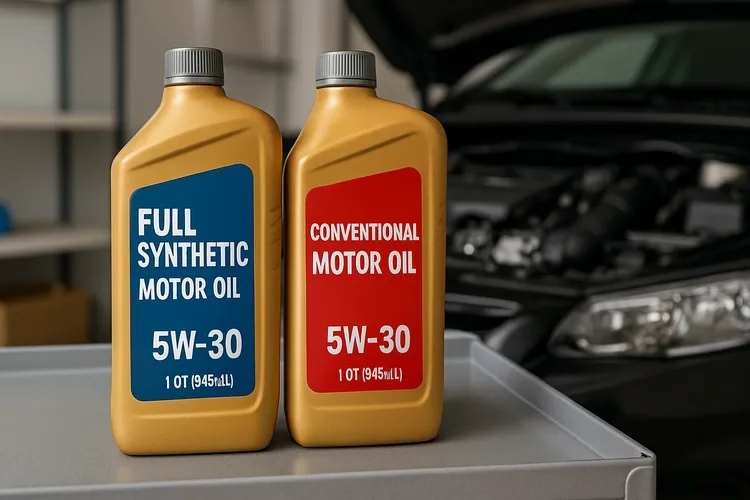
Conventional vs. Synthetic Blend vs. Full Synthetic: The Side-by-Side That Settles the Aisle Debate
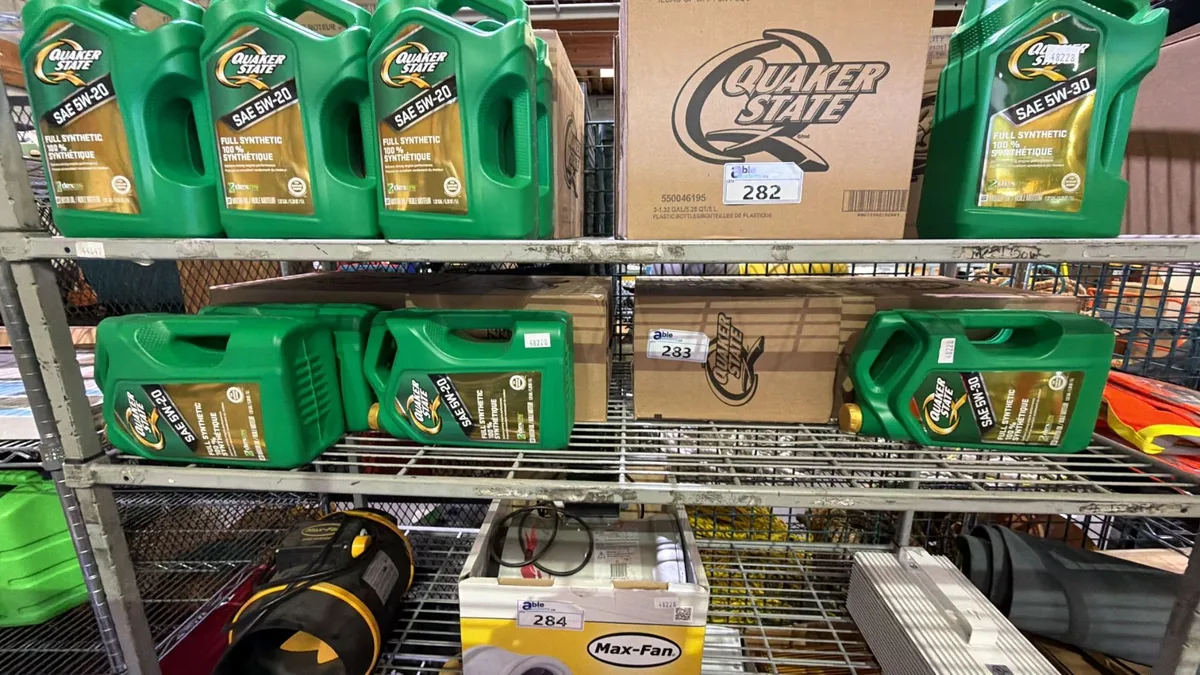
You've got three cans in hand. Which one matches your engine, your climate, and your wallet? The answer depends on three variables: your OEM spec, your annual mileage, and your cold-start temperature.
Here's the comparison that actually matters at the register:
| Factor | Conventional (Group I/II) | Synthetic Blend | Full Synthetic (Group III+) |
|---|---|---|---|
| Base stock source | Refined mineral crude | Mineral + PAO or ester | PAO, GTL, or ester (90%+ saturation) |
| Price per quart (U.S., 2026) | $2.50 to $5.50 | $5 to $9 | $8 to $15 |
| Real-world drain interval | 3,000 to 5,000 mi | 5,000 to 7,500 mi | 7,500 to 15,000+ mi |
| Viscosity index (typical) | 100 to 140 | 130 to 160 | 140 to 200+ |
| TBN (mg KOH/g) | 7 to 12 | 9 to 13 | 10 to 15+ |
| Cold-start film strength | Moderate | Good | Excellent |
| Shear stability over drain | Lower | Good | High |
| Best fit | Simple NA engines, short trips, budget | Mixed driving, moderate climates | Turbocharged, high-performance, extreme climates, extended intervals |
The key insight: you're not buying "better." You're buying a different degradation curve. Conventional oil thins out faster. Its VI improvers shear.
Its TBN drops. It needs a shorter drain cycle.
Synthetic holds its viscosity and alkalinity longer, which is why the interval stretches. If your engine was designed around mineral oil (and most engines before 2015 were), conventional is the correct fuel for the machine.
Upsizing to full synthetic doesn't hurt, but you're paying for extended-interval protection you may never use. That $12 extra per quart buys a benefit your 1996 V6 doesn't need.
The comparative logic is simple. Match the oil's drain-interval ceiling to your actual driving cycle. If you do 8,000 miles a year, conventional at 5,000-mile intervals means two fills a year.
Synthetic at 10,000-mile intervals means one fill.
The math flips in synthetic's favor once you're doing 12,000+ miles a year or running in sub-zero climates where cold-start shear is the enemy.
The Specs That Separate a Decent Conventional Oil From an Underperforming One
You can walk into a store and see four jugs of "5W-30 conventional" from four brands. Two of them will protect your engine beautifully. Two will clog the pickup screen by drain #3.
The difference is in the numbers on the TDS that nobody reads.
Here's what to check, and why each one matters:
Viscosity Index and Shear Stability
The VI tells you how well the oil holds its thickness across temperature swings. A conventional 5W-30 with a VI of 105 will thin noticeably by the end of a 5,000-mile cycle. One with a VI of 140 (usually Group II or a Group II/III blend) holds up better.
Per ASTM D4465 shear testing, a good conventional VI improver loses no more than 2 cSt of 100°C viscosity over 20 hours of shear. If a TDS doesn't list shear data, assume it's on the softer side.
Total Base Number
TBN is your acid-neutralizing budget. Conventional oils start at 7 to 12 mg KOH/g. By drain, you want to see at least 4 to 5 remaining.
If a lab analysis comes back at 2 or lower, the oil has already spent its detergent reserve. That's when sludge starts forming on the piston skirts.
Flash Point and Pour Point
Flash point (typically 200 to 240°C for conventional) is the ceiling. It tells you when the oil starts contributing volatiles to the crankcase ventilation system.
Pour point matters in cold climates. A 0W-30 conventional that pours at -25°C is fine for Minnesota. A 10W-30 that pours at -18°C is borderline for a -25°C morning start.
The API Donut and ILSAC Mark
Every API-certified jug carries the "donut" seal. As of 2026, the current gas-engine service category is SP (introduced 2020). SP addresses low-speed pre-ignition (LSPI) in turbocharged engines and improves fuel-economy additivism.
If your manual says "SP or higher" and you grab an SN jug, you're technically under-specing. The ILSAC GF-6B mark targets hybrid and short-trip duty. Conventional jugs with that mark carry a lower-SAPS package for catalyst protection.
What to Ignore on the Label
"Premium," "ultra protection," "engine guard" are marketing adjectives. They don't map to any ASTM or API test. The only things that matter are the SAE grade, the API service letter, the ILSAC mark (if present), and the OEM spec number.
That last one includes dexos1, WSS-M2C950, MS-9102, and similar codes. If the TDS lists a VI, a TBN, and a flash point, you've got enough to judge the oil. Everything else on the front of the jug is copy.
Where Conventional Oil Is the Right Pick (and Why Your 1998 Sedan Doesn't Need $12/Quart Synthetic)
Let's be blunt. If you're driving a 1998 Chevrolet Impala with a 3.8L LT1 doing 10,000 miles a year in a moderate climate, conventional 5W-30 is the correct answer. Full synthetic is not.
You're not saving your engine by spending $70 on a fill. You're spending $70 on a product that over-specs the tolerance stack your engine was machined for.
Here's where conventional oil genuinely fits:
- OEM-specified mineral engines (pre-2014): Most vehicles before 2014 list "5W-30 conventional or synthetic" in the manual. Conventional meets spec. Period.
- High-mileage, low-stress vehicles: A 2003 truck with 180,000 miles on the clock that gets daily 10-mile commutes. A high-mileage conventional formula with extra ZDDP and seal conditioners is the budget-friendly, correct maintenance fluid.
- Small-engine and powersports: SAE 30 conventional for a riding mower, a chainsaw, or a 9.9-hp outboard. The API service letter for these is different (SG, SH, SJ for small engines). You don't need automotive SP.
- Budget-constrained fleet or single-car owners: A $15 fill that gets changed every 3,000 miles beats a $60 synthetic that gets "forgotten" and runs to 9,000 miles. Consistency of interval matters more than fluid premium.
- Classic and vintage restorations: A 1972 Land Rover or a 1989 Buick that runs a wet-sump pump and looser main bearings. Conventional straight-weight SAE 30 is what the builder expected. The thicker mineral film is actually a feature for those tolerances.
The Cost Math That Makes This Obvious
| Scenario | Conventional (5 qt fill + filter) | Full Synthetic (5 qt fill + filter) | Annual cost (at drain intervals) |
|---|---|---|---|
| 10,000 mi/yr, 5,000-mi drains | ~$30 per fill × 2 = $60 | ~$70 per fill × 1 = $70 | $60 vs. $70 |
| 10,000 mi/yr, 3,000-mi drains | ~$30 × 3.3 = $100 | ~$70 × 1.1 = $77 | Synthetic wins on interval |
| 5,000 mi/yr, 5,000-mi drains | ~$30 × 1 = $30 | ~$70 × 1 = $70 | Conventional wins by $40 |
The crossover point is annual mileage. Under about 8,000 miles a year, conventional's shorter drain interval doesn't cost you enough extra fills to justify the synthetic premium. Above 12,000 miles, the math flips.
Most sedans and crossovers in the U.S. log 8,000 to 12,000 miles a year. For that middle band, conventional at 5,000-mile intervals is the economical and technically correct choice. Don't let a parts-counter upsell talk you out of it.
One caveat. If your OEM manual says "synthetic only" or "dexos1 full synthetic," you're not in this conversation. The word "conventional" stops applying the moment the spec sheet mandates a Group III+ base.
When "Conventional" Becomes the Cheap Mistake: Turbo Engines, Tight Clearances, and Warranty Risk
Not every engine on the road can run conventional oil. The moment your owner's manual says "synthetic only" or "dexos1 full synthetic," you've left conventional's safe zone. The cost of ignoring that line is a coked turbocharger, a cracked piston, or a voided powertrain warranty.
Here's why modern engines are different. Turbocharged 1.5L and 2.0L engines (the kind filling up every showroom since 2018) run hotter, tighter, and faster than anything from the '90s. The main-bearing clearance is often 0.05 to 0.08 mm.
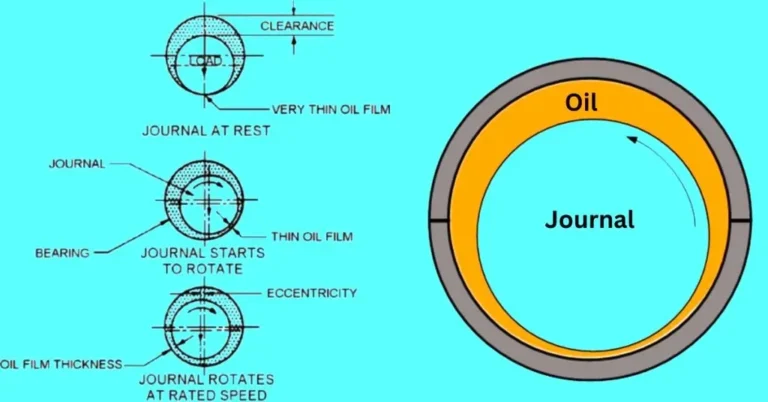
The turbocharger shaft speed tops out near 150,000 RPM. That shaft needs a thin, stable film at 100°C and above.
Conventional oil's VI improvers shear. The film thins. The bearing surface contacts metal.
You're running boundary lubrication at 150,000 RPM on a shaft that was designed for a stable synthetic film.
The second danger is low-speed pre-ignition (LSPI). It hits when you're towing or climbing a grade at low RPM with the turbo spinning. The cylinder pressure spikes.
A drop of fuel ignites before the spark plug fires.
Conventional oil's additive package, especially higher ZDDP levels, lowers the auto-ignition threshold of the trapped fuel. The API SP spec was written to address this. SP requires specific ZDDP caps and friction-modifier packages.
An SN jug in a turbocharged Ford EcoBoost or a GM 2.7L LT4 isn't just "slightly less good." It's a genuine LSPI risk.
What the Warranty Language Actually Says
Open your manual's "Limited Warranty" section. Most OEMs from 2016 forward state that using a non-specified oil type voids the powertrain warranty. "Specified" usually means full synthetic meeting a particular OEM code.
GM's dexos1, BMW's LL-01, Toyota's 0029. If you fill a 2020 Civic with conventional 5W-30 and the turbo fails at 40,000 miles, the dealer's service manager will pull the maintenance records. One line reading "5W-30 conventional" ends the conversation.
Used oil (conventional or synthetic) is classified as a hazardous waste by the EPA under 40 CFR 261. That means your disposal obligation doesn't change based on fluid type. But the warranty obligation does.
One is federal law. The other is a contract between you and the OEM.
The Quick Rule
- If your manual says "conventional or synthetic" and the engine is naturally aspirated, pre-2014: conventional is fine.
- If your manual says "synthetic only" or lists a full-synthetic OEM spec: conventional voids your warranty and risks the turbo.
- If you're between the two (a 2013 to 2015 hybrid, for example): check whether the spec calls for ILSAC GF-6B. If it does, a conventional ILSAC-marked jug is acceptable. If it doesn't, default to synthetic.
What a Jug of Conventional Oil Actually Costs Per Service Visit, Per 1,000 Miles, Per Year
We already showed the per-fill math. Let's go one layer deeper. Cost per 1,000 miles is the number that actually drives the decision, and it depends on three variables: oil price, drain interval, and annual mileage.
The Per-1,000-Mile Formula
Cost per 1,000 miles equals (quart price times quarts needed, plus filter, plus labor) divided by (drain interval in miles divided by 1,000). Here's how that plays out for three realistic U.S. scenarios:
| Scenario | Oil + Filter (retail) | Drain Interval | Annual Miles | Fills/Year | Labor ($45 shop) | Annual Total | Per 1,000 mi |
|---|---|---|---|---|---|---|---|
| 2004 Honda Accord, 5W-30 conventional, 3,000-mi | $18 + $7 = $25 | 3,000 mi | 12,000 mi | 4 | $180 | $280 | $23.33 |
| 2004 Honda Accord, 5W-30 conventional, 5,000-mi | $25 | 5,000 mi | 12,000 mi | 2.4 | $108 | $168 | $14.00 |
| 2022 Ford Escape, 0W-20 full synthetic, 10,000-mi | $52 + $12 = $64 | 10,000 mi | 12,000 mi | 1.2 | $54 | $131 | $10.92 |
The synthetic per-fill is double the conventional. But the interval is double-plus. Over a year, the synthetic actually costs less for the 12,000-mile driver.
The crossover point sits around 8,000 to 10,000 annual miles.
Below that, conventional at 5,000-mile intervals is cheaper. Above it, synthetic at 10,000-mile intervals wins on both cost and protection.
DIY vs. Shop Labor
If you change your own oil in the driveway, you save the $45 to $60 labor line. That shifts the math hard. A $25 conventional fill plus $7 filter plus $3 drain plug washer equals $35 per service.
At 5,000-mile intervals and 10,000 miles a year, you're at $70 per year. Full synthetic at $64 plus $12 plus $3 equals $79 per service, one service per year. The gap narrows to $9.
That's a rounding error.
But if you're paying a shop $55 for labor and disposal, the conventional save per visit is $30 to $40. Over two or three visits a year, that's $60 to $120. That's a real number.
It's also why the "just get synthetic, it's cheaper in the long run" pitch works at the counter.
How to Read the Label at the Parts Counter and Pick the Right SAE Grade and API Service Letter
You're standing in the oil aisle. Four shelves of jugs. You've got 90 seconds before the person behind you wants to compare prices.
Here's the 20-second reading method.
Step 1: Match the SAE Grade
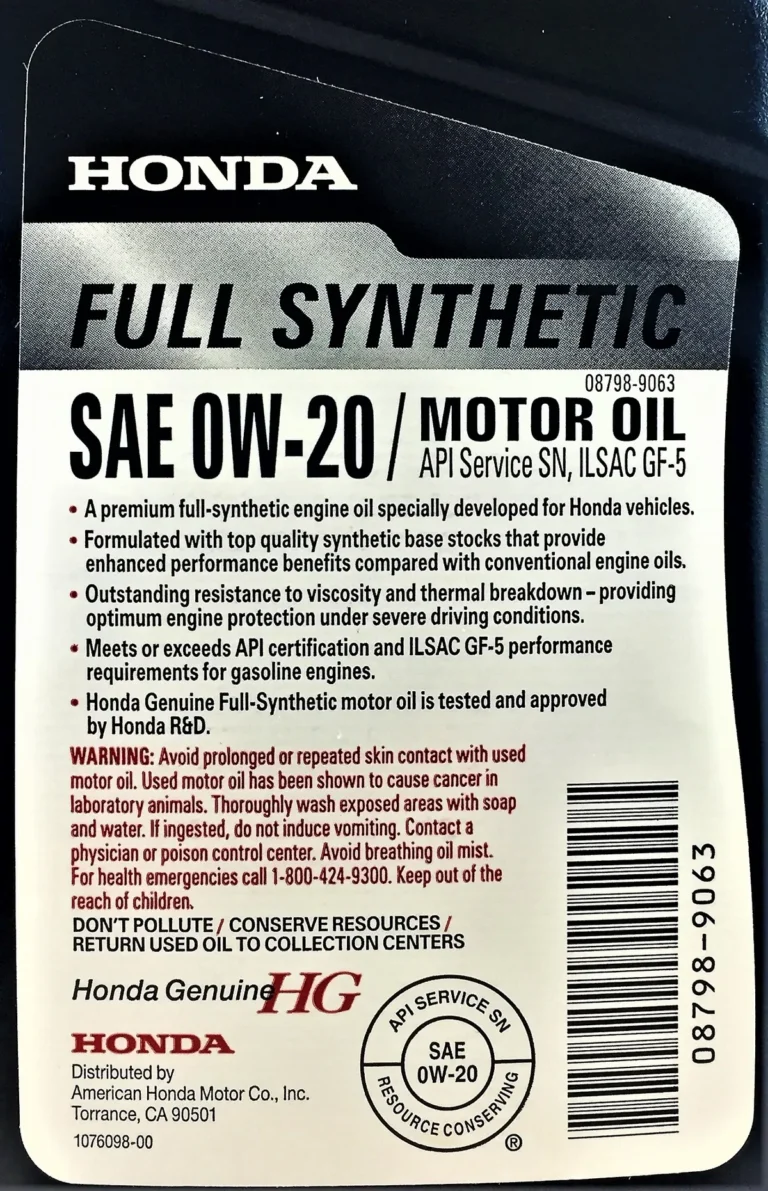
Turn the jug toward you. The SAE grade is the big number on the front: 5W-30, 10W-40, 0W-20. Cross-check it against your owner's manual.
The manual's "Recommended Oil" section lists the SAE grade. If it says 5W-30, grab 5W-30. Do not substitute 10W-30 "because it's thicker and better." It isn't.
The first number governs cold-start viscosity. Your engine's piston rings and bearing journals weren't designed for a thicker cold film.
Step 2: Read the API Service Letter
Below the SAE grade, look for the API "donut" symbol. Inside it, you'll see "API SP" or "API SN." As of 2026, SP is current for gas engines.
If your manual says "SP or higher," an SN jug is technically under-spec. The difference is LSPI protection and fuel-economy additives. For a pre-2010 engine, SN is perfectly fine.
For a 2021 turbo, you want SP.
Step 3: Check the OEM Spec Number
This is the one most people skip. On the back or bottom of the jug, you'll see a line like "Meets GM dexos1" or "VW 502.00" or "Toyota 0020."
If your manual lists a specific OEM code, match it. A conventional 5W-30 that meets GM dexos1 is different from one that meets Chrysler MS-9102. The additive package, the ZDDP level, and the SAPS content all shift between OEM specs.
Step 4: Confirm It's Actually Conventional
Look for the words "conventional," "mineral," or "petroleum" on the label. If it says "synthetic blend" or "synthetic," you're in a different product.
Some jugs say "performance mineral," which is Group II conventional. That's fine. Just make sure you're not accidentally grabbing a blend and thinking it's straight conventional.
The price tag gives it away. A $14 five-quart "conventional" is probably Group II or a blend. A $14 five-quart true Group I conventional is rare as of 2026.
The market has moved up.
The "I Can't Read the Back" Shortcut
If the label is cramped and you can't make out the API letter, flip the jug and look at the barcode side. Most U.S. brands print "API SP" or "API SN" in 8-point type next to the UPC. It's tiny, but it's there.
If you genuinely can't tell, grab the jug and ask the parts-counter person. They've got a lookup screen. Twenty seconds.
No charge.
Five Mistakes People Make With Conventional Oil That Quietly Hurt the Engine
These aren't dramatic failures. No smoke, no check-engine light on day one. They're slow, cumulative, and they show up as a rough idle at 90,000 miles or a $2,200 timing-chain replacement at 140,000.
Mistake 1: Extending the Drain Interval "Just a Little"
The jug says "up to 5,000 miles." You do 6,500. Then 7,000. Then "oh, it's fine, it's still amber."
Conventional oil's TBN drops faster than synthetic. By 6,500 miles in short-trip driving, your TBN is at 4 or below. The acids from combustion byproducts start eating the bearing surfaces.
The sludge layer on the piston rings thickens. The next drain plug comes out with a brown-black, gritty fluid instead of the dark-brown you expected.
The "just a little" extension is the single most common way conventional oil quietly degrades an engine.
Mistake 2: Ignoring the Calendar Component
Mileage isn't the only clock. A car that sits for four months in a garage, then gets 800 miles in a weekend, has aged oil regardless of the dipstick reading.
Water vapor condenses in the crankcase during cold starts. It emulsifies with the conventional base stock. You get a milky, low-surfactant fluid that can't protect the cam followers.
The rule: change conventional oil every six months maximum, even if the mileage says you're "not due yet."
Mistake 3: Mixing Conventional Into a Synthetic-Filled Engine
You've got a 2019 SUV filled with 0W-20 full synthetic. You top off a quart of conventional 5W-30 after a minor leak. It's not an explosion.
The oils are miscible.
But you've just diluted the VI package, lowered the TBN, and introduced a sheared-thinner fluid into a system designed for a stable 200+ VI. The next drain interval you run is now a compromise. The lab analysis will show a blended fluid that doesn't match either spec.
Do it once and you're fine. Do it every other fill and you've just paid synthetic prices for conventional performance.
Mistake 4: Using the Wrong ZDDP Level for an Older Engine
Pre-2000 engines (think a 1997 Camry, a 2002 Accord) were designed around 1,400 to 1,600 ppm ZDDP. The current API SP spec caps ZDDP near 800 to 1,000 ppm to protect catalytic converters and reduce LSPI.
If you run SP conventional in a 1997 engine, you're under-protecting the camshaft and lifters. The lifters tap at idle. The cam profile wears out of spec by 120,000 miles.
The fix: use an SN or SM conventional jug for pre-2004 engines. They carry higher ZDDP. The catalytic converter on a 1997 car is not going to break from the extra zinc.
Mistake 5: Buying the Wrong Viscosity for Your Climate
You live in Boise, Idaho (Zone 7a, winter lows near -18°C). You grab a 10W-30 conventional because it's $3 cheaper than the 5W-30.
In January, that 10W oil is 40% more viscous than a 5W at -18°C. The oil pump struggles. The bearing oil galleries don't reach full pressure for 8 to 12 seconds longer on every cold start.
Multiply that by 150 winter starts and you've added 1,500 to 2,000 seconds of boundary-lubrication wear to your crank throws. The $3 you saved costs you a main bearing at 130,000 miles.
Drain Intervals, Top-Offs, and Why Short-Trip Driving Makes Conventional Oil Degrade Faster Than the Bottle Claims
The "5,000 miles" on the conventional jug is a highway number. It assumes the oil reaches full operating temperature (90 to 105°C) and stays there for the bulk of each cycle. Most U.S. drivers don't do that.
What Short-Trip Driving Actually Does to Conventional Oil
You drive 4 miles to work. The engine hits 60°C. You park.
The oil cools. You drive 4 miles home. Same cycle.
The oil never crosses the 100°C threshold where water and fuel vapors boil out of the crankcase. That water emulsifies with the conventional base stock. The fuel dilution drops the flash point.
The ZDDP and detergent package works 30 to 40% harder to neutralize the extra acids.
Per API SP testing protocols, "severe service" (defined as 50% or more of driving under 20 minutes per trip) cuts the effective drain interval by 30 to 40%. A 5,000-mile conventional interval becomes a 3,000 to 3,500-mile interval. The bottle won't tell you this.
The API test report will.
The Practical Adjustment
- If 50%+ of your miles are under 20 minutes per trip: change conventional every 3,000 miles or 4 months, whichever comes first.
- If you mix highway and short trips (about 30% short): 4,000 to 4,500 miles is the safe ceiling.
- If you're mostly highway (50+ mile commutes, sustained 70+ mph): 5,000 miles holds. Push to 5,500 max. Not 6,000.
Top-Off Protocol
When you check the dipstick and it's half a quart low, you need to add the same SAE grade and API service letter that's already in the crankcase. Add conventional 5W-30 SP to a conventional 5W-30 SP engine.
Do not add synthetic 0W-20 to a conventional 5W-30 system. The viscosity jump confuses the oil pump's pressure curve for the next drain cycle. The next filter change will show a mix that neither the old nor the new fluid was designed to handle.
If you don't know what's in the engine, match the SAE grade. A quarter-quart top-off of the same viscosity is almost always safe. A quarter-quart of a different viscosity class is a small error.
A full fill of the wrong type is a bigger one.
When to Send a Used-Oil Sample to a Lab
If you're running conventional oil on a high-mileage engine (80,000+) and extending intervals even slightly, a $30 to $50 used-oil analysis every 12 months is cheap insurance. The lab reports TBN, viscosity at 100°C, water content, fuel dilution, and wear metals (iron, copper, lead, aluminum).
If the TBN is below 4, the viscosity has drifted more than 5 cSt from spec, or water content is above 0.5%, you've hit your drain window. Don't wait for the mileage number. The fluid has already spent its budget.
Warranty, Catalytic Converters, and the EPA Rule That Makes Dumping Old Oil Illegal
The legal side of conventional oil has three layers most drivers never think about. Federal warranty law, catalytic converter chemistry, and federal waste classification. They interact in ways that change what you can do with a $15 jug of oil.
The Magnuson-Moss Warranty Act and Your Powertrain Coverage
The federal Magnuson-Moss Act says an OEM can't void your warranty just because you use an aftermarket part. But it does let them void it if the fluid is the cause of a failure.
Used motor oil (conventional or synthetic) is classified as a hazardous waste by the EPA under 40 CFR 261. That classification applies to conventional and synthetic alike. The moment you drain a conventional fill and dump it in a storm drain, you're not just breaking a contract.
You're in violation of federal waste law.
Most state and local enforcement leans on the EPA's 40 CFR 261.31 and 261.32. A single pour of even one quart into soil or a drain triggers a Class I hazardous waste violation. The EPA fine starts at $67,000 per violation per day.
State agencies (California DEQ, Texas TCEQ, New York NYSDEC) layer on top with their own penalty schedules. A home driveway pour that seeps into a residential catch basin is reportable. You call your local spill response line.
You don't just hose it off and walk away.
Sulfated Ash, Phosphorus, and Sulfur (SAPS) and the Catalytic Converter
Conventional oil carries more sulfated ash than a low-SAPS synthetic. The zinc in ZDDP, the calcium in the detergent package, and the sulfur in the base stock all end up in the exhaust stream.
The catalytic converter's substrate (typically a cordierite honeycomb) is designed to handle a specific SAPS load. Exceed it and the ash coats the catalyst cells. The three-way converter stops converting CO, NOx, and unburned hydrocarbons.
The check-engine light throws a P0420 or P0430 code. The repair bill is $1,200 to $2,500.
The API SP spec caps ZDDP and total SAPS specifically to protect modern converters. A pre-2010 car with a single catalytic converter is more forgiving.
A 2022 car with a dual-stage GPF (gasoline particulate filter) downstream of the cat is not. The GPF traps soot particles. Ash from a high-SAPS conventional oil plugs the GPF channels.
The EGR valve recirculates hot exhaust to burn the soot. The cycle repeats until the GPF reaches its thermal limit. At that point, the engine management system goes into limp mode.
The car won't pass above 2,500 RPM.
What the EPA Actually Requires for Disposal
Per EPA 40 CFR 261, used motor oil is a hazardous waste. Here's what that means in practice:
- Collection point: Take used conventional oil to a participating auto parts store (AutoZone, O'Reilly, NAPA, Walmart), a municipal transfer station, or a certified re-refiner. Most cities run a "Hazardous Household Waste" day once or twice a year.
- Container rules: Seal the oil in its original jug or a labeled, leak-proof container. No cardboard boxes. No mixing with antifreeze, brake fluid, or solvent.
- Recordkeeping (for shops): If a shop drains your oil, they must track the volume and the re-refiner's chain-of-custody number. You don't need to do this at home. But if you've drained 10 quarts in a weekend and don't know where they went, the local DEQ can ask.
- The re-refining loop: Conventional used oil is the feedstock for 80% of U.S. re-refined base stock. A used quart becomes a Group II or III base stock for the next generation of oil. The American Petroleum Institute tracks re-refined capacity. As of 2026, roughly 95% of U.S. used oil is captured and re-refined. The 5% loss is primarily residential misdisposal.
Three Real-World Scenarios: Picking the Right Conventional Jug at the Store
Abstract specs mean nothing until you're standing in the aisle with a specific car, a specific climate, and a specific annual mileage. Here are three scenarios that cover most U.S. driving patterns.
Scenario 1: 1996 Honda Civic EX, 2.0L D16Y6, 220,000 Miles, 8,000 Miles/Year, Columbus, Ohio
The manual says "5W-30 conventional or synthetic, API SG or higher." You're in Zone 6a. Winter lows hit -10°C in January. Summer highs clear 35°C.
- SAE grade: 5W-30. The 5W handles the -10°C cold start. The 30 protects the 2.0L at 220,000 miles where bearing clearances have widened.
- API service: SG is the floor. SN is current and available. Grab SN. It's the same price as SG at the store.
- OEM spec: Honda doesn't mandate a proprietary code for this engine. Any API SN 5W-30 conventional works.
- Drain interval: 5,000 miles or 6 months, whichever comes first. At 8,000 miles a year, that's two fills.
- ZDDP note: The D16Y6 was designed around 1,200 to 1,400 ppm ZDDP. An SN conventional typically carries 1,000 to 1,200 ppm. That's close enough. If you want to be safe on the lifters, look for a "high-mileage" conventional 5W-30 that lists 1,400+ ppm on the TDS.
- Cost: A 5-quart jug of conventional 5W-30 SN at Walmart or Home Depot runs $14 to $19. Filter is $6 to $9. Total per fill: $20 to $28. Two fills a year: $40 to $56.
Scenario 2: 2003 Ford F-150, 5.4L Triton V8, 160,000 Miles, 3,000 Miles/Year, Fargo, North Dakota
The manual says "SAE 10W-30 or 5W-30, API SE or higher, for gas engines." But this is a 5.4L V8 doing 3,000 miles a year in Zone 4a. Winter lows hit -30°C. The engine sits idle at a job site for 40 minutes a day.
- SAE grade: 5W-30. A 10W-30 at -30°C is a cold-start problem. The oil won't reach the top of the cam tower for 20 seconds. The 5W thins faster at low temperature.
- API service: SE is 1972-era. You want SP or at minimum SN. The 5.4L Triton runs hot in summer and idles long in winter. SN handles the idle sludge better.
- The idle problem: 40 minutes of idle at 3,000 RPM means the oil circulates but the thermostat is open. The engine runs at 90°C. The short-trip thermal cycle means the oil never gets a sustained 105°C boil-out. Water accumulates. The TBN drops faster than the mileage suggests.
- Adjusted drain interval: 3,000 miles or 4 months. At 3,000 miles a year, that's one fill plus one calendar-based top-up. You're not overpaying. You're protecting a 160,000-mile V8 in the coldest state in the contiguous U.S.
- Cost: A 5-quart 5W-30 conventional is $16 to $22 in Fargo. The 5.4L takes 6 quarts (with filter). Add a $4 extra quart. Total: $20 to $26 per fill. One fill a year plus one top-up. Under $50.
Scenario 3: 2008 Toyota Camry Hybrid, 2.4L 2AZ-FE, 60,000 Miles, 10,000 Miles/Year, Phoenix, Arizona
The manual says "0W-20 synthetic, API SL or higher, ILSAC 2." This is the tricky one. The OEM spec says synthetic. But the engine is a naturally aspirated 2.4L that runs mostly at low RPM because the hybrid system does the heavy lifting.
- The conflict: The spec says 0W-20 synthetic. You can't run conventional here without violating the manual. The 0W-20 viscosity is too thin for a conventional base stock to maintain film strength at 105°C in Phoenix summer (45°C ambient, 110°C+ coolant).
- The workaround that doesn't work: "I'll just use a 5W-30 conventional because 0W-20 is too expensive." No. The 5W-30 is thicker at cold start. The hybrid system's electric motor spins the oil pump at 0 RPM during electric-only driving. The thicker oil resists the pump's low-speed prime. The 2.4L's tight main bearing clearance (0.05 mm) gets a 15% thinner film at operating temp than the 0W-20 spec calls for.
- The correct pick: 0W-20 full synthetic, API SP, ILSAC GF-6B. The GF-6B mark is critical for hybrid duty. It handles the on/off engine cycling that a conventional formula wasn't designed for.
- Cost: This is the one scenario where you're paying the synthetic premium. A 5-quart 0W-20 synthetic is $45 to $60. The 2.4L takes 4.5 quarts. You use one jug per fill. Interval is 10,000 miles or 12 months. At 10,000 miles a year, one fill. $45 to $60.
The Pattern Across All Three
| Variable | Scenario 1 (Civic) | Scenario 2 (F-150) | Scenario 3 (Camry Hybrid) |
|---|---|---|---|
| Conventional works? | Yes | Yes | No, spec mandates synthetic |
| SAE grade | 5W-30 | 5W-30 | 0W-20 (synthetic only) |
| API letter | SN | SN or SP | SP, ILSAC GF-6B |
| Real-world drain | 5,000 mi / 6 mo | 3,000 mi / 4 mo | 10,000 mi / 12 mo |
| Annual cost | $40 to $56 | Under $50 | $45 to $60 |
The through-line: the manual is the gatekeeper. If it says conventional is acceptable, you're in conventional territory. If it says synthetic only, you're not, no matter how much you wish you were.
The Bottom Line: A Simple Decision Guide for Your Next Oil Change
You've got a jug in your hand or a tab open. You need a 30-second decision framework. Here it is.
Question 1: What Does the Manual Say?
Open the "Recommended Oil" page. Read the SAE grade. Read the API service letter.
Read the OEM spec number.
If it says "conventional or synthetic," you can use conventional. If it says "synthetic only" or lists a full-synthetic OEM code (dexos1, LL-01, 0029), you're locked into synthetic. Stop reading.
Go to the synthetic aisle.
Question 2: What's Your Annual Mileage and Driving Cycle?
- Under 6,000 miles/year, mostly short trips: Conventional at 3,000-mile or 4-month intervals. Two to three fills a year. Budget: $60 to $90.
- 6,000 to 10,000 miles/year, mixed highway/urban: Conventional at 5,000-mile intervals. Two fills a year. Budget: $40 to $60.
- Above 10,000 miles/year, mostly highway: Synthetic at 10,000-mile intervals. One fill a year. Budget: $60 to $90. The per-1,000-mile cost is lower than conventional at three fills.
Question 3: What's the Coldest Morning You'll Start the Engine?
Check the pour point on the TDS. If your winter low is below the pour point, you need a lower W number.
-20°C winter means 0W or 5W. -10°C means 5W works. -5°C means 10W is fine. In Phoenix, 10W is irrelevant. You'll never start below 10°C.
The One-Page Summary
| If your engine is… | Use… | Interval | Watch for… |
|---|---|---|---|
| Pre-2014 NA, manual says "conventional or synthetic" | Conventional, correct SAE + API | 3,000 to 5,000 mi | Short-trip TBN drop, calendar expiry |
| Pre-2014 NA, high-mileage (100k+) | High-mileage conventional (extra ZDDP) | 3,000 mi | Oil consumption, seal seepage |
| 2014 and later, turbocharged | Full synthetic, OEM spec | 10,000 to 15,000 mi | LSPI, GPF ash loading |
| Hybrid (any year) | Synthetic, ILSAC GF-6B | 10,000 mi or 12 mo | Engine cycling, low-RPM oil starvation |
| Small engine / powersports | SAE 30 or 10W-30 conventional | 50 to 100 engine hours | API SF/SG/SH letter, not automotive SP |
| Classic / vintage (pre-1990) | SAE 30 or 10W-40 conventional | 3,000 mi | Looser clearances need thicker film |
The decision is never "conventional is bad." The decision is "does my engine's spec, climate, and mileage pattern actually need the synthetic premium?" For most cars built before 2014 doing under 10,000 miles a year, the answer is no.
Conventional is the right, the cheap, and the OEM-intended answer. Spend the savings on the filter, the drain plug washer, and a new set of wipers.
FAQs About Conventional Motor Oil
Is conventional oil bad for my engine?
No. Conventional oil protects any engine whose spec allows it. The word "conventional" describes the base stock (Group I or II petroleum-refined fluid), not a quality tier.
If your manual lists "conventional or synthetic," you're covered. The mistake is using it in an engine that mandates full synthetic, not in the engines it was designed for.
Can I mix conventional and synthetic oil in the same engine?
Yes, they're chemically miscible. A top-off quart of conventional 5W-30 into a synthetic 5W-30 engine won't cause damage. But the blended fluid no longer matches either spec.
The VI drops, the TBN drops, and the drain interval shortens. Treat it as a one-time fix, not a strategy. The next full drain should return to a single oil type.
What's the difference between conventional and a "performance mineral" oil?
A "performance mineral" or "enhanced conventional" is Group II base stock with a heavier additive package. It's still conventional by API rules (under 90% saturation in the base stock). It outperforms straight Group I on shear stability and oxidative resistance.
It's not a synthetic blend. Check the TDS. If the base stock is listed as "Group II/III blend," it's technically a synthetic blend, not conventional.
How long does conventional motor oil last between changes?
The jug says 5,000 miles. In highway driving, that holds. In short-trip driving (50%+ of trips under 20 minutes), cut it to 3,000 miles or 4 months.
The calendar matters as much as the mileage. Water and fuel vapor that don't boil out in short trips eat into the TBN faster than the mileage number suggests.
Does conventional oil work in a diesel engine?
It does, but the API service letter is different. Diesel engines use API CF, CG, or CI service categories (not the gas-engine SP/SN). A conventional CF-4 15W-40 is the standard for older 4-stroke diesels.
The additive package is tuned for higher soot loads and longer drain intervals. Don't grab a gas-engine SP conventional for a diesel. The detergent and anti-wear balance is wrong.
What should I do with used conventional motor oil?
Seal it in the original jug or a labeled container. Take it to any participating auto parts store, municipal transfer station, or certified re-refiner. The U.S.
EPA classifies used motor oil as a hazardous waste under 40 CFR 261. Dumping it on soil or into a drain is a federal violation with fines starting at $67,000 per occurrence. Recycle it.
Ninety-five percent of U.S. used oil is captured and re-refined into next-generation base stock.