What Is Synthetic Motor Oil Made From
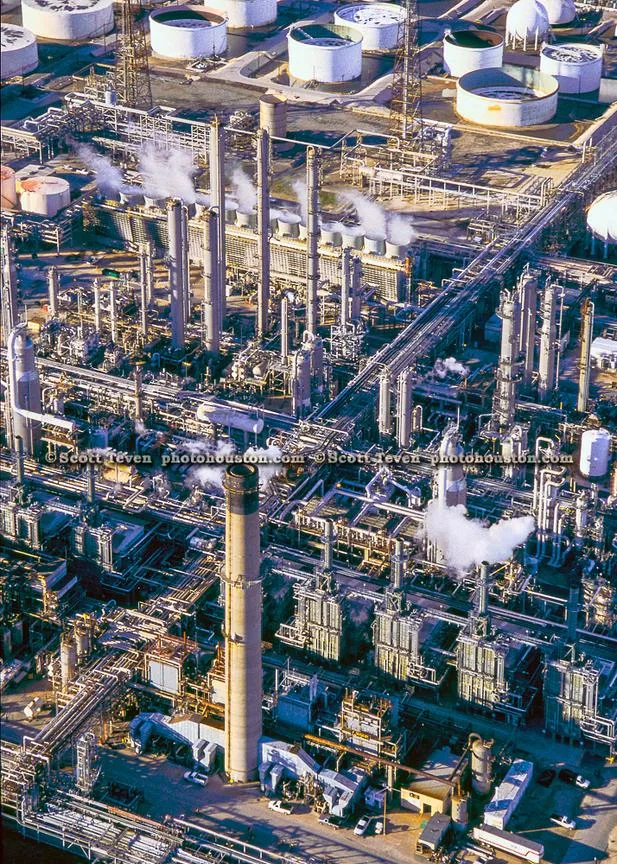
If you've ever picked up a quart of "full synthetic" and wondered what is synthetic motor oil made from, you're not alone. The bottle screams "engineered in a lab," but the actual origin story is a lot more refinery than science fiction.
Here's the short version: every major synthetic base stock still traces back to petroleum feedstocks. As of 2026, API-licensed brands run hydrocracked naphtha and straight-run gas oil through multi-stage refining before polymerizing or esterifying those streams. That's where the real chemistry begins, and it's not what most front labels advertise.
Quick Answer
Synthetic motor oil is made from refined petroleum feedstocks. Naphtha and gas oil get hydrocracked into lighter, cleaner streams. Those streams then undergo polymerization or esterification.
The result is PAO, synthetic esters, or polyphenylene ether base stocks. Blenders cut these to SAE viscosity grades and add a detergent package.
It's Not "Lab-Made": Synthetic Oil Still Starts in a Refinery
The word "synthetic" throws people. They picture a chemist in a white coat pulling molecules out of thin air. That's not what's happening.
The raw material is still crude oil. Specifically, the light naphtha fraction (C5 to C10) and straight-run or hydrocracked gas oil (C10 to C20).
The American Petroleum Institute defines base-stock groups in its Base Oil Interchangeability Manual. Every group, from I through V, derives from petroleum or from monomers synthesized from petroleum. "Synthetic" in this context means the molecular structure was engineered, not that the carbon atoms appeared from nowhere.
So when you read "100 percent synthetic," think of it as "100 percent engineered base stock." The carbon backbone still came from a barrel of crude. The difference is what the refinery does to that carbon between first distillation and the finished pour.
The Actual Chemistry: Naphtha, Hydrocracking, and Polymerization

Here's the pipeline, step by step:
| Step | What Happens | Output |
|---|---|---|
| 1. Feedstock prep | Naphtha separation and gas oil hydrocracking | Clean, light hydrocarbon streams |
| 2. Hydroisomerization | Linear paraffins rearrange into branched iso-paraffins | Group III / III+ base stock |
| 3. Olefin polymerization | Linear alpha-olefins (C8 to C14) polymerize via Ziegler-Natta catalyst | PAO (Group IV) |
| 4. Esterification | Dicarboxylic acid reacts with a long-chain alcohol | Polysynthetic esters (Group V) |
| 5. Hydrofinishing | H2 treatment strips S, N, O, and metals | Clean, stable base stock |
For PAO specifically, the key feedstock is linear alpha-olefins. A Ziegler-Natta or Phillips catalyst chains them into polyolefins with a target molecular weight of 1,000 to 2,000 g/mol. That's what gives PAO its high viscosity index, landing around 160 to 270 depending on the blend.
Esters take a different route. You start with a dicarboxylic acid and react it with a long-chain alcohol. The hydroformylation pathway, where you feed syngas into an olefin to make an aldehyde, then oxidize and esterify, shows up in many "synthetic ester" product lines.
Neither route is "from scratch." Both are multi-stage refinery operations. The "synthetic" label just means the final base oil was assembled, not distilled.
PAO, Esters, and PPE: What the API Base-Stock Groups Mean for Your Oil
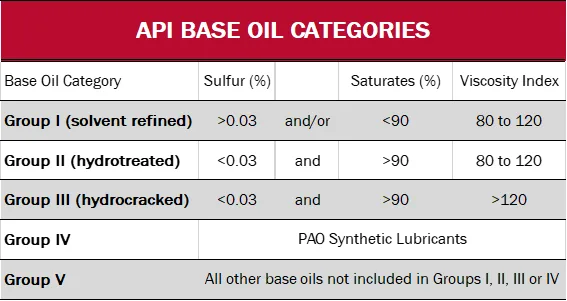
The ISO 4915 classification breaks base stocks into five groups. Here's how they map to what's actually in your quart:
| Group | Chemistry | VI Range | Pour Point | Typical Use |
|---|---|---|---|---|
| I (mineral) | Solvent-refined | 90 to 120 | -15 to -30 C | Conventional oil |
| III+ (hydroisomerized) | Hydrocracked, S below 0.03 wt% | above 135 | -30 to -40 C | Extended-interval oils |
| IV (polyolefin) | PAO 3, PAO 4 | 160 to 270 | -40 to -60 C | Full synthetic passenger |
| V (esters, PPE, PAG) | Ester, polyphenylene ether | 120 to 200+ | -35 to -55 C | Aviation, gear, niche auto |
A "full synthetic" label on a consumer bottle usually means 90 percent or more of the base is Groups IV and V. Some brands sneak in III+ and still call it synthetic. That's legal, but it shifts your pour point and oxidation stability in ways the front label won't spell out.
The group you get matters for cold starts and extended drain intervals. PAO holds viscosity better at -40 C than III+ does. Esters add natural anti-wear film strength but can lose viscosity under shear.
PPE sits in a niche: high VI, excellent thermal stability, but cost and shear limits keep it out of most car oils.
Where the "Synthetic" Label Gets Muddled, and Why It Actually Matters
The API doesn't define a minimum percentage of "true synthetic" (Groups IV or V) for a product to carry the word "synthetic" on the label. A quart that's 80 percent III+ hydroisomerized wax and 20 percent PAO can legally say "synthetic blend." In some markets, 95 percent III+ and 5 percent PAO still gets the "synthetic" call.
That's where the marketing language breaks down for you as a buyer. "Synthetic blend" and "full synthetic" sound like a clean spectrum, but the regulatory line is blurrier than most people assume. Manufacturer data sheets will list the base-stock group breakdown, but you have to actively look for it.
Why does this matter in practice?
- Pour point. III+ bottoms out around -35 C. PAO hits -40 to -60 C. In northern Canada or Scandinavia, that gap is the difference between a cold crank and a no-start.
- Oxidative stability. Per ASTM D4661 (TOST) testing, PAO blends routinely exceed 400 hours at 275 C. Mineral or III+ blends often sit at 200 to 300.
- Shear stability. Viscosity index improver in III+ blends shears over time, dropping your oil from 5W-30 closer to 5W-20. PAO needs less VII, so it holds grade.
None of that shows up on the front label. It's all buried in the technical data sheet or the API Donut's licensed category.
How to Decode the Bottle: Donuts, Specs, and What to Look Past the Front
The front of the bottle sells you "full synthetic, ultra-clean." The back is where the actual engineering lives. Here's what to check, in order:
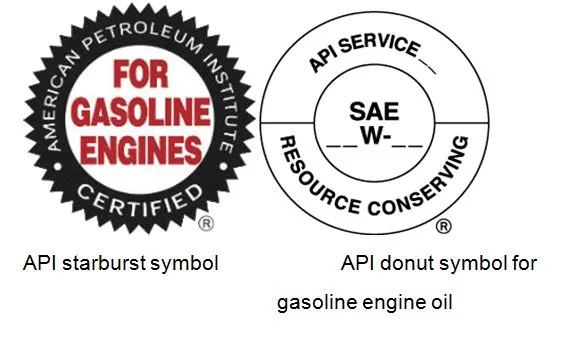
1. API service category. For gasoline engines, you want API SP or SQ. For diesel, CK-4 or FA-4.
The API Donut mark is only valid after independent lab verification of every performance claim on that label.
2. SAE viscosity grade. 0W-20 means the oil must pass a cold-crank simulator at -35 C, holding below 6,000 cP. The "W" number is winter performance.
The second number is kinematic viscosity at 100 C.
3. ILSAC or ACEA sequence. GDI engines with a gasoline particulate filter need ACEA C2 or C5 (low-SAPS, S and P below 0.8 wt percent). Ignore this and you'll clog the GPF well before the next service.
4. OEM approvals. If your owner's manual calls for VW 504 00, MB 229.51, or BMW LL-17FE, the oil must carry that exact approval stamp. The API Donut alone isn't enough to satisfy warranty terms.
5. Base-stock disclosure. Most major brands publish a technical data sheet online. It lists the percentage by group.
If you're paying premium for "full synthetic," confirm you're actually getting Group IV or V as the dominant stock.
Skip a step and you might be paying $12 a quart for something that performs like a $6 conventional. The chemistry is all there. You just have to read past the marketing.
Get This Wrong and You'll Void Your Warranty (or Damage the GPF)
Here's where "it's just oil" thinking costs you real money. Pour a high-SAPS oil (S and P above 0.8 wt percent) into a car with a gasoline particulate filter, and those ash deposits bake solid onto the GPF substrate. The filter clogs.
The check engine light fires. A GPF replacement runs $1,500 to $3,000 at most dealerships.
OEM warranty terms are not flexible. If your manual specifies ACEA C5 and you top off with a C3 mid-SAPS oil, that's a spec violation on paper. The dealer can deny every oil-related warranty claim after that.
You signed the service booklet. It holds up.
Running API SN where the engine requires API SP means you're missing LSPI protection (low-speed, high-load pre-ignition) in a turbocharged GDI setup. One stop-and-go morning, one lean-burn event, and you can crack a piston. That repair runs $2,000 to $4,000.
| Mistake | Consequence | Typical Cost |
|---|---|---|
| High-SAPS oil in GPF car | Filter clog, flow restriction | $1,500 to $3,000 |
| Wrong API category | LSPI, piston damage | $2,000+ |
| Missing OEM approval | Warranty denial | Full out-of-pocket |
| Undersized viscosity grade | Thin film, bearing wear | Reduced engine life |
The fix is simple. Check for a GPF first. Match the ACEA sequence.
Confirm the API category. In that order. Skip one and you're writing the check yourself.
Quick Answers to the Questions That Keep Popping Up
Is synthetic oil actually made from crude oil?
Yes. Every API-licensed synthetic base stock traces back to petroleum feedstocks. Naphtha and gas oil get hydrocracked, then polymerized or esterified.
"Synthetic" describes the assembly process, not the origin. No commercial full synthetic starts from non-petroleum carbon.
Can I mix conventional and synthetic oil in the same engine?
You can top off with either without causing damage. The chemistries are compatible. However, mixing dilutes the synthetic's advantages.
If your engine runs a 10,000-mile drain interval, topping with conventional mineral oil shortens the effective life of that interval. Stick to one grade throughout.
Does "full synthetic" guarantee 100 percent Group IV or V base?
No. API rules don't mandate a minimum percentage of Groups IV or V for the "synthetic" label. Some products carry 80 to 95 percent III+ hydroisomerized wax and still use the term.
Check the manufacturer's technical data sheet for the actual group breakdown before you pay premium pricing.
What breaks if I use the wrong viscosity grade?
Too thin (say, 0W-20 where 0W-40 is required) and the film collapses under high load. You get bearing wear and reduced oil pressure at temperature. Too thick and cold-start friction spikes, increasing wear during the first 30 seconds after a cold crank.
Do I need a new oil filter when switching from conventional to synthetic?
Not strictly. A quality spin-on filter handles either fluid. However, if your current filter's bypass valve is set too low, synthetic's lower viscosity at operating temperature can push oil past the bypass more readily.
A modern filter with a tighter bypass crack pressure is the safer call.