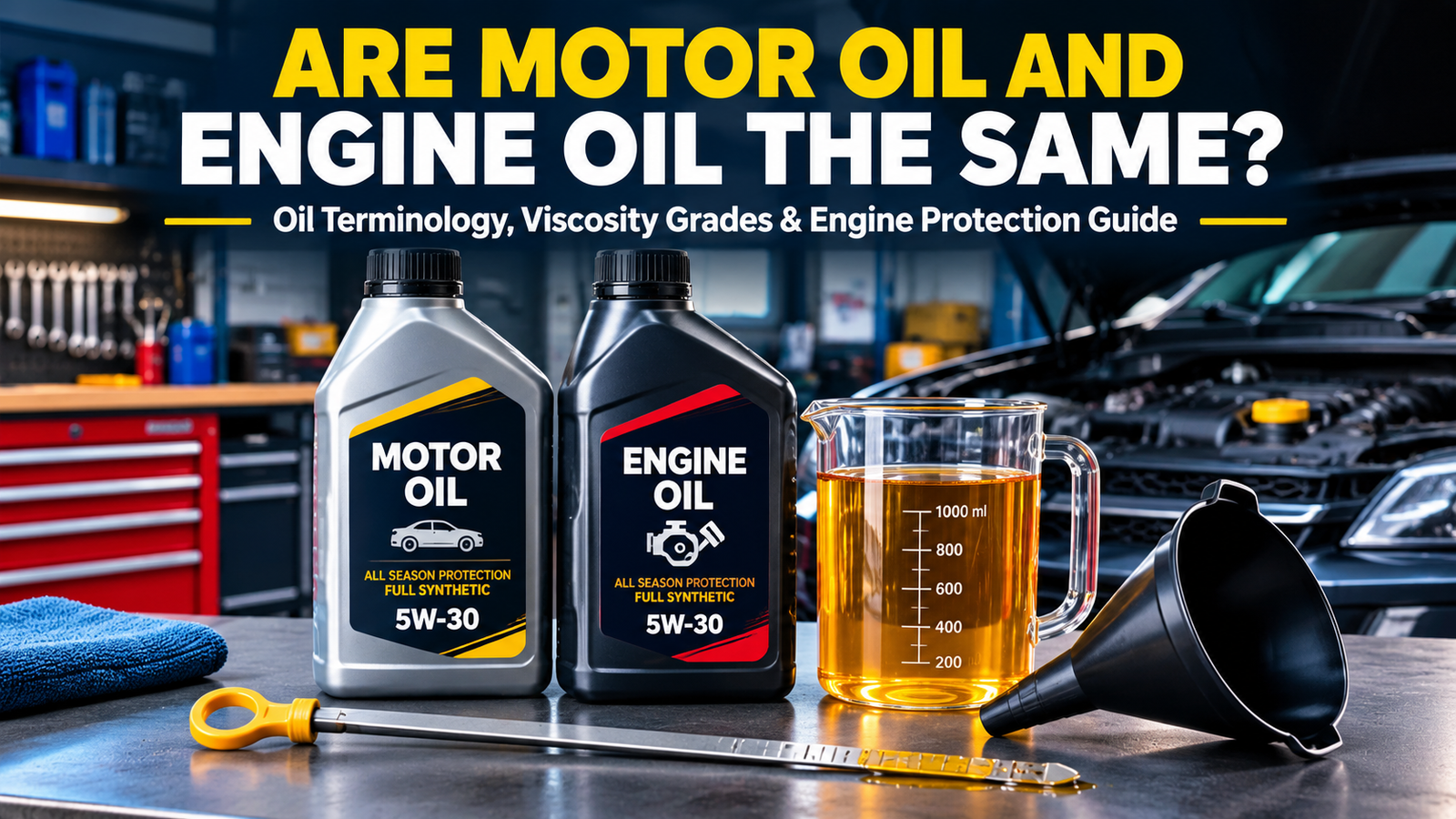
Are Motor Oil and Engine Oil the Same? A Complete Guide for Car Owners
If you have ever stood in an auto parts store and wondered whether motor oil is different from engine oil, you are not alone. In the United States, both terms are widely used for lubricating oil made for internal combustion engines. The key is not the name on the bottle. The key is whether the oil meets your vehicle’s required specifications.
Modern engine oil does much more than reduce friction. It helps control heat, carries dirt toward the oil filter, protects metal parts from wear and rust, and helps keep deposits under control. So when choosing oil, focus on the **SAE viscosity grade, API or other required performance standard, and the automaker’s stated requirements** rather than simply looking for the words “motor oil” or “engine oil”.
Are Motor Oil and Engine Oil the Same?
For most passenger cars, trucks, and SUVs, **motor oil and engine oil are two names for the same product category**. Both terms describe lubricating oil designed for an engine. The words may vary by country, brand, store, or driver, but the basic purpose is the same.
In the United States, “motor oil” is very common on product labels. “Engine oil” is also widely used in technical writing and vehicle manuals. This means a driver does not normally need to buy a product labeled one way instead of the other.
The important question is not “motor oil or engine oil?” It is “Does this oil meet my engine’s requirements?” Two bottles can both say motor oil and still be very different products because they may have different viscosity grades, additive packages, and performance ratings.
- ✦ Motor oil
A common consumer term for lubricating oil made for vehicle engines.
- ✦ Engine oil
A technical and general term for oil used to lubricate and protect an engine.
- ✦ The real difference
The terms usually do not mark a different oil type. The meaningful differences are the oil’s grade, formulation, standards, and vehicle approval.
Why Do People Use Two Different Names?
Language is the main reason. In the U.S., drivers often say “motor oil,” while mechanics, manuals, and manufacturers may use “engine oil.” Both can point to the same basic lubricant.
The word “motor” can sound as if the oil belongs to an electric motor. That is not what the term normally means in an automotive oil aisle. Traditional motor oil is made for internal combustion engines and has properties suited to high heat, pressure, and moving engine parts.
What Does Motor Oil Actually Do?
An engine contains many metal parts that move at high speed. Pistons move up and down, bearings support rotating parts, and valve-train parts move thousands of times during normal driving. Engine oil forms a protective film between many of these surfaces and helps reduce direct metal-to-metal contact.
Oil also moves through the engine and carries heat away from hot parts. It helps suspend or transport small contaminants so the oil filter can capture them. Modern oils also contain additives that help fight oxidation, corrosion, deposits, foam, and wear.
This is why oil choice matters. The correct oil is part of the engine’s overall design. A bottle with the right basic viscosity but the wrong performance standard may still fail to meet what the manufacturer expects.
- ✦ Reduces friction
Oil creates a lubricating film that helps moving engine parts work with less direct surface contact.
- ✦ Controls heat
Oil absorbs and moves heat away from parts that can become very hot during engine operation.
- ✦ Controls deposits
Detergent and dispersant additives help manage deposits and keep contaminants suspended until they can be removed.
- ✦ Protects against wear
The oil and its additive system help protect engine surfaces under normal operating conditions.
- ✦ Helps prevent corrosion
Special additives help protect internal engine surfaces from moisture and chemical attack.
Why Oil Becomes Dirty
Engine oil can darken as it works. Heat, combustion byproducts, tiny wear particles, and other contaminants can change its appearance. Dark oil does not automatically mean the oil has failed, and clean-looking oil does not automatically mean it is still suitable for extended use.
The oil filter removes many contaminants, but oil also undergoes chemical changes over time. That is why oil changes are based on the vehicle maker’s service schedule, oil-life system, driving conditions, and oil specification rather than color alone.
The Most Important Difference Is the Oil Specification
If you are asking, “are motor oil and engine oil the same,” the answer is usually yes. But that does not mean every motor oil is suitable for every engine. Engine oils come in many formulations, and modern engines can have very specific needs.
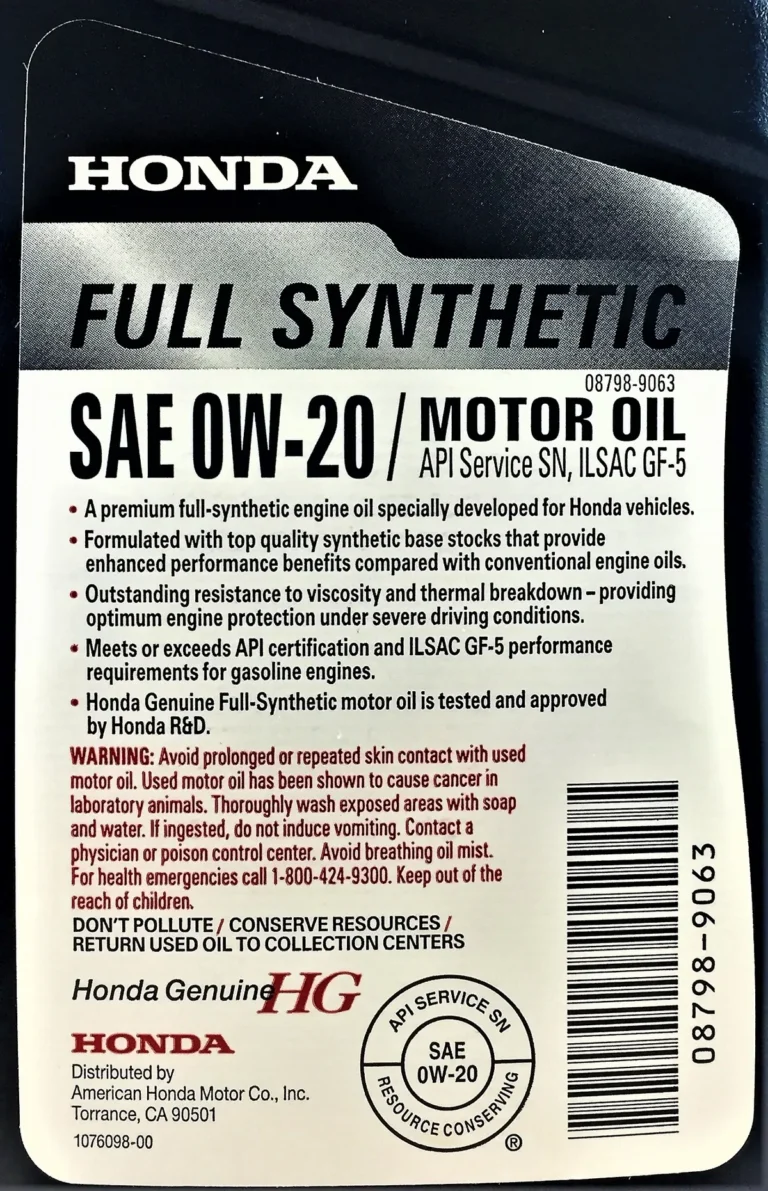
Your owner’s manual may list a viscosity such as SAE 0W-20, 5W-20, 5W-30, or 10W-30. It may also list a performance standard, manufacturer approval, or other specification. These details can be more important than the general product name.
Always check the current requirements for your exact vehicle, engine, model year, and market. A truck with a diesel engine, a gasoline-powered sedan, and a high-performance car may require very different oils even though all three products are called motor oil.
- ✦ Viscosity grade
Shows how the oil flows at different temperatures. Examples include 0W-20 and 5W-30.
- ✦ Performance standard
Shows whether the oil meets a recognized performance level for the intended engine and service.
- ✦ Manufacturer approval
Some engines require oil that meets a specific automaker specification or approval.
- ✦ Oil type
The oil may be conventional, synthetic blend, or full synthetic, depending on the product and application.
Understanding SAE Viscosity Grades
A grade such as 5W-30 describes how an oil behaves at different temperatures. The “W” refers to winter, and the first number relates to cold-temperature flow. The second number describes the oil’s viscosity at a higher test temperature.
A lower winter number generally means the oil is designed to flow more easily during cold starts. The second number helps describe its viscosity when the engine is hot. This does not mean that a lower number is always better; the correct grade depends on the engine design and the manufacturer’s requirements.
Understanding API and Other Oil Standards
Oil labels may carry marks or statements showing that the product meets recognized industry standards. In the U.S., the American Petroleum Institute, or API, provides widely used service categories and licensing information for engine oils.
Some vehicles also require specifications from organizations, automakers, or other industry groups. The safest approach is simple: match the oil to the requirements in the owner’s manual rather than choosing only by brand or price.
Different Types of Motor Oil and Engine Oil
Once you know that motor oil and engine oil usually mean the same thing, the next step is to understand the different formulations. The base oil and additive package can vary a lot from one product to another.
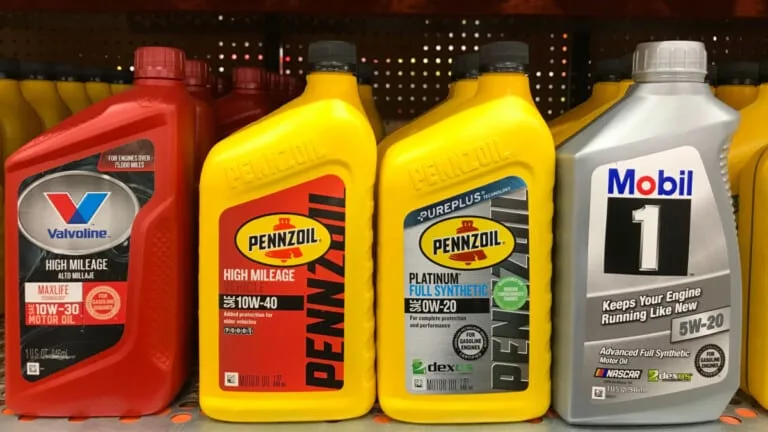
The main consumer categories include conventional oil, synthetic blend oil, and full synthetic oil. These names describe how the oil is made or formulated, but they do not replace the viscosity and performance requirements set by the vehicle manufacturer.
- ✦ Conventional oil
Uses a mineral-based petroleum oil as its main base stock. It can be suitable for some engines when it meets the required specification.
- ✦ Synthetic blend oil
Combines conventional and synthetic base oils. It is used in many applications where the required specification allows it.
- ✦ Full synthetic oil
Uses highly refined and engineered base oils with an additive system designed for specific performance needs. Many modern vehicles call for synthetic oil.
- ✦ High-mileage oil
Formulated for engines with significant mileage and may include additives aimed at seals, deposits, or oil consumption concerns.
Is Synthetic Oil Better?
Synthetic oil can offer useful performance benefits, especially in engines designed around modern low-viscosity oils, severe temperatures, or long service intervals. It often provides strong resistance to oxidation and can perform well across a broad temperature range.
However, “synthetic” alone does not tell you whether an oil is correct for a particular engine. A synthetic oil with the wrong viscosity or specification is still the wrong choice. Always match the complete specification.
Motor Oil Is Not the Same as Transmission Fluid or Other Fluids
One important point can prevent a costly mistake: motor oil and engine oil are generally the same category, but they are **not the same as every automotive fluid**. Transmission fluid, brake fluid, coolant, power steering fluid, and differential fluid serve different systems and have different chemical and physical requirements.
Never use engine oil simply because the bottle says it is a lubricant. Automotive fluids are designed for specific components. Using the wrong fluid can cause poor performance, accelerated wear, seal problems, or component damage.
- ✦ Engine oil
Made for internal combustion engine lubrication and protection.
- ✦ Automatic transmission fluid
Designed for transmission lubrication, hydraulic control, clutch operation, and heat management.
- ✦ Brake fluid
Designed to transfer hydraulic pressure in braking systems. Engine oil should never be used in its place.
- ✦ Coolant
Designed to manage engine temperature and protect the cooling system. It is not a substitute for engine oil.
- ✦ Gear oil
Used in certain differentials and manual transmissions and often has different viscosity and additive needs from engine oil.
Can You Use Any Motor Oil in Your Car?
No. This is one of the most important points in answering “are motor oil and engine oil the same.” Even if two bottles both contain motor oil, they may not be interchangeable. The engine’s design, emissions system, operating temperature, fuel type, and service conditions can affect the required oil.
For example, some modern gasoline engines use very low-viscosity oils to improve efficiency. Some turbocharged engines have strict oil requirements because of high heat and pressure. Diesel engines can also need oils with specific performance characteristics, especially when emissions-control systems are involved.
Before buying oil, check the owner’s manual or the official service information for the exact vehicle. If the manual calls for a specific specification, look for that requirement on the oil label.
- ✦ Check the owner’s manual
Find the recommended viscosity, performance standard, capacity, and any special approval.
- ✦ Check the oil label
Confirm that the bottle meets the required viscosity and performance specification.
- ✦ Consider the engine
Gasoline, diesel, turbocharged, hybrid, and high-performance engines may have different oil needs.
- ✦ Follow the service schedule
Use the vehicle maker’s oil-change interval or the vehicle’s oil-life monitoring system when applicable.
What About Mixing Different Brands?
If two engine oils meet the same required specification and viscosity, a small amount of mixing is generally less concerning than using an oil that does not meet the required specification. Many modern oils are designed to meet industry standards and can be mixed in normal top-up situations.
Still, routine mixing is not ideal when it means losing track of what oil is in the engine. For regular service, using one suitable product makes it easier to maintain a clear service record. If you need to top up, use the correct specification first.
Does Motor Oil Expire or Go Bad?
Engine oil does not usually fail overnight, but it can change with time, heat, moisture, and poor storage. An unopened bottle stored in a clean, dry place and kept away from extreme heat is generally in much better condition than oil that has been left open or contaminated.
Once oil is inside an engine, the situation is different. It is exposed to heat, combustion byproducts, moisture, and mechanical stress. That is why the oil-change schedule matters even when the vehicle has not been driven very far.
If you have an old bottle with an uncertain history, check the manufacturer’s guidance before using it. Avoid oil that is visibly contaminated or has been stored in a way that could introduce water, dirt, or other material.
- ✦ Store oil properly
Keep unused oil sealed and stored in a clean, dry place away from extreme temperatures.
- ✦ Keep containers clean
Do not allow dirt or water to enter an opened oil container.
- ✦ Do not judge by color alone
Oil color by itself is not a reliable test of whether engine oil should be changed.
How Often Should You Change Your Engine Oil?
There is no single oil-change interval that fits every vehicle. Modern engines, oils, and oil-life systems have changed service practices, so the correct interval depends on the vehicle and how it is driven.
Short trips, frequent idling, towing, heavy loads, dusty roads, extreme temperatures, and other severe conditions can affect maintenance needs. Some vehicles use an oil-life monitor that calculates service needs from driving conditions.
For a U.S. driver, the best starting point is the maintenance schedule in the owner’s manual. If the manufacturer provides a normal and severe-service schedule, choose the one that matches your actual driving pattern.
- ✦ Short trips
Frequent short drives can prevent the engine from staying hot long enough to fully manage moisture and fuel-related contaminants.
- ✦ Heavy loads
Towing and hauling can place extra heat and load on an engine.
- ✦ Frequent idling
Long periods of idling can count as demanding engine use even when the vehicle is not moving far.
- ✦ Extreme weather
Very hot or very cold conditions can affect engine operating conditions and oil demands.
Should You Change Oil by Mileage or Time?
Both can matter. If a vehicle is driven very little, the manufacturer may still recommend an oil change based on time because oil can accumulate moisture and contaminants during use.
The safest method is to follow the service interval provided for your exact vehicle. Do not assume that a universal mileage number applies to every engine.
Common Mistakes When Choosing Motor Oil
Many oil-related mistakes happen because drivers focus on the brand name, price, or a single number on the bottle. Those factors can matter, but they do not replace the complete vehicle specification.
A good oil choice starts with the owner’s manual. Once you know the required grade and standard, you can compare suitable products based on formulation, brand, availability, and cost.
- ✦ Choosing by brand alone
A trusted brand can make good oils in many grades, but not every product from that brand is correct for every engine.
- ✦ Choosing only by viscosity
The correct SAE grade is important, but the oil may also need to meet a specific performance standard or approval.
- ✦ Assuming thicker is always better
A thicker oil is not automatically safer. Modern engines are designed around specific oil flow and viscosity needs.
- ✦ Ignoring the manual
Internet advice and general rules cannot replace the requirements for your exact engine.
- ✦ Using the wrong fluid
Engine oil should not be substituted for transmission fluid, brake fluid, coolant, or other vehicle fluids.
How to Choose the Right Motor Oil for Your Vehicle
Choosing engine oil becomes simple when you use a clear process. Start with the vehicle maker’s requirements, then match the oil label to those requirements.
For most U.S. car owners, the owner’s manual is the best first source. If you do not have the manual, the automaker’s official service information or a reputable parts supplier’s vehicle-specific lookup can help, but the final oil choice should still match the manufacturer’s specification.
- ✦ Step 1: Identify the vehicle
Note the model year, make, model, engine size, and engine type.
- ✦ Step 2: Find the required viscosity
Look for the SAE grade recommended by the manufacturer.
- ✦ Step 3: Find the required performance standard
Check for API, ILSAC, ACEA, automaker, or other specifications listed for your vehicle.
- ✦ Step 4: Choose a suitable formulation
Select conventional, synthetic blend, or full synthetic oil only as allowed by the vehicle requirements.
- ✦ Step 5: Check the oil capacity
Use the correct amount listed by the manufacturer, including the filter if the specification provides separate capacities.
- ✦ Step 6: Keep a service record
Record the date, mileage, oil grade, and product used so future maintenance is easier.
A Simple Example
Suppose a vehicle manual calls for SAE 0W-20 oil that meets a stated modern gasoline-engine performance standard. A bottle of 0W-20 that meets that standard may be a suitable choice, while a bottle of 10W-40 may not be appropriate simply because it is marketed as premium motor oil.
This example shows why the answer to “are motor oil and engine oil the same” is only the first step. The terms tell you what general product you are looking at. The specification tells you whether the product fits your engine.
Why the Right Engine Oil Matters for Modern Cars
Modern engines are built to meet goals that include fuel efficiency, emissions control, power, durability, and lower operating costs. Engine oil is part of that system. Its flow behavior and additive chemistry can affect how well the engine and emissions equipment operate over time.
Turbocharged engines can place especially demanding conditions on oil because turbocharger components can operate at very high temperatures and speeds. Some engines also use technologies such as variable valve timing, cylinder deactivation, or gasoline particulate filters that can create specific oil requirements.
This is another reason not to choose oil based only on a familiar brand or a vague claim such as “works in all cars.” The exact specification on the label matters.
- ✦ Fuel economy
Some modern engines use low-viscosity oils as part of their design for improved efficiency.
- ✦ Turbocharger protection
Turbocharged engines can expose oil to high heat and demanding conditions.
- ✦ Emissions systems
Oil chemistry can matter to engines equipped with modern emissions-control hardware.
- ✦ Engine durability
Using oil that meets the required specification helps provide the protection expected by the engine design.
Frequently Confused Questions About Motor Oil
The names can create confusion, but most oil questions become easier once you separate the product name from the technical specification. Think of “motor oil” and “engine oil” as broad names, then use viscosity and performance standards to identify the right product.
- ✦ Same product category
For normal automotive use, motor oil and engine oil generally refer to the same engine lubricant.
- ✦ Not all oils are interchangeable
Different engines can require different viscosity grades and performance standards.
- ✦ The manual comes first
The manufacturer’s requirements should guide your final choice.