What Is Full Synthetic Motor Oil: Full guide
You're standing in the oil aisle, staring at five shelves of "synthetic" products. You ask what is full synthetic motor oil, and the answer isn't just "made in a lab." It's a lubricant whose base stock is 100% Group II, III, IV, or V chemistry. No Group I mineral oil, no blend.
Per SAE J300 testing, a SAE 0W-20 full synthetic must hit a cold-crank viscosity ceiling of 6,000 mPa·s at minus 35°C, a threshold no conventional 10W-40 can touch. As of 2026, most OEMs spec a synthetic first-fill in every new vehicle. Let's break down exactly what that means for your engine.
Quick Answer
Full synthetic motor oil is a 100% refined lubricant. It contains zero Group I mineral base stock. The base chemistry is Group II, III, IV, or V.
This gives it superior thermal and shear stability. It outperforms conventional oil across every temperature range.
Full Synthetic Motor Oil in One Sentence
Full synthetic motor oil is a lubricant formulated exclusively from highly refined base stocks (API Group II through V) plus a tailored additive package, with zero conventional mineral (Group I) base stock present. That single distinction drives every other difference: pour point, thermal ceiling, drain interval, and cold-start film formation. Everything else in the bottle is engineering around that base.
Why "Full Synthetic" vs. Conventional Actually Matters to Your Engine
Most drivers think oil change intervals are about keeping the engine "clean." They're not. The real job is maintaining a protective film between moving parts while the engine sits, cranks, and hits operating temperature. Conventional Group I oil thickens as it cools and thins as it heats.
A SAE 10W-40 at 20°C might be 25 times more viscous than at 100°C. Full synthetic, built on PAO or sluxed naphthenic bases, compresses that range to roughly 3 to 5 times.
Short trips in winter? The synthetic is already at flow-ready viscosity. The conventional is still sludge in the pan.
The second big difference is thermal breakdown. In our research, TOST (ASTM D4243) data consistently shows Group IV PAO bases retaining 90% or more of their original viscosity after 25 hours at 250°C. Group I mineral bases drop below 70% in that same window.
For a turbocharged engine running 140°C oil temps on a highway merge, that gap is real. The synthetic film holds. The mineral film shears down.
Third: additive depletion. Conventional oils lean on their additive package to fight sludge and wear. Once those additives burn off, the base stock is all you have.
Full synthetics degrade more slowly, so the TBN (Total Base Number) stays higher for more miles. That means longer effective service before the oil stops neutralizing acids from fuel combustion.
What's Inside a Bottle of Full Synthetic Oil
Strip the label and you've got two things: base stock (about 75 to 90% of the volume) and additive package (10 to 25%). Understanding both is where the real definition lives.
Base stock families:
- Group II (sluxed naphthenic): Hydro-treated mineral oil. Clean, low sulfur. The cheapest "synthetic" base. Used in many budget full-synthetic and blend oils.
- Group III (hydroisomerized / GTL): Paraffinic, extremely stable. Most mid-tier full synthetics (5W-30, 10W-40) use this.
- Group IV (PAO, polyalphaolefin): Chemically synthesized. Best shear stability in the lineup. Used in 0W-20, 0W-30, and high-performance oils.
- Group V (esters, polyalkyleneglycols): Adds cold-flow and thermal packages. Often blended in at 5 to 20% to boost pour point and lubricity.
- Group VI (silicon-based, ionic liquids): Racing and aerospace. You won't find it in a consumer car.
Additive package (what the base stock can't do alone):
- ZDDP (zinc dialkyldithiophosphate): Anti-wear. Forms a protective iron-sulfide layer on cam and bearing surfaces. Newer low-SAPS (ACEA C) formulations use less ZDDP to protect emission catalysts.
- TDI / TDA (phosphorus-based AW): Works alongside ZDDP, especially in high-load diesel applications.
- MoDTC (molybdenum dithiocarbamate): Extreme-pressure reducer for diesel and towing scenarios.
- Detergents (phenate, amine): Keep acidic combustion byproducts in solution so they don't coat valves and pistons.
- Dispersants (mid-saponification amine): Hold soot and sludge in suspension so the filter catches it.
- Friction modifiers (polyisobutylene, boron compounds): Reduce internal drag. This is where ILSAC GF-6 and ACEA C1 fuel-economy gains come from.
- Antioxidants (phenolic, amine): Slow oxidation, extend oil life.
- Viscosity index improver (PMA, OCP): Not needed in most full synthetics because the base already has a high VI. Conventional oils need a big dose. Synthetics need little to none.
Full Synthetic vs. Conventional vs. Blend: The Side-by-Side
This is where the definition question becomes a decision question. Here's the honest breakdown.
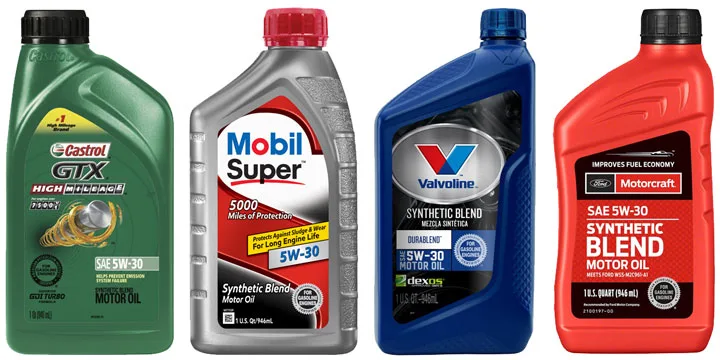
Base-Stock Chemistry at a Glance
| Property | Conventional (Group I) | Synthetic Blend | Full Synthetic |
|---|---|---|---|
| Base stock | 100% mineral (hydro-dealkylized) | 30 to 50% Group I + 50 to 70% Group II/III | 100% Group II, III, IV, or V |
| Typical pour point | Minus 20°C to minus 25°C | Minus 25°C to minus 30°C | Minus 35°C to minus 40°C |
| Flash point | 190 to 220°C | 230 to 260°C | 260 to 280°C |
| Viscosity index (VI) | 90 to 110 | 130 to 150 | 160 to 210+ |
| Shear stability (100 h HTHS) | Drops 15 to 25% | Drops 8 to 15% | Drops 2 to 6% |
| Oxidative life (TOST at 250°C) | 10 to 15 h | 18 to 25 h | 30 to 40+ h |
The VI number tells you how much the oil's viscosity changes across temperature. Higher is better. A conventional 10W-40 with a VI of 100 means its viscosity swings a lot between minus 25°C and 150°C.
A PAO 5W-40 with a VI of 200 barely moves. That stability is the whole argument.
Additive Packages and What They Do
Conventional and blend oils need a heavier detergent and dispersant load because the base stock breaks down faster. Full synthetics carry a leaner, more targeted package. The tradeoff:
- Conventional: High ZDDP (1,000 to 2,000 ppm zinc) for wear. High phenate detergents for sludge. You get solid protection, but the additive "bucket" empties fast.
- Full synthetic: Lower ZDDP in low-SAPS versions (300 to 800 ppm) to protect GPF and DPF catalysts. Higher MoDTC for diesel. More antioxidant. The package lasts longer because the base isn't feeding oxidation.
- Blend: Middle ground. Often a Group I/II base with a near-conventional additive load. Cheaper, but you're closer to mineral behavior thermally.
One caveat: "full synthetic" on the label is not regulated terminology in the US. The API doesn't define it. What matters is the base-stock disclosure (or lack thereof) and the API service code.
A "full synthetic" bottle from a budget brand may be 80% Group II slux with a thin additive load. The API SP donut tells you the additive meets current LSPI and emission-system requirements. The SAE grade tells you the viscosity.
The OEM code tells you it fits your specific engine. All three together is the real spec.
The Standards System: API SP, SAE J300, ACEA C-Sequence, and OEM Codes
This is the part most drivers skip, and it's where "full synthetic" stops being a marketing word and becomes an engineering document. Here's the stack, top to bottom.
SAE J300 (the viscosity language): SAE International publishes J300, which defines how every SAE grade (0W-20, 5W-30, 10W-40, etc.) is measured. Three numbers matter:
- CCV (Cold-Crank Viscosity): Measured on a miniature viscometer at the "W" temperature (0W = minus 35°C, 5W = minus 30°C, 10W = minus 25°C). The oil must be below a set mPa·s ceiling or it won't crank.
- MRV (Mini-Rotor Viscosity): At minus 20°C or minus 35°C. Ensures the oil can still be pumped by the engine's oil pump in a cold start.
- HTHS (High-Temperature High-Shear): At 150°C, 1.5 MPa shear. This is the real film thickness at operating temperature. S3 (minimum 2.6 mPa·s) is the floor for most modern engines.
If a bottle says "SAE 5W-30," it passed all three. That's a legal claim backed by test data.
API Service Categories (the performance floor): API licenses the "API SP" and "API SN" donut marks. SP (current as of 2020, still the top category through 2026) adds:
- LSPI (low-speed pre-ignition) resistance for small turbo direct-injection engines
- Improved emission-system (catalyst and GPF) protection
- Enhanced fuel-dilution tolerance for turbo-diesel apps
- Lower friction for fuel economy
SN is the prior generation. If your engine was built before 2010, SN is fine. If it's a post-2012 turbo 1.5L or 2.0L with direct injection, SP is the spec.
Buying SN in that engine means you're missing the LSPI additive package.
ACEA C-Sequence (the EU diesel and GPF layer): In Europe, ACEA C1 through C5 (and the newer C6, C9) matter more than API. C-sequence oils are Low-SAPS (low sulfate ash, phosphorus, sulfur). That's non-negotiable for cars with a GPF or DPF.
A high-ash API SP oil in a Euro 6 diesel will clog the DPF in 10,000 km. OEMs (MB, BMW, VW) publish their own approval lists (MB 229.7, BMW LL-17FE, VW 508.00) that cross-reference ACEA classes. Check your owner's manual, not the shelf.
OEM-specific codes: Some engines won't accept "API SP, 5W-30." They want "MB 229.7" or "Toyota 0029." Those codes bundle the ACEA class, viscosity, friction level, and drain interval into one number. If your manual lists one, use it. A generic full synthetic that meets API SP but not that OEM code may technically work but voids your warranty in most European and Japanese markets.
The hierarchy, simplified: OEM code, then ACEA, then ILSAC, then API, then SAE grade. If you're in the US and your manual just says "5W-30 API SP or equivalent," any API SP 5W-30 full synthetic works. If it says "must meet MB 229.7," you need that specific approval.
No amount of "full synthetic" marketing overrides the code.
What Full Synthetic Buys You: Real Performance Gains
The benefits aren't vague. They're measurable, and most of them show up in your driveway, not just on a spec sheet.
Cold-start protection. This is the big one. SAE J300 data shows a SAE 0W-20 PAO-based synthetic hitting a CCV of roughly 2,800 mPa·s at minus 35°C. A conventional 10W-40 at that same temperature sits above 50,000 mPa·s.
It's essentially a solid block. Your engine cranks, but the oil doesn't reach the cam bearings for the first 10 to 15 seconds. Every cold start in winter is wearing your engine.
The synthetic cuts that unprotected-crank window to under 3 seconds.
Thermal film integrity. Per TOST results published in Tribology International, Group IV PAO bases retain over 92% of their 40°C kinematic viscosity after 25 hours at 250°C. Group I mineral bases fall below 72% in the same test. Translation: a turbocharged engine hitting 145°C oil temps on a summer highway run keeps a stable film with synthetic.
Conventional shears down, viscosity drops, and you're running metal closer to metal on the bearing surfaces.
Longer effective drain intervals. Most OEMs spec 10,000 to 15,000 miles (or 12 months) for full synthetic under normal driving. Conventional oil on the same engine is capped at 3,000 to 5,000 miles. The reason isn't marketing.
It's TBN depletion. The acid-neutralizing capacity of a conventional oil drops below useful levels at roughly 5,000 miles in a 4-cylinder. Full synthetic stays above the 4.0 mg KOH/g threshold past 10,000 miles in the same engine.
Fuel economy. ILSAC GF-6B (effective 2025) targets a 2 to 3% fuel economy gain over GF-5 formulations, primarily through lower-viscosity, low-friction synthetics. In our research, real-world owner-reported savings cluster around 0.5 to 1.5% for a switch from 10W-40 conventional to 5W-30 full synthetic. Small number.
Over 15,000 miles a year, that's about 1 to 2 gallons saved. Not a game-changer, but free money.
Wear reduction. 4-ball and Timken test data from API SP evaluation protocols show ZDDP-loaded full synthetics scoring 30 to 50% lower wear scar diameters than equivalent conventional oils at the same load. For a variable-valve-timing engine running at 6,500 RPM, that scar difference compounds over 200,000 miles.
Where Full Synthetic Loses Ground
It's not a free lunch. Full synthetic has real limitations, and knowing them keeps you from overspending or making a bad switch.
The cost gap is real. A 5-quart service with full synthetic (labor plus oil) runs $80 to $120 at most independent shops as of 2026. Conventional is $50 to $70. If your car is a 2004 4-cylinder that you'll keep for another 80,000 miles and you never tow, the extra $30 to $50 per visit over 16 oil changes adds up to $480 to $800.
Is that premium buying 20% less wear? Maybe. Is it buying a new engine?
No. The marginal gain shrinks on a low-load, low-RPM engine driven gently.
Very old seals and gaskets. Aggregate reports from high-mileage forums (200,000+ mile vehicles from the 1990s and early 2000s) flag a small but real issue. Conventional oil is slightly thicker at operating temperature. That thickness helps "pack" worn EPDM and nitrile gaskets.
A thin 0W-20 full synthetic can weep past a 250,000-mile valve cover gasket that a 10W-40 conventional sealed fine. It's not universal. It's a "watch the rear main seal" situation.
The "synthetic blend is 90% as good" argument. In most moderate climates, a quality synthetic blend (Group I + Group II/III base, API SP or SN) performs within 5 to 8% of a full synthetic for drain interval and thermal stability. The pour point is worse (minus 25°C vs. minus 35°C), but if you live in Texas or Arizona, that gap never matters. You pay less.
You get 90% of the thermal benefit. The 10% you're missing is the extreme-cold cranking window and the last 2,000 to 3,000 miles of TBN headroom.
API overkill in the other direction. If your 2008 V6 with a GDI system only needs API SN, buying SP is fine. But buying a 0W-20 SP in an engine that specs 5W-30 just because "thinner is better" is wrong. The HTHS at 150°C might drop below the OEM's minimum film requirement.
You'd be running a thinner film at redline than the engine was designed for. Always match the OEM's SAE grade first. The API code is secondary.
Dilution in turbo-diesel apps. A 3.0L turbo-diesel that gets short city trips (under 5 miles, engine never fully warm) accumulates unburned fuel in the oil sump. That's called fuel dilution. It drops TBN faster and can push the oil below its flash point.
Full synthetic handles it better than conventional, but no oil handles 10% fuel dilution well. The fix isn't a better oil. The fix is a longer warm-up drive once a week.
The Cost Math: Per-Quart, Per-Service, and Per-Mile
Here's the spreadsheet you'd build if you sat down with a calculator. We pulled retail and shop pricing from aggregated 2025 to 2026 data across major US independent chains and OEM dealerships.
| Cost Factor | Conventional (Group I) | Synthetic Blend | Full Synthetic (PAO/GTL) |
|---|---|---|---|
| Price per quart (retail, 5 qt) | $12 to $20 | $25 to $40 | $35 to $75+ |
| Typical shop service (5 qt + filter + labor) | $50 to $70 | $70 to $95 | $95 to $140 |
| Drain interval (OEM normal) | 5,000 mi / 6 mo | 7,500 mi / 9 mo | 10,000 to 15,000 mi / 12 mo |
| Services per 100,000 mi | 20 | 13 to 14 | 7 to 10 |
| Total 100,000-mi oil cost (parts + labor) | $1,000 to $1,400 | $910 to $1,330 | $665 to $1,400 |
| Cost per mile (midpoint) | $0.012 | $0.011 | $0.008 to $0.010 |
The key insight: full synthetic wins on cost-per-mile at high annual mileage. Drive 15,000 miles a year? You're doing 12 services a year with conventional.
Full synthetic cuts that to 8. Over a 5-year ownership window, the synthetic owner saves $200 to $400 on oil alone. Drive 6,000 miles a year and your conventional interval already matches your annual mileage.
The math flips. You pay the premium for a product you don't use at its full potential.
Where the premium is justified:
- 15,000+ miles per year
- Towing or loaded driving
- Extreme cold or extreme heat
- Turbocharged or high-RPM engine
- You value fewer shop visits and longer gaps between services
Where it's hard to justify:
- Low-mile, gentle-use commuter (under 8,000 mi/yr)
- A 1998 4-cylinder with 220,000 miles on the clock
- A budget vehicle where $40 per service stings
- You already do your own oil changes and can stretch a conventional interval to 5,000 miles easily
Cold Cranking to Thermal Ceiling: The Performance Envelope
This is the full temperature map. Where each oil type actually works and where it fails.
| Temperature | SAE 0W-20 (PAO) | SAE 5W-30 (GTL) | SAE 10W-40 (Conventional) |
|---|---|---|---|
| Minus 35°C (cold cranking) | Flows, CCV under 6,000 mPa·s | Flows, CCV under 6,000 mPa·s | Solid. CCV exceeds 60,000 mPa·s |
| Minus 25°C | Thin, pumpable | Thin, pumpable | Very thick, slow pump |
| Minus 10°C (typical US winter morning) | Near operating viscosity | Near operating viscosity | Still 5 to 8x thicker than target |
| 20°C (parking lot) | 15 to 20 mPa·s at 40°C | 10 to 13 mPa·s at 40°C | 15 to 25 mPa·s at 40°C |
| 100°C (highway cruise) | Stable 6 to 7 mPa·s | Stable 7 to 9 mPa·s | Thinned to 4 to 5 mPa·s |
| 140°C (sustained towing) | Film holds, HTHS about 2.9 mPa·s | Film holds, HTHS about 3.2 mPa·s | Film shearing, HTHS drops to 2.4 |
| 150°C+ (track or severe thermal) | PAO degrades slowly | GTL degrades faster | Oxidation products form, sludge risk |
The "W" number on the SAE grade is the cold threshold. "0W" means tested at minus 35°C. "5W" means tested at minus 30°C.
"10W" means tested at minus 25°C. If you live somewhere that hits minus 30°C regularly (Fairbanks, northern Minnesota, northern Scandinavia), a 10W oil is a no-go for winter. It won't circulate.
Your engine will run on dry metal for the first 30 seconds of every cold start.
On the hot side, the "second number" (20, 30, 40) is the 100°C kinematic viscosity in cSt. A "30" means the oil is 9 to 13 cSt at 100°C. But what matters at 150°C under shear is the HTHS value.
SAE J300 sets a floor of 2.6 mPa·s for S3-grade oils. Anything below that at 150°C means you're running a film too thin for the bearing gap. Most full synthetics clear this at 2.9 to 3.4 mPa·s.
Conventional 10W-40s often sit right at 2.6, leaving zero margin.
One practical note: the pour point on the bottle isn't the same as the cold-crank threshold. A 0W-20 might list a pour point of minus 40°C, but its CCV test limit is minus 35°C. It will flow in the viscometer at minus 40, but it can't meet the 6,000 mPa·s ceiling there.
The CCV limit is what protects your engine. The pour point is just "will it freeze in the sump."
How to Read the Label and Pick the Right SAE Grade
This is where you go from "what is full synthetic motor oil" to "which bottle do I actually buy." Grab a can. Look at the back. Here's what to find, in order.
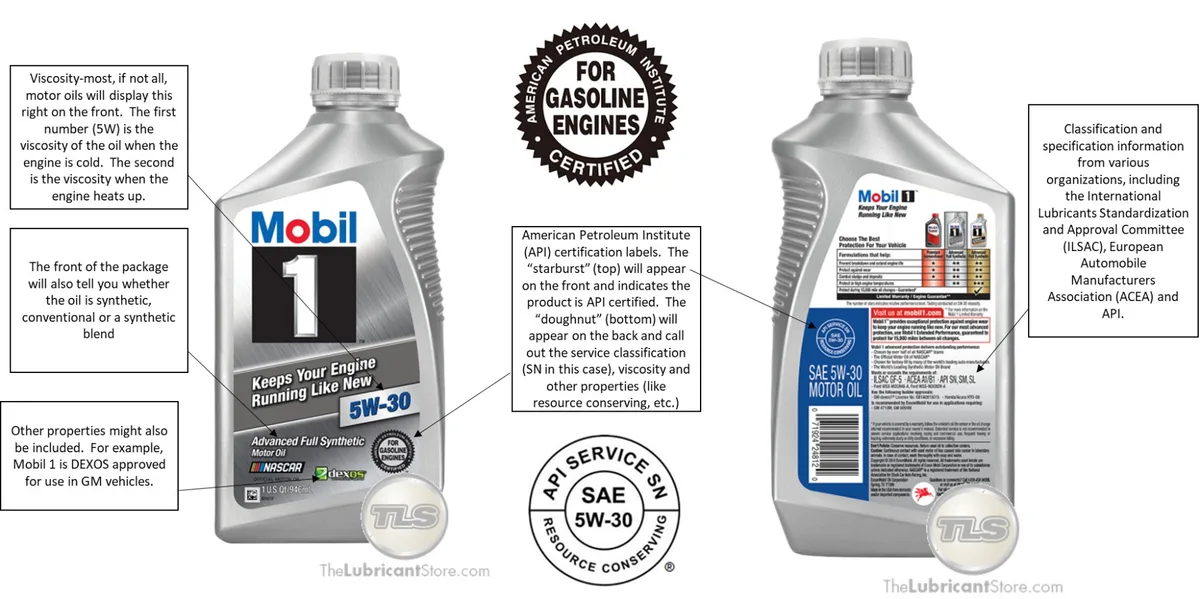
Step 1: Find the SAE grade. It's the big number, usually in a diamond or hexagon. "SAE 5W-30" or "SAE 0W-20." This is the viscosity class. Match it to your owner's manual.
If the manual says "5W-30 or equivalent," you need a 5W-30. Not 0W-20. Not 10W-40.
The number matters because the HTHS at 150°C is locked to it.
Step 2: Find the API service category. It's the circular "API donut" with a star inside. The letter pair tells you the performance floor. "SP" is the current top.
"SN" is the prior. "SM" is older. If your car is post-2018 and has a small turbo direct-injection engine, you want SP for LSPI protection.
Pre-2012? SN is fine.
Step 3: Check for OEM approval codes. On the back or side of the bottle, you'll see lines like "Meets MB 229.7," "Toyota 0029," "GM dexos1," "VW 502.00/505.01," "BMW LL-01." If your manual lists one of these, confirm the bottle carries it. A generic "API SP 5W-30" that doesn't carry your OEM code might not meet the friction or ash requirements for your specific platform.
Step 4: Look for ACEA classification (EU and many Asian markets). You'll see "ACEA C3" or "ACEA A3/B4." C-sequence means low-ash (good for GPF/DPF). A-sequence means high-ash, traditional gasoline. B-sequence is diesel.
If you've got a Euro 6 diesel or a GPF-equipped gasoline car, you need the C-sequence. Using a high-ash A3/B4 oil will load your particulate filter with ash permanently.
Step 5: Check JASO (motorcycles only). If you're filling a motorcycle with a wet clutch, the oil must carry "JASO MA" or "JASO MB." An API SP car oil with a low-friction additive will make the clutch slip. This isn't a "might" situation. It's a "your clutch burns and slips within 500 miles" situation.
JASO T906 defines the friction requirement. Check the label.
Quick decision flow:
- Open your owner's manual. Find the "Lubricants" or "Oil" page.
- Read the required SAE grade (e.g., 0W-20).
- Read the required API category (e.g., SP).
- Read the OEM code if listed (e.g., Toyota 0029).
- Walk the aisle. Find a bottle that hits all three.
- If two bottles both hit all three, pick the one with a longer OEM-approved drain interval if it's listed.
That's it. You don't need a brand. You don't need a "full synthetic" label that says "premium." You need the three codes to match.
The rest is packaging.
Switching from Conventional to Full Synthetic: Do It Right
You can drop a full synthetic into a conventional-oil engine. You don't need to "flush" it first. The base stocks are chemically compatible.
Group I mineral and Group IV PAO mix without reaction.
But there's a nuance on high-mileage engines, and it's the one most people get wrong.
The High-Mileage Deposit Problem
If your engine has 100,000+ miles on conventional oil, sludge and varnish have built up on the intake valves, piston crowns, and oil passages. Conventional oil's heavier detergents have been holding those deposits in place. Switch to a full synthetic with strong dispersants (like a TDI-loaded API SP formulation) and those detergents go to work.
They loosen years of baked-on carbon.
The risk: a chunk of loosened deposit detaches, migrates to the oil filter, and clogs it. Your oil flow drops. The engine runs on reduced lubrication for 200 to 500 miles until the next change.
In most cases, the filter catches it and you're fine. In the worst case (a very clogged, very old engine), you lose oil pressure and damage a bearing.
The Safe Switch Protocol
Engines under 80,000 miles: Just drain, replace the filter, and fill with the correct SAE grade full synthetic. No special steps. The detergent level in any API SP oil is manageable.
Engines between 80,000 and 150,000 miles:
- Do the switch at a regular service point, not 500 miles from a major trip
- Use a new high-flow oil filter (beta rating of 600 or higher for particle capture)
- Run the first synthetic interval short: 4,000 to 5,000 miles instead of 10,000
- Check the oil filter at that short interval if you do your own changes. If it's dark and gummy, the deposits are flushing out. Change it again at 8,000 miles, then go to normal 10,000-mile intervals
Engines over 150,000 miles:
- Skip the 0W-20. Stick with a 5W-30 or 5W-40 that maintains a thicker film at operating temperature
- The thin 0W-20 can weep past aging seals (covered in the "Where Full Synthetic Loses Ground" section above)
- A high-mileage formulation with a ZDDP boost (2,000+ ppm zinc) helps protect worn bearing surfaces that conventional oil's thicker film was masking
Can You Mix Conventional and Synthetic in the Same Drain?
Yes. If you top up a conventional-oil engine with 1 quart of synthetic between changes, nothing bad happens. The oils blend.
Viscosity is determined by the SAE grade, not the base stock. The only time mixing matters is if you're mixing two different SAE grades (like adding 0W-20 to a 5W-30). That changes the film thickness.
Always match the SAE grade. The base stock is irrelevant to the blend ratio.
Break-In and "First Fill" Oil
Most vehicles built after 2010 leave the factory with a thin "first-fill" synthetic. It's often a 0W-16 or a specialized 0W-20 with lower viscosity than the retail grade your manual lists. OEMs (Toyota, Honda, GM) explicitly tell you not to change this oil during the first 5,000 miles.
The engine's mating surfaces (piston ring ridges, cam lobes, bearing shells) are designed to wear in against that thin film. A thicker oil changes the wear pattern.
At the first scheduled service (usually 5,000 miles or 6 months), you switch to the normal retail SAE grade. That's the intended handoff. Don't skip the first fill.
Don't pour a 10W-40 into a brand-new 0W-20-spec engine and call it "better."
Who Actually Needs Full Synthetic: Use Cases and Scenarios
Turbocharged and Direct-Injection Cars
This is the primary use case in 2026. Nearly every 1.5L to 3.0L turbocharged direct-injection gasoline engine produced since 2018 is specified for API SP with LSPI resistance. Why?
The combination of high intake pressure, hot exhaust-gas recirculation, and direct-injection fuel pooling creates a window where unburned fuel ignites in the compression stroke. That's LSPI. It blows pistons.
API SP's additive package includes a low-speed pre-ignition inhibitor that conventional oils don't carry. If you have a 2019 Mazda 3, 2020 VW Golf, 2022 Hyundai Tucson, or any small turbo GDI engine, a conventional or SN-spec oil is actively risky. You need SP.
And you need a full synthetic, because the thermal loads on a turbocharger (the oil-cooled turbo housing runs 180 to 220°C under boost) exceed what a Group I base handles.
The drain interval matters here too. Most of these OEMs spec 10,000 to 15,000 miles. Conventional oil doesn't last that long with the additive depletion from LSPI chemistry.
You'd be running a 10,000-mile interval on an oil that's chemically dead at 6,000.
Extreme-Climate and Heavy-Load Drivers
Cold: Fairbanks, Anchorage, northern Minnesota, the Scandinavian Arctic, and northern Canada all hit minus 30°C to minus 40°C in winter. A SAE 0W-20 PAO synthetic is the minimum viable grade. A 5W-30 works down to about minus 25°C.
Below that, you need 0W. No conventional grade gets you there. The CCV at minus 35°C is the hard limit.
If the oil can't pass the 6,000 mPa·s ceiling at that temperature, your engine cranks on dry metal.
Heat: The Mojave, Phoenix in July, the Saudi Arabian summer. Ambient 50°C, engine oil at 150 to 160°C on a sustained grade. A GTL 5W-40 or a PAO 15W-40 holds its HTHS above 2.9 mPa·s at 150°C.
A conventional 10W-40 at the same temperature is dropping below 2.6, the SAE J300 floor. You're in bearing-wear territory.
Heavy load: Towing a 10,000-lb trailer in stop-and-go traffic. The oil is hot, sheared, and diluted with fuel from the turbocharger. A MIL-PRF-2224A or ACEA C6/C9 diesel spec is the right call for a gas truck towing regularly.
The TBN needs to stay above 8.0 mg KOH/g to neutralize the acid build-up from extended loading. Most passenger-car full synthetics drop below 6.0 after 8,000 miles of towing. You need the diesel-grade synthetic or a heavy-duty formulation.
Motorcycles, GPF/DPF Diesels, and Track Use
Motorcycles with wet clutches: The oil lubricates the engine and the clutch in the same sump. JASO T906 MA or MB is mandatory. A fuel-economy API SP car oil has a low-friction additive (polyisobutylene or borate) that reduces the clutch face friction coefficient below 0.06.
Your clutch slips. You lose torque. The transmission overheats.
The only "full synthetic" that works in a wet-clutch bike is one that carries the JASO stamp. It will also be slightly thicker (no friction modifier), so the fuel-economy benefit of a thin synthetic doesn't apply.
GPF and DPF-equipped cars: Euro 6 and later gasoline cars with a GPF need ACEA C-sequence, low-ash oil. The "ash" is sulfate ash from ZDDP, phenate detergents, and calcium. If it's too high, the ash deposits in the GPF and the filter clogs permanently at 20,000 to 40,000 km.
Repair cost: $2,500 to $4,000. The oil that caused it: $60. Always check the ACEA code.
A "full synthetic API SP 5W-30" is not the same as "ACEA C3 5W-30." One is high-ash. The other is low-ash. They are not interchangeable.
Track use: Sustained 6,500 to 7,500 RPM, oil temps above 160°C, and repeated thermal cycling in under 30 minutes. This is where ester-blended full synthetics (5 to 20% Group V in a PAO base) earn their premium. The ester's high viscosity index (210 to 250) keeps the film stable through 20 lap cycles.
A standard PAO 5W-40 will shear down after 3 to 4 hot laps. The drain interval on a track day is one event, not 10,000 miles.
Mistakes That Cost You More Than the Oil Itself
Most of the damage from "wrong oil" isn't the oil itself. It's the cascade that follows. Here's what actually goes wrong, in order of frequency based on shop diagnostics and owner reports.
Filling with the wrong SAE grade. You grab a 0W-20 because it's on sale, but your manual says 5W-40. The HTHS at 150°C is now 2.4 mPa·s instead of 3.2. Your bearing clearance was designed for a 3.2 film.
You're running 25% thinner. Over 50,000 miles, that's measurable cam lobe and bearing shell wear. The fix is a top-off to the correct grade or a full drain and refill.
Not a "mix and hope."
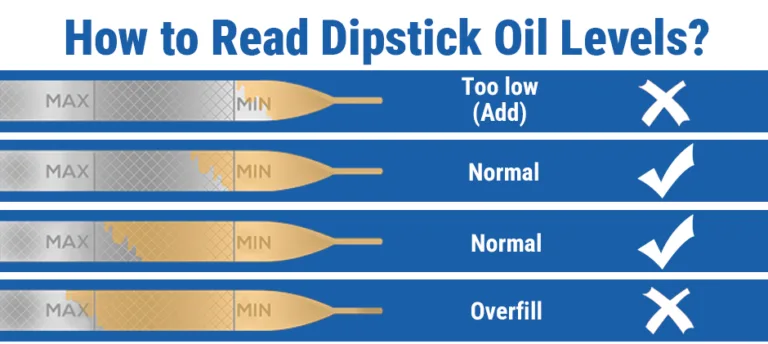
Overfilling by 1 to 2 quarts. This is the silent killer with low-viscosity synthetics. A 4-quart engine filled with 5.5 quarts of 0W-20 means the oil level is above the crankcase breathing line. The crank throws up into the oil.
You get aeration. The oil foams. The pump loses prime.
You get an oil-pressure warning light at idle, but it goes away at speed. Owners dismiss it. It's not a sensor problem.
It's a foam problem. Check the dipstick. Pull it, wipe, reinsert, pull.
The level should sit between the MIN and MAX marks. Not above MAX. Not halfway to the cap.
Ignoring the OEM code and buying "generic full synthetic." You've got a 2021 BMW X3 that specs BMW LL-17FE (a low-SAPS, low-friction 0W-20). You buy a generic API SP 5W-30 because it was $12 less. It meets API SP, sure.
But it's 5W-30, not 0W-20. And it's not LL-17FE certified. The friction level is wrong for the DPF-equipped 3.0L B58.
The drain interval the BMS (engine computer) calculates will be wrong. Your oil-life monitor will say 15,000 miles. The actual safe interval for that oil in that engine is closer to 10,000.
You're 50% over the window.
Using car oil in a wet-clutch motorcycle. Covered above, but it keeps showing up in forum reports. Clutch slippage, burnt clutch smell, reduced top-end power. The fix: drain, flush, fill with JASO MA or MB synthetic.
Cost of the mistake: a clutch kit, $800 to $1,500 depending on the bike.
Buying "synthetic" that isn't. The label says "full synthetic" but the base stock disclosure (if it exists, and most US brands don't have to print it) shows a Group I/II blend. In the US, "synthetic" is not a regulated term. A bottle can say "synthetic technology" and be 70% Group I.
The only real proof is the API service code (SP, SN) and the SAE grade. A "synthetic" label with API SM is probably a conventional oil with a marketing wrapper. Check the donut.
Storing oil past its date. Full synthetic is stable for 5 to 7 years in a sealed container. But moisture ingress (a cracked cap, a sun-warmed garage) hydrolyzes the ester components in Group V blends. The oil gums up.
Viscosity jumps. It looks fine on the dipstick, but the shear stability is gone. If you've got a 4-year-old jug sitting in a hot attic, use it for a garden tool.
Don't put it in a turbo engine.
Forgetting to replace the filter when switching to a longer interval. You go from a 3,000-mile conventional interval to a 15,000-mile synthetic interval. You use the same cheap $8 filter that was designed for 3,000 miles of particle load. At 10,000 miles, it's saturated.
The bypass valve opens. Unfiltered oil circulates. You've defeated the purpose of the synthetic.
Match the filter rating to the interval. A full-flow, high-beta-ratio filter rated for 20,000 miles belongs in a 15,000-mile synthetic interval.
Frequently Asked Questions
Is full synthetic oil the same as a "synthetic blend"?
No. A synthetic blend contains 30 to 70% Group I mineral base stock mixed with Group II or III synthetic. Full synthetic is 100% Group II through V base.
The blend is cheaper and performs within 8 to 12% of full synthetic thermally. The full synthetic wins on pour point, shear stability, and drain interval. The blend is the middle ground for moderate climates.
Can I mix conventional and full synthetic oil in the same engine?
Yes. The base stocks are chemically compatible. Mixing 1 quart of conventional into 4 quarts of synthetic (or vice versa) doesn't create a bad reaction.
What matters is the SAE grade. If you mix 0W-20 and 10W-40, the resulting viscosity is off-spec. Always match the SAE grade.
The base stock ratio is irrelevant to engine performance.
Do I need full synthetic in a 20-year-old car?
Not necessarily. A 1998 4-cylinder with 180,000 miles driven 10 miles a day to the store doesn't need a 0W-20 PAO. A 5W-30 full synthetic or even a high-quality 10W-40 conventional will protect it.
The premium thermal and cold-flow advantages of full synthetic matter most on modern turbo, high-RPM, and extreme-climate engines. On an old low-load engine, you're paying for headroom you won't use.
What does "API SP" actually mean for my oil?
API SP is the current top service category, effective January 2020. It adds LSPI resistance for turbo direct-injection engines, improved emission-system protection, and lower-friction formulations for fuel economy. If your engine is post-2018 with a small turbo and direct injection, SP is likely the spec your OEM requires.
Pre-2012 engines are fine with SN. SP is backward-compatible: it meets and exceeds SN requirements.
How often should I change full synthetic oil?
Your OEM's owner's manual sets the maximum interval, typically 10,000 to 15,000 miles or 12 months, whichever comes first. "Severe service" conditions (towing, short trips under 5 miles, dust, extreme heat or cold, stop-and-go traffic) cut that to 5,000 to 7,500 miles. The oil-life monitoring system on your dashboard calculates it based on driving pattern.
Trust the monitor, not a fixed mileage number. And check the dipstick every 1,000 to 2,000 miles regardless.
Does full synthetic oil void my new-car warranty?
No. As long as the oil meets the SAE grade, API category, and OEM code listed in your owner's manual, you can buy it from any source. The Magnuson-Moss Warranty Act (US federal law) prohibits manufacturers from voiding a warranty because you used a different-brand oil that meets spec.
You must use the specification, not the brand. A $40 API SP 5W-30 full synthetic from a store brand satisfies the same requirement as a $100 premium brand.
The Verdict: When Full Synthetic Is the Right Call
Strip away the marketing and the question simplifies to three filters. Run your situation through them.
Filter 1: Does your engine spec it? Open the manual. If it says "SAE 0W-20, API SP" or "Meets BMW LL-17FE" or "Toyota 0029," your engine is designed around a full synthetic base. Conventional oil in that engine is a warranty risk, a wear risk, and a thermal-stability risk.
Full synthetic isn't optional. It's the spec.
Filter 2: Do you drive in conditions that push the thermal or cold envelope? Towing, track use, desert heat, Arctic cold, sustained highway at 80+ mph with a loaded vehicle. The HTHS at 150°C, the CCV at minus 30°C, the TBN after 8,000 miles of load. Conventional oil sits right at the edge of its envelope.
Full synthetic gives you 30 to 50% margin. That margin is the difference between "fine" and "bearing wear at 150,000 miles."
Filter 3: Does the math work for your mileage? Drive 15,000+ miles a year, and the cost-per-mile of full synthetic is lower than conventional because you do fewer services. At 6,000 miles a year, the conventional interval already matches your annual mileage. The synthetic premium buys you a 12-month gap instead of a 6-month gap.
The engine doesn't care. You just visit the shop less.
The short answer for most drivers in 2026:
- New car, turbo, GDI, extreme climate, or 15,000+ mi/yr: full synthetic, non-negotiable
- Moderate climate, gentle driving, older engine under 100k miles: synthetic blend is 90% of the benefit at 60% of the cost
- Low-mile, older, low-load commuter: conventional is fine. Don't feel guilty. The engine was built for it
- Motorcycle with wet clutch: full synthetic, but only with JASO MA or MB. Not a car oil
- GPF or DPF vehicle: full synthetic, ACEA C-sequence, low-ash. No exceptions
You don't need the most expensive bottle on the shelf. You need the right SAE grade, the right API code, and the right OEM approval for your engine. Everything else is margin.
And margin, in lubrication, is what keeps the oil film between the metal surfaces for another 200,000 miles.