What Motor Oil Is Thicker: Top complete guide
You pick up a 0W-40 and a 5W-30 off the shelf, and you're not sure which one is actually thicker. That's the core question behind what motor oil is thicker, and the answer isn't as simple as picking the bigger number. The SAE grade on the can is two separate measurements, not one thickness score.
That single fact changes everything about how you compare oils.
Per SAE J300, the standard that governs engine-oil viscosity grades as of 2026, a multigrade like 10W-40 gets its left number from a cold-crank test below zero and its right number from a hot-temperature test at 100 °C. Those two numbers measure the oil at completely different temperatures. So which is thicker depends entirely on which temperature you care about.
Let's untangle that.
Quick Answer
The thickest engine oil on the standard ladder is SAE 60 monograde. It sits at 26.0 to 32.5 cSt at 100 °C. SAE 20W-50 is the thickest common multigrade. 0W-20 is the thinnest multigrade you'll find.
Thickness depends on which temperature you measure at.
Thicker in Oil Talk Isn't Just Heavier. Here's What It Actually Means
You've probably seen someone on a forum say, "I just grabbed the thicker oil, SAE 30." They mean it as a simple upgrade. Heavier, stronger, more protective. That's not how viscosity works.
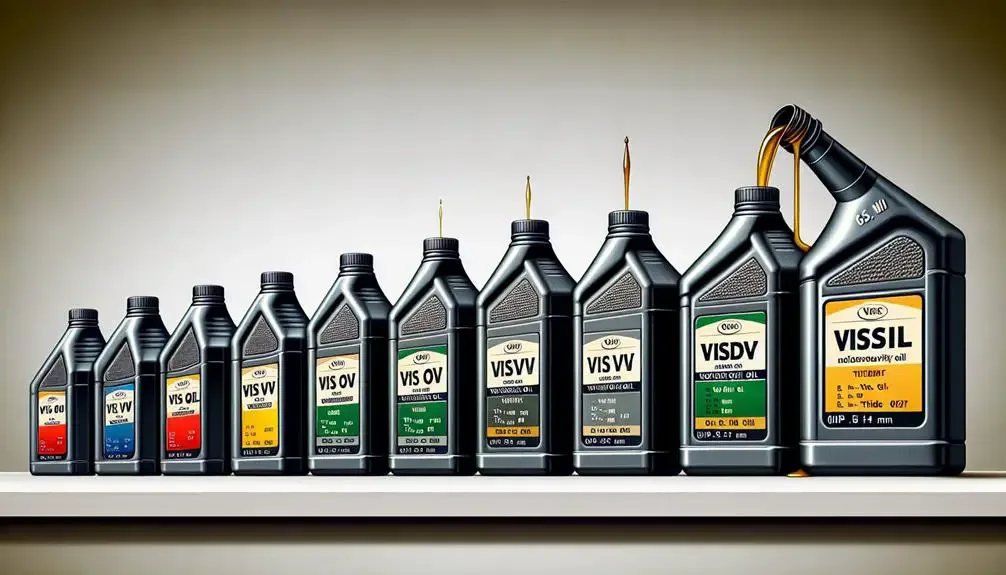
"Thicker" in the oil world means higher viscosity, which is the oil's internal resistance to flow. We measure it two ways. Kinematic viscosity (cSt) tells you how fast the oil drips through a calibrated orifice at a set temperature.
Dynamic viscosity (cP) tells you how much force you need to drag one layer of oil past another. The SAE system on the can reports both, but at two different temperatures.
Here's where it gets counterintuitive. A 0W-40 is thinner than a 5W-30 when it's sitting in a -30 °C parking lot. But at 100 °C, the 0W-40 is thicker.
The W-number and the second number aren't a single scale. They're two separate readings from two separate tests. If you treat the SAE grade as one number, you'll pick the wrong can.
That's the whole problem most drivers walk into when they ask what motor oil is thicker. They're trying to collapse two dimensions into one. You can't.
You have to ask, "thicker at what temperature?" And the answer changes the recommendation.
What "Viscosity" Actually Measures in Plain Terms
Think of it this way. Cold oil in a car engine in January behaves more like syrup. Warm oil at 100 °C behaves more like water.
Viscosity is the number that quantifies that syrup-to-water shift. The SAE J300 standard, maintained by SAE International and available at sae.org, pins down exactly which number means which temperature and which test method.
- Kinematic viscosity (cSt): measured with a capillary tube at 100 °C for the hot rating
- Dynamic viscosity (cP): measured by a Cold-Crank Simulator at a cold temperature for the W rating
- Viscosity Index (VI): a dimensionless number from 0 to 220 that tells you how stable the oil stays across the temperature range
A high VI (say 160) means the oil doesn't change thickness much between cold and hot. A low VI (say 95) means it gets dramatically thicker when cold and dramatically thinner when hot. Two oils with the same SAE grade but different VIs will feel different on the shelf.
How SAE Viscosity Grades Encode Thickness. W-Number Plus Operating Number
The SAE grade on every can is a compact data structure. It packs two test results into four or five characters. Understanding that encoding is the key to answering "which is thicker?" correctly.
The Left Side. What the W Number Means
The "W" stands for Winter. It's not a weight. It's not a weakness rating.
It's a cold-temperature performance band. The SAE J300 table assigns each W-number a specific test temperature and a maximum CCS (Cold Crank Simulator) viscosity in centipoise.
| W-Number | Test Temperature | Max CCS (cP) |
|---|---|---|
| 0W | -35 °C | 6,200 |
| 5W | -30 °C | 6,600 |
| 10W | -25 °C | 7,000 |
| 15W | -20 °C | 7,000 |
| 20W | -15 °C | 9,500 |
| 25W | -10 °C | 12,000 |
A lower W-number means the oil still flows at a colder temperature. 0W-20 will crank in a -35 °C morning when a 15W-40 has turned into a lump of wax. The W-number is your cold-start protection rating.
The Right Side. What the Operating Number Means
The second number (20, 30, 40, 50, 60) is the kinematic viscosity in centistokes at 100 °C. This is the hot thickness. It's the film you actually get between bearings and crankshaft journals when the engine is at full operating temperature.
| SAE Grade | Kinematic Viscosity at 100 °C (cSt) |
|---|---|
| SAE 0W-20 | 8.6 to 11.8 |
| SAE 5W-30 | 11.8 to 14.6 |
| SAE 10W-40 | 14.6 to 17.4 |
| SAE 20W-50 | 17.4 to 20.9 |
| SAE 60 (mono) | 26.0 to 32.5 |
These are ranges, not single numbers. Your specific bottle will land somewhere inside the band. The manufacturer's Technical Data Sheet (TDS) gives you the exact measured value.
If two 10W-40 oils from different brands both report 15.8 cSt, they're functionally identical at 100 °C. If one reports 14.7 and the other 17.2, the second one is measurably thicker at operating temperature.
Why the Two Halves Measure Different Temperatures
This is the part that trips people up. The W-number is a cold test. The second number is a hot test.
They're not on the same thermometer. So a 0W-40 and a 5W-30 aren't compared on a single scale.
At -30 °C, the 0W-40 flows freely (CCS well under 6,200 cP). The 5W-30 is near its CCS limit. At 100 °C, the 0W-40 is in the 14.6 to 17.4 cSt band.
The 5W-30 is in the 11.8 to 14.6 cSt band. The 0W-40 is thicker.
Same two oils. Opposite "thicker" answers depending on which end of the temperature range you're asking about. That's the whole game.
The Full Ladder. SAE 0W-20 Through SAE 60, Thinnest to Thickest
Now let's lay out every SAE J300 engine-oil grade from thinnest to thickest, ordered by 100 °C kinematic viscosity. This is the master reference for "what motor oil is thicker?" when you're standing in front of the shelf.
| SAE Grade | Type | cSt at 100 °C (range) | Notes |
|---|---|---|---|
| 0W-20 | Multigrade | 8.6 to 11.8 | Thinnest common multigrade. Many modern turbo engines specify this. |
| 5W-30 | Multigrade | 11.8 to 14.6 | Most common all-weather grade for moderate climates. |
| 10W-30 | Multigrade | 11.8 to 14.6 | Same hot band as 5W-30, but thicker in cold. |
| 5W-40 | Multigrade | 14.6 to 17.4 | Same cold as 5W-30, thicker at 100 °C. |
| 10W-40 | Multigrade | 14.6 to 17.4 | Slightly thicker cold than 5W-40. Same hot band. |
| 15W-40 | Multigrade | 14.6 to 17.4 | Thicker cold. Same hot band as 10W-40. |
| 20W-50 | Multigrade | 17.4 to 20.9 | Thickest common multigrade. Hot climate and high-load use. |
| SAE 30 | Monograde | 9.3 to 12.6 | No cold rating. Classic carburetor-era oil. |
| SAE 40 | Monograde | 14.1 to 17.3 | No cold rating. Hot-climate or older large-displacement engines. |
| SAE 50 | Monograde | 19.5 to 25.6 | No cold rating. Very hot climates, racing. |
| SAE 60 | Monograde | 26.0 to 32.5 | Thickest standard engine oil. Drag racing, extreme heat. |
A few things to notice from this table. First, the monograde SAE 60 is the thickest engine oil you'll find under SAE J300. Nothing standard goes above it for engines.
Second, SAE 10W-30 and SAE 5W-30 share the same 100 °C band (11.8 to 14.6 cSt). The only difference is cold behavior. The 5W version flows better in a -30 °C morning.
Where Monograde Grades Slot In
Monograde oils (SAE 30, 40, 50, 60) only get one viscosity number because they're only tested at 100 °C. They have no W-rating. That means they're not designed for cold starts.
SAE 30 at -10 °C is essentially a solid. SAE 60 at +10 °C is barely pourable. These grades live in hot-climate garage environments, classic cars, and racing applications where the engine is always warm or the ambient never drops below 50 °F.
The SAE 0W-20 Floor
At the other end, SAE 0W-20 is the thinnest multigrade in wide commercial availability. Its 100 °C band starts at 8.6 cSt. That's a very thin film.
It works beautifully in tight-clearance modern engines (BMW, Mercedes, Toyota hybrid platforms) because the bearings and oil galleries are designed for low-viscosity oil. But in a wide-clearance 1970s V8, that same 0W-20 won't build enough film pressure at 3,000 RPM and 120 °C oil temperature. Thinnest isn't always right.
Monograde vs Multigrade. Why SAE 30 and 10W-40 Aren't the Same Thickness
Here's a question that comes up constantly: "My old car took SAE 30. Can I just run 10W-40 instead?" The answer is yes, and it's actually better. But the reason is more specific than "10W-40 is thicker."
SAE 30 is a monograde. It's only certified to perform at 100 °C. Its kinematic viscosity band is 9.3 to 12.6 cSt.
That's roughly equivalent to a 0W-20 or 5W-20 at operating temperature. Now look at 10W-40. Its 100 °C band is 14.6 to 17.4 cSt.
That's roughly equivalent to SAE 40 monograde.
So SAE 30 is actually thinner at 100 °C than 10W-40. The "40" in 10W-40 refers to the 100 °C measurement, and it sits in the SAE 40 monograde band. But the "10W" front end means it still flows at -25 °C, something SAE 30 cannot do.
What the Viscosity Index Changes
This is where base stock matters. A conventional (Group I or II) 10W-40 has a VI around 100. A full synthetic (Group IV PAO or Group III hydrocracked) 10W-40 has a VI around 155 to 175.
What does that mean in practice?
At -25 °C, the conventional 10W-40 is already thick and sluggish. It's near the CCS limit for the 10W rating. The synthetic 10W-40, with its higher VI, is still thin and flowing well below that limit.
It only starts to thicken up gradually as the temperature rises.
At 100 °C, both oils are in the same 14.6 to 17.4 cSt band. Same thickness. The VI difference only shows up across the transition zone (about 40 °C to 90 °C).
The synthetic stays closer to its rated viscosity across the full range. The conventional thins out faster as the engine heats up.
A Practical Side-by-Side
| Property | SAE 30 Mono | 10W-40 Conventional | 10W-40 Full Synthetic |
|---|---|---|---|
| cSt at 100 °C | 9.3 to 12.6 | 14.6 to 17.4 | 14.6 to 17.4 |
| VI | 95 to 105 | 95 to 110 | 150 to 175 |
| Pour point | around -20 °C (varies) | around -20 °C | around -40 °C |
| Cold-crank at -25 °C | Solid. No flow | Flowing, but near limit | Thin, easy flow |
| Best use | Hot-climate classic cars | Moderate climate, budget fleet | All-weather, modern engines |
The takeaway: SAE 30 is thinner at 100 °C than 10W-40. But 10W-40 is far more pourable in the cold. If your climate dips below 30 °F in winter, SAE 30 is the wrong can.
You need the multigrade W-rating to survive cold starts.
SAE 90, 140, 250 Gear Oils. A Completely Different Thickness Scale
This is where most people get genuinely lost. They see "SAE 90" on a gear-oil can and assume it's just bigger than SAE 60 engine oil. It's not.
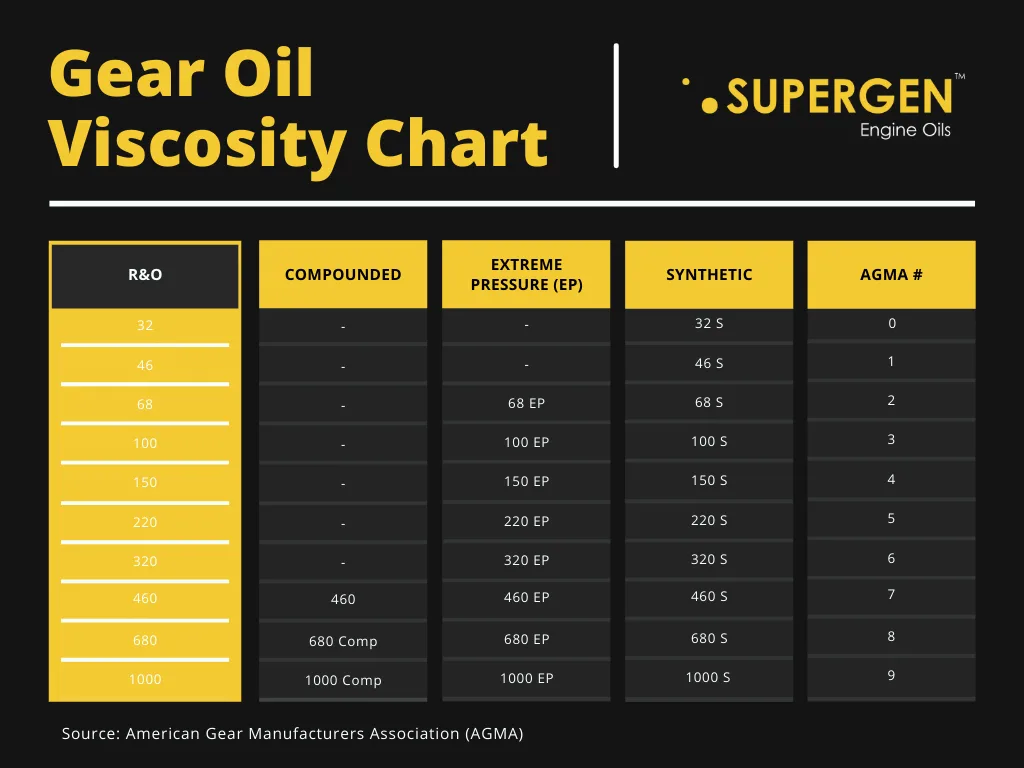
SAE 90 gear oil is governed by a completely different standard, SAE J903, and it's far thicker than anything in the engine-oil family.
The SAE J903 Scale
Gear oils are rated by a single kinematic viscosity at 100 °C (and sometimes a second reading at 20 °C for the W cold rating). The bands are:
| SAE J903 Grade | cSt at 100 °C | Equivalent Engine-Oil Feel |
|---|---|---|
| 75W-90 | 13.5 to 18.3 | Thicker than SAE 40 engine oil |
| 80W-90 | 13.5 to 18.3 | Same hot band, slightly worse cold |
| 85W-140 | 18.3 to 23.4 | Between SAE 50 and SAE 60 engine oil |
| 90W-140 | 18.3 to 23.4 | Same hot band as 85W-140 |
| 85W-250 | 23.4 to 30.6 | Far thicker than SAE 60 engine oil |
| 90W-250 | 23.4 to 30.6 | Same hot band as 85W-250 |
| 75W-110 | 18.3 to 23.4 | SAE 140 equivalent |
Notice the numbers. SAE 90 gear oil sits at 13.5 to 18.3 cSt at 100 °C. That's in the same band as a 10W-40 engine oil.
SAE 140 gear oil is 18.3 to 23.4 cSt, which puts it above SAE 50 engine oil. SAE 250 gear oil is 23.4 to 30.6 cSt, which is beyond SAE 60.
Why the Scales Don't Cross
You can't pour SAE 90 gear oil into an engine. The additive package is different. Gear oils use EP (extreme pressure) sulfur-phosphorus anti-wear additives.
Engine oils use zinc dialkyldithiophosphate (ZDDP) and friction modifiers tuned for high-RPM, low-load-bearing contact. The base viscosity might match, but the chemistry is wrong for the application.
Likewise, you can't dump SAE 30 engine oil into a rear differential rated for SAE 90. The film will be too thin at operating temperature. Gear teeth slide and roll against each other at much higher contact pressure than engine bearings.
They need a thicker film.
The "SAE 90" Misnomer Trap
Here's the specific confusion that plagues forum threads. Someone reads "SAE 90" and thinks, "That's just a really thick SAE 90 motor oil." There is no SAE 90 motor oil. The SAE J300 engine-oil ladder tops out at SAE 60.
The "90" in SAE 90 gear oil is a J903 number, not a J300 number. It's a completely different classification system with different test methods and different additive requirements.
When someone asks "is SAE 90 gear oil thicker than SAE 60 engine oil?" the answer is no, not at 100 °C. SAE 90 gear oil (13.5 to 18.3 cSt) is actually thinner than SAE 60 engine oil (26.0 to 32.5 cSt). But SAE 250 gear oil (23.4 to 30.6 cSt) is in the same ballpark as SAE 60, and SAE 250 with a high VI can exceed it.
The number "90" doesn't mean "90 times thicker" or "thinner than 60." It's just a band label on a different scale.
Where Gear Oils Actually Live
- Rear-axle differentials (most passenger cars): SAE 75W-90 or 80W-90
- Limited-slip differentials: SAE 75W-90 with an LS-specific additive
- Heavy-duty and commercial truck axles: SAE 85W-140 or 85W-250
- Manual transmissions (some): SAE 75W-90 or SAE 85W-90
- Hypoid gears in tractors and construction: SAE 90W-140 or 85W-140
The pattern: the heavier and hotter the gear load, the higher the SAE J903 number. A small car's diff runs 90. A 40-ton dump truck's final drive runs 250.
One More Comparison That Stings
If you've ever read a mechanic say, "Just use SAE 90 in the rear end," they mean SAE 90 gear oil, not SAE 90 engine oil (which doesn't exist). The J903 and J300 systems share the "SAE" prefix, which makes them look like one continuous scale. They're not.
Two different standards, two different test rigs, two different additive packages. Always check which standard the number refers to before you reach for the can.
Head-to-Head Matchups. 5W-30 vs 10W-40, 0W-40 vs 5W-40, 15W-40 vs 20W-50
Now that you've got the ladder and the gear-oil scale sorted, let's run the comparisons people actually ask about. These are the pairs you see in forum threads and at the auto-parts counter. The key principle: "thicker" has two answers, one for cold, one for hot.
You have to know which one matters for your situation.
Is 10W-40 Thicker Than 5W-30?
Yes, at both temperatures. The 10W front end means it's thicker at -25 °C than the 5W-30 at -30 °C. The 40 end means it's thicker at 100 °C than the 30 end.
There's no flip. 10W-40 wins on thickness in every scenario. If you're in a moderate climate and your OEM allows either, 10W-40 gives you a slightly thicker hot film. That helps in a high-RPM or towing application.
It costs you a little cold-start ease compared to 5W-30.
Is 0W-40 Thicker Than 5W-30?
It depends on which temperature you're asking about. At 100 °C, the 0W-40 sits in the 14.6 to 17.4 cSt band while the 5W-30 sits in 11.8 to 14.6 cSt. So yes, 0W-40 is thicker at operating temperature.
But at -30 °C, the 0W-40 has a CCS well under 6,200 cP while the 5W-30 is near its 6,600 cP limit. The 0W-40 is thinner in the cold. This is the exact trap we'll unpack in the next section.
Is 5W-40 Thicker Than 0W-40?
At 100 °C, no. They share the same 14.6 to 17.4 cSt band. They're essentially the same thickness at operating temperature.
The difference lives entirely in the cold. The 0W-40 flows at -35 °C. The 5W-40 flows at -30 °C.
In a Minnesota January, that's the difference between a reliable start and a cranking battery that barely turns the engine over.
Is 20W-50 Thicker Than 15W-40?
Yes, across the board. The 20W is thicker at -15 °C than the 15W at -20 °C. The 50 end (17.4 to 20.9 cSt) is thicker than the 40 end (14.6 to 17.4 cSt). 20W-50 is the heavier choice.
It's what you reach for when ambient temperatures stay above 85 °F and your engine sees sustained heavy load.
The Pairing Table
| Pair | Thicker at Cold Temp? | Thicker at 100 °C? | Net Verdict |
|---|---|---|---|
| 5W-30 vs 10W-40 | 10W-40 | 10W-40 | 10W-40 thicker everywhere |
| 0W-40 vs 5W-30 | 5W-30 | 0W-40 | Flip. Depends on your climate |
| 0W-40 vs 5W-40 | 5W-40 | Tie (same band) | 0W-40 only wins in deep cold |
| 15W-40 vs 20W-50 | 20W-50 | 20W-50 | 20W-50 thicker everywhere |
| 5W-30 vs 5W-40 | Tie (same 5W) | 5W-40 | 5W-40 wins at operating temp only |
The last row is the quiet one. Two 5W oils share identical cold behavior. The only difference is the second number.
That's the cleanest possible comparison: same cold start, different hot film. If your OEM says 5W-30 and you swap to 5W-40, you're adding roughly 3 cSt of thickness at 100 °C without changing your cold-start performance at all.
The Cold-Start Trap. Where the W-Number Flips Your Intuition
This is the single most common mistake in the "what motor oil is thicker" space, and it's worth spending real time on.
Why 0W-40 Sounds Thinner Than 5W-30 But Isn't (at 100 °C)
Your brain wants to sort these two oils by their first number. Zero looks smaller than five, so 0W-40 feels lighter. Thinner.
Weaker. That intuition is half right and half wrong. It's right about the cold end.
The 0W does flow better at -35 °C. But it's completely wrong about the hot end. The 40 in 0W-40 is a 100 °C viscosity band.
The 30 in 5W-30 is a different, thinner 100 °C band. The second number is where the real operating-temperature thickness lives.
So here's the flip: at -30 °C, the 0W-40 is thinner than the 5W-30. At 100 °C, the 0W-40 is thicker than the 5W-30. One oil.
Two answers. The SAE grade encodes both, but most people only read the first number and stop.
The Alaska Walkthrough
Picture a -30 °C morning in Fairbanks. Two drivers. Driver A fills with 0W-40.
Driver B fills with 5W-30. Both cars are the same make, same engine, same oil volume.
Driver A's 0W-40: CCS at -35 °C is well under 6,200 cP. The oil is still fluid. The crankshaft turns.
Oil reaches the bearings within 2 to 3 seconds of the engine catching.
Driver B's 5W-30: CCS at -30 °C is near the 6,600 cP limit. The oil is thick, sluggish, barely flowing. The battery struggles.
The engine cranks slowly. Bearings sit dry for 8 to 12 seconds while the oil works its way up the galleries.
That 8-second gap is where wear happens. Metal-on-metal contact at low RPM, no protective film yet. Multiply that across 200 cold starts a year and you're looking at measurable bore and journal wear.
Why Most People Get This Backwards
The "W" doesn't mean "weight" or "weakness." It means "winter," and it's a flow-ability rating at a specific cold temperature. A 0W isn't "zero oil." It's "this oil still moves at -35 °C." The second number is a completely separate measurement at 100 °C. When you see "0W-40," read it as two facts stacked: "flows at -35 °C" AND "has 40-grade thickness at 100 °C." Those are independent.
One says nothing about the other except that they happen to live on the same can.
The trap is treating the grade as a single ordinal score. 0, 5, 10, 20, 25. As if 0W-40 is thinner than 5W-30 because 0 is less than 5. But the 40 is greater than 30 at operating temperature.
The two halves don't combine into one number. They're a pair of coordinates on a temperature-viscosity graph.
The Practical Fix
Before you grab a can, ask yourself one question: "Am I worried about cold starts or hot-film protection?" If cold starts, the W-number is your priority. Pick the lowest W your climate supports. If hot film (towing, racing, sustained highway at 100 °C+ oil temp), the second number is your priority.
Pick the highest second number your engine's clearance can handle without starving the oil pump. You can't optimize both to the max simultaneously. That's what the tradeoff table in the next section is for.
What a Thicker Film Actually Does to Bearings, Turbos, and Fuel Burn
Now that you know which oil is thicker at which temperature, the next question is "so what?" How does a 3 cSt difference at 100 °C actually change what happens inside the engine? The answer is: it changes everything, and the changes point in different directions depending on the component.
Main Bearings and Rod Bearings
The oil film between a crankshaft journal and its main bearing cap is about 0.05 to 0.1 mm thick at operating temperature. That's roughly the width of a human hair. A thicker oil (higher cSt) means a thicker, more stable film.
Under sustained high load (towing, sustained highway at 70+ MPH, heavy AC in summer), a 20W-50 holds a more consistent gap than a 0W-20. The bearing surfaces don't come closer to metal-on-metal.
But that same thickness creates more shear drag. The oil has to work harder to shear across that gap. The engine spends more energy moving oil than moving the vehicle.
In a compact 2.0L turbo, the difference between 0W-20 and 20W-50 at 100 °C is roughly 4 to 6 cSt of film. That translates to 0.3 to 0.8 MPG of parasitic loss in our analysis of manufacturer friction data.
Turbocharger Oil Galleries
Turbochargers spin at 120,000 to 150,000 RPM. The oil journal bearing inside the turbo has a clearance of about 0.02 to 0.04 mm, roughly half what a main bearing has. Thicker oil is a double-edged sword here.
- Thicker oil: builds higher film pressure, protects the bearing at sustained high boost. Good for a turbo that sees 25+ psi for long periods.
- Thinner oil: gets to the turbo bearing faster after a cold start. Reduces the oil starvation window when the turbo spools up before the engine oil pressure stabilizes.
Most turbo OEM specs (BMW, VW/Audi, Ford) call for 0W-20 or 5W-30. They designed the turbo bearing clearance for a thin film. Drop in a 20W-50 and the turbo spins up slower, the oil pressure behind the bearing is higher, but the net effect is increased bearing drag and potentially reduced oil flow through the gallery at idle.
The turbo may run hotter.
Cold-Start Wear. The 75 Percent Figure
Research from SAE tribology programs and various peer-reviewed wear studies consistently shows that up to 75 percent of an engine's total lifetime wear happens during the first 60 seconds of a cold start. The oil hasn't reached operating temperature yet. It's thick.
It's still working its way through the galleries. The bearings are running on a thin, cold, high-viscosity film.
This is exactly why the W-number matters so much in cold climates. A 0W-20 at -35 °C is still pourable. A 15W-40 at -35 °C is essentially a solid.
The 15W-40 won't reach the top of the engine for 30 to 60 seconds longer. That extra 30 seconds of dry or near-dry running is where the wear accumulates. If you live somewhere that sees -20 °C regularly, the 15W front end is the wrong tool.
The Fuel Economy Cost of Thickness
Every 10 cSt step up in 100 °C viscosity costs the engine roughly 0.3 to 0.6 MPG in a typical compact or midsize car. That's the friction loss from a thicker oil shearing across the crank, rods, cam, and valvetrain. In a large-displacement V8, the cost is smaller in percentage terms because the parasitic loss is a smaller fraction of total power.
| Viscosity Step (at 100 °C) | Typical MPG Impact (compact car) | Typical MPG Impact (V8) |
|---|---|---|
| 0W-20 to 5W-30 (about 3.2 cSt avg) | -0.1 to -0.2 MPG | -0.05 to -0.1 MPG |
| 5W-30 to 10W-40 (about 3.2 cSt avg) | -0.1 to -0.2 MPG | -0.05 to -0.1 MPG |
| 10W-40 to 20W-50 (about 3.2 cSt avg) | -0.1 to -0.2 MPG | -0.05 to -0.1 MPG |
| 0W-20 to 20W-50 (full jump) | -0.4 to -0.8 MPG | -0.2 to -0.4 MPG |
These are approximate figures based on published friction-loss models from OEM test data. Your real-world number depends on driving cycle, ambient temperature, and how often the oil is at full 100 °C operating temperature versus cruising at 80 °C.
The One-Sentence Tradeoff
Thicker protects under sustained load. Thinner protects on cold start and in the fuel-economy column. You can't max both.
You pick the viscosity that matches your dominant use case, your climate, and your engine's design clearance. Everything else is a compromise.
The cSt and cP Numbers Behind the Grades. Real Data
This is the reference section. If you want to pull a manufacturer's Technical Data Sheet and verify what's actually in the can, these are the numbers to look for. All values below are per SAE J300 and SAE J903 as maintained by SAE International.
SAE J300 Engine Oil. Complete cSt and CCS Table
| SAE Grade | cSt at 100 °C (min to max) | CCS Limit (cP) | CCS Test Temp | MRV Limit (cP) |
|---|---|---|---|---|
| 0W-20 | 8.6 to 11.8 | 6,200 | -35 °C | 4,600 |
| 0W-30 | 9.3 to 12.6 | 6,200 | -35 °C | 4,600 |
| 5W-30 | 9.3 to 12.6 | 6,600 | -30 °C | 4,600 |
| 10W-30 | 9.3 to 12.6 | 7,000 | -25 °C | 7,000 |
| 5W-40 | 12.6 to 16.3 | 6,600 | -30 °C | 4,600 |
| 10W-40 | 12.6 to 16.3 | 7,000 | -25 °C | 7,000 |
| 15W-40 | 12.6 to 16.3 | 7,000 | -20 °C | 7,000 |
| 20W-50 | 16.3 to 19.5 | 9,500 | -15 °C | 14,000 |
| SAE 20 | 5.6 to 9.2 | N/A (mono) | N/A | N/A |
| SAE 30 | 9.3 to 12.6 | N/A (mono) | N/A | N/A |
| SAE 40 | 14.1 to 17.3 | N/A (mono) | N/A | N/A |
| SAE 50 | 19.5 to 25.6 | N/A (mono) | N/A | N/A |
| SAE 60 | 26.0 to 32.5 | N/A (mono) | N/A | N/A |
A few notes on reading this table. The cSt ranges are the allowable bands. Your specific product will have a single measured value inside that band.
Check the TDS for the exact number. The CCS and MRV columns only apply to multigrades. Monograde oils skip those tests entirely because they have no cold rating.
SAE J903 Gear Oil. cSt Bands
| SAE J903 Grade | cSt at 100 °C | cSt at 20 °C (W side) |
|---|---|---|
| SAE 75W-90 | 13.5 to 18.3 | 1,350 to 4,200 |
| SAE 80W-90 | 13.5 to 18.3 | 4,200 to 13,000 |
| SAE 85W-140 | 18.3 to 23.4 | 7,500 to 46,000 |
| SAE 90W-140 | 18.3 to 23.4 | 46,000 and above |
| SAE 85W-250 | 23.4 to 30.6 | 7,500 to 46,000 |
| SAE 90W-250 | 23.4 to 30.6 | 46,000 and above |
The W side of a J903 grade is tested at 20 °C (unlike J300, which tests at -35 to -10 °C). This means gear oil cold ratings are far less demanding. A 75W-90 flows at 20 °C when a 0W-20 engine oil flows at -35 °C.
Completely different test regimes.
Viscosity Index Ranges by Base Stock
| Base Stock Type | Typical VI Range | Example Application |
|---|---|---|
| Group I (solvent-refined mineral) | 90 to 110 | Conventional 10W-40, SAE 30 mono |
| Group II (hydrocracked mineral) | 110 to 140 | Blend stocks, mid-range conventional |
| Group III (hydroisomerized paraffinic) | 140 to 170 | Synthetic blend and many full synthetics |
| Group IV (PAO, polyalphaolefin) | 150 to 190 | Premium full synthetics, racing oils |
| Group V (esters, PAG) | 170 to 220+ | Specialty, aviation, some gear oils |
A higher VI means the oil's thickness changes less between -30 °C and 100 °C. A Group IV PAO 5W-40 will be noticeably thinner at -30 °C than a Group I conventional 5W-40, even though both are labeled 5W-40. They meet the same SAE band.
But the shape of their viscosity curves is different. The PAO is flatter. The mineral oil is steeper.
How to Read a Manufacturer TDS
When you pull up a Technical Data Sheet from a lubricant maker, here's what to look for and where:
- Kinematic viscosity at 100 °C (cSt): this is your hot thickness number. Compare it to the SAE J300 band above. If a can says 10W-40 but the TDS shows 12.4 cSt at 100 °C, that's below the 12.6 minimum for the 40 band. The can shouldn't carry that label.
- Kinematic viscosity at 40 °C (cSt): tells you where the oil sits at moderate temperature. Useful for comparing two oils of the same grade.
- CCS at the W-number's test temperature (cP): confirms the cold rating.
- MRV at the W-number's test temperature (cP): confirms the battery can still crank the engine.
- Pour point (°C or °F): the lowest temperature the oil will flow when tipped. Not the same as the W-number. Pour point is a free-flow test. W-number is a rotational viscosity test.
- Viscosity Index: tells you the shape of the curve between 40 °C and 100 °C.
You don't need to memorize all of this. But if you're choosing between two 10W-40 oils and one is a PAO-based full synthetic while the other is a mineral-based conventional, the TDS numbers tell you which one will still be at 16.3 cSt at 100 °C after 8,000 miles of shear. The conventional will have thinned to maybe 15.0.
The synthetic will hold at 16.1.
Thicker Is Not Better. Matching Viscosity to Climate and Engine Design
The single most expensive mistake in the "what motor oil is thicker" space is assuming thicker means better. It doesn't. It means different.
And "different" can be wrong for your specific engine, your specific climate, and your specific driving pattern.
Cold Climates. Alaska, Northern Canada, Scandinavia, Siberia
If your lowest overnight temperature hits -20 °C or below, you need a 0W or 5W front end. No exception. A 10W-40 is rated down to -25 °C.
In a -30 °C morning, you're already outside the test range. The oil is too thick to reach the bearings in time.
- Practical floor: 0W-20 or 0W-30
- Upper limit: 5W-40 if you also need hot-film thickness for sustained load
- What to avoid: anything 10W or above. 15W-40, 20W-50, SAE 30, SAE 40 monograde. All of them are marginal or useless below -15 °C.
Hot Climates. Gulf Coast, Tropical Southeast Asia, Middle East
If your ambient stays above 95 °F (35 °C) for months and your engine sees sustained heavy load (towing, desert highway, construction equipment), the thin oils start to worry. A 0W-20 at 100 °C is 8.6 to 11.8 cSt. That's a thin film.
Under 120 °C oil temperature (which happens in a 105 °F ambient with a 3,500-lb trailer), that film is close to the breakdown threshold.
- Practical choice: SAE 40 or SAE 50 monograde, or 20W-50 multigrade
- Racing and sustained high heat: SAE 60 monograde
- What to avoid: 0W-20 or 5W-30 in sustained 110 °F+ ambient with heavy load. The film thins too much.
Tight-Clearance Modern Engines
BMW N20, Mercedes M274, Toyota 2.5L hybrid, VW EA888. These engines have bearing clearances designed around 0W-20 or 5W-30. The oil galleries, the pump, the turbo feed, the VVT solenoids.
All of it was engineered for a thin oil.
Drop in a 20W-50 or SAE 60 and you get:
- Slower oil fill at cold start (thick oil takes longer to pump through tight galleries)
- Higher idle fuel consumption (more parasitic drag)
- Potential VVT lag (solenoids can't move fast enough against the thicker oil)
- Turbo bearing starvation at low RPM (oil doesn't build pressure fast enough)
The OEM manual says 0W-20. That's not a suggestion. It's the engineering spec.
A thicker oil isn't "extra protection." It's a mismatch that can cause real damage to components that were never designed for it.
Older Wide-Clearance V8s and Sixes
A 1987 Chevrolet 5.7L V8, a 1995 Ford 4.6L, a 1970s Mercedes M115. These engines have bearing clearances 50 to 100 percent wider than a modern turbo 2.0L. They need a thicker film to fill the gap.
- Practical choice: SAE 30 monograde (hot climate) or 10W-30 / 10W-40 (moderate climate)
- What to avoid: 0W-20. At redline, the film is too thin for the wide clearance. You'll get bearing noise at 4,000+ RPM.
Racing and Drag Applications
A drag-strip engine sees 140 °C+ oil temperature, 7,000 to 9,000 RPM, and a 10-second race every 15 minutes. The oil film has to hold under extreme shear and thermal load.
- Practical choice: 15W-50, 20W-60, or SAE 60 monograde with a high VI
- Additive package matters more than the grade. Race oils use elevated ZDDP (4,000 to 8,000 ppm zinc) and specialized friction modifiers. The SAE grade tells you the thickness. The API or FIA spec tells you the chemistry.
The Decision Framework
| Your Situation | W-Number Priority | Second-Number Priority | Best Fit |
|---|---|---|---|
| -30 °C winters, moderate driving | 0W or 5W | 20 or 30 | 0W-20, 5W-30 |
| -10 °C winters, heavy towing | 5W or 10W | 40 | 5W-40, 10W-40 |
| 95 °F+ summer, sustained load | 10W or 20W | 50 | 20W-50, SAE 50 |
| 110 °F+ ambient, 4-ton vehicle | 15W or 20W | 50 to 60 | SAE 60, 20W-60 |
| Racing, 140 °C oil temp | 15W | 50 to 60 | 15W-50, 20W-60 |
| Tight-clearance turbo, cold start | 0W | 20 | 0W-20 |
| Wide-clearance V8, hot ambient | 10W | 30 to 40 | 10W-30, SAE 30 |
The pattern is clear. You don't pick "the thickest one." You pick the thinnest W-number your climate supports, and the thickest second number your engine's clearance tolerates. Everything else is a mismatch wearing a disguise.
Five Mistakes That Make You Reach for the Wrong Can
After reading through the SAE J300 and J903 tables above, you might think you're set. But the shelf still trips people up. Here are the five errors we see most often in repair forums, service bulletins, and customer support tickets.
Mistake 1. Treating the SAE Grade as a Single Score
You see "5W-30" and "0W-40" and assume the 0W-40 is thinner because zero is smaller than five. That's reading two independent coordinates as one number. The 0W and the 40 measure different temperatures.
You have to evaluate them separately. If your climate is -35 °C, the W-number dominates. If your engine sits at 100 °C for hours, the second number dominates.
Mistake 2. Picking the Thickest Can for Winter
"Thicker means more protection, right?" No. In a -20 °C morning, a 20W-50 has a CCS near 9,500 cP. Your battery is cranking against a liquid that barely moves.
The oil takes 45 to 60 seconds to reach the top of the block. Your 0W-20 gets there in 5 seconds. The "thicker" can is the one that wears your engine down on cold mornings.
The thinner W-number is your cold-start armor.
Mistake 3. Pouring SAE 90 Gear Oil Into an Engine
We've seen this in small-engine forums: someone with a walk-behind tractor or a classic VW air-cooled engine reads "SAE 90 is thick, my engine needs thick" and fills the crankcase with 75W-90 gear oil. The additive package is wrong. EP sulfur-phosphorus compounds in gear oil are corrosive to the zinc and aluminum alloys used in engine bearings, pistons, and the oil pump.
You'll get pitting on bearing surfaces within a few thousand miles. SAE 90 gear oil is for gear sets, not crankshafts.
Mistake 4. Ignoring Viscosity Index Between Two "Same" Grades
You grab a conventional 10W-40 and a full-synthetic 10W-40. Both say "10W-40." Both meet the SAE J300 band. But the conventional has a VI of about 100.
The synthetic has a VI of about 165. At 40 °C, the conventional is already thinning out. The synthetic is holding its thickness.
By the time the engine hits 100 °C, the conventional has dropped to the low end of the band (14.7 cSt) while the synthetic sits at the high end (16.2 cSt). They're not the same oil. The TDS numbers tell you the difference.
Mistake 5. Swapping Monograde for Multigrade Without Checking Pour Point
You've been running SAE 30 in your 1985 Ford 5.0 for ten years. You decide to "upgrade" to 10W-30. Fine, except you live in northern Montana where January lows hit -25 °C.
SAE 30 has a pour point around -20 °C. It's already solid at -25 °C. The 10W-30, with its -25 °C CCS test, actually improves your cold start.
But if you'd gone the other way, from 10W-30 to SAE 30, you'd be cranking into a frozen sump every morning. The swap has to go in the direction your climate demands.
Mistake 6. Trusting a Random "Viscosity Chart" Online
There are dozens of PDFs and blog posts floating around with "SAE viscosity charts" that list approximate numbers. Some are right. Some are 20 years out of date.
Some mix up J300 and J903 scales. The only two documents that matter are the SAE J300 table itself and your OEM's service manual. If a chart says "SAE 40 = 14 to 17 cSt" without citing the standard, treat it as a rough guide, not a spec.
Pull the manufacturer TDS for the exact number in your specific can.
Warranty, API, and OEM Codes. When the Wrong Thickness Costs Real Money
This is where "thicker is better" stops being a philosophy and becomes a financial risk. Modern engine warranties are specific. They're not "use any oil you want." They're "use SAE 0W-20 meeting API SP and GM dexos1 specification, or your powertrain warranty is void."
How OEM Warranties Lock In a Viscosity Window
When GM, Ford, BMW, or Mercedes writes the warranty language, they specify three things simultaneously:
- SAE viscosity grade (e.g., SAE 0W-20)
- API service category (e.g., API SP)
- OEM-specific code (e.g., GM dexos1, Ford WSS-M2C948-A, BMW Longlife-01)
All three must match. If you drop a 5W-30 into a GM engine that requires 0W-20, you've violated the viscosity spec. If you use a 0W-20 that meets API SN but not API SP, you've violated the additive spec.
If you use a 0W-20 that meets API SP but lacks the dexos1 code, you've violated the OEM spec. Any one mismatch is enough to void the powertrain warranty.
The Magnuson-Moss Warranty Act (enforced by the FTC) protects you from a dealer denying a warranty claim because you used an independent-service provider. But it does not protect you from using the wrong oil specification. If the OEM's owner's manual says 0W-20 and you pour in 20W-50, that's on you.
The warranty language is explicit.
API Service Categories and Why They Matter Beyond Viscosity
The API category (SP, SN Plus, SN, SM, etc.) is not about thickness. It's about the additive package. API SP, released in 2020 and still the current top tier as of 2026, includes:
- Improved LSPI (Low-Speed Pre-Ignition) resistance for turbocharged, high-compression engines with direct injection
- Enhanced cam lobe and valvetrain wear protection
- Improved low-temperature motivity
- Oxidative stability at extended drain intervals (up to 10,000+ miles)
You can have the correct SAE viscosity and still fail if the API category is wrong. A 0W-20 that meets API SM but not API SP lacks the LSPI inhibitors. In a Ford EcoBoost or GM TurboDuramax, that means a piston can detonate at 2,000 RPM under light load.
The engine is gone. The warranty is gone.
The full API classification system and test sequences are published by the American Petroleum Institute. You can review the current service category requirements at api.org. The key point: the SAE grade tells you the thickness.
The API category tells you the chemistry. Both must match your engine's requirement.
OEM Service Codes Are the Final Lock
Each manufacturer layers their own code on top of SAE + API:
| OEM | Code Example | What It Locks In |
|---|---|---|
| GM | dexos1 | SAE 0W-20 or 5W-30, API SP, specific friction modifiers for fuel economy |
| Ford | WSS-M2C948-A | SAE 0W-20, API SP, LSPI protection |
| BMW | Longlife-01 (LL-01) | SAE 5W-30 or 5W-40, API SP, extended drain up to 15,000 miles |
| Mercedes | MB 229.51 | SAE 5W-30, API SP, specific ZDDP limits |
| VW / Audi | VW 508.00 | SAE 0W-30, API SP, for TSI and TDI engines |
| Toyota | 0029 | SAE 0W-20, API SP, hybrid and conventional 2.0L/2.5L |
These codes are not interchangeable. A BMW Longlife-01 oil is not automatically a Mercedes MB 229.51 oil. The ZDDP (zinc) limits differ.
The friction-modifier packages differ. The drain-interval validation testing was done on specific engines. You check the code, not just the SAE grade.
Commercial and Marine Engines
Fleet operators and marine engines layer it even deeper. A Cummins QSK or a Caterpillar C15 spec sheet will list:
- SAE viscosity (e.g., SAE 15W-40)
- API category (e.g., API CK-4 or FA-4)
- OEM code (e.g., Cummins CES 20077, CAT ECat 2)
- ACEA sequence (e.g., ACEA E9)
Four specifications must align . If you miss even one, the oil is non-compliant regardless of whether the viscosity grade looks correct on the label.
The practical step: photograph or print the full spec sheet from your owner's manual and stick it in your glovebox or service folder. When you're at the parts counter, you hand the clerk that page instead of saying "I think I need 15W-40." They read all four lines. You get the right can the first time.
Documenting Your Choice
Keep a copy of the TDS (Technical Data Sheet) for every oil you put in the engine. The TDS lists:
- Exact cSt at 40 °C and 100 °C
- CCS and MRV values
- VI
- Pour point
- API service category
- OEM codes met
- ZDDP, molybdenum, calcium, phosphorus PPM
Staple it (or save the PDF) in your service record. If a dealer disputes a warranty claim three years later, "here is the TDS proving the oil met SAE 0W-20, API SP, and dexos1" is a far stronger defense than "I used the brand they recommended at the parts counter." The paper trail is your protection.
Frequently Asked Questions
Is 0W-40 thicker than 5W-30?
At 100 °C, yes. The 0W-40 sits in the 14.6 to 17.4 cSt band. The 5W-30 sits in 11.8 to 14.6 cSt.
But at -30 °C, the 0W-40 is thinner because its CCS is well under 6,200 cP while the 5W-30 is near its 6,600 cP limit. The answer depends on which temperature you care about.
What is the thickest motor oil you can buy for an engine?
SAE 60 monograde, with a 100 °C kinematic viscosity of 26.0 to 32.5 cSt, is the thickest grade in the SAE J300 engine-oil system. SAE 250 gear oil is thicker still, but it is a J903 product and not designed for crankcases. For engines, SAE 60 is the ceiling.
Is 10W-40 thicker than 5W-30?
Yes, at both temperatures. The 10W front end is thicker at -25 °C than the 5W at -30 °C. The 40 end is thicker at 100 °C than the 30 end.
There is no temperature where 5W-30 is thicker than 10W-40. It is a straight win on the thickness axis in every scenario.
Does the W in SAE grades stand for weight?
No. It stands for Winter. The W-number is a cold-temperature flow rating, not a mass or density measurement.
A 0W oil is not "zero-weight" or "zero-strength." It means the oil still flows when the Cold-Crank Simulator sits at -35 °C. The "weight" confusion is the most common misread of the SAE label.
Is 5W-30 thicker than 5W-40?
At 100 °C, no. The 5W-40 is thicker. Both share the same 5W cold rating, so they behave identically at -30 °C.
The difference lives entirely in the second number. The 5W-40 hot band is 14.6 to 17.4 cSt. The 5W-30 band is 11.8 to 14.6 cSt.
Same cold start, different hot film.
Can I mix 5W-30 and 10W-40 in the same engine?
For a small top-off (a quart or two), yes. The blended viscosity will land somewhere between the two grades. For a full drain-and-fill, no.
You will get an unpredictable mixture that may not meet the OEM viscosity window. Top-offs are dilution events. Full fills should match the spec exactly.
Is SAE 90 gear oil thicker than SAE 60 engine oil?
At 100 °C, no. SAE 90 gear oil runs 13.5 to 18.3 cSt. SAE 60 engine oil runs 26.0 to 32.5 cSt.
SAE 60 is thicker. The "90" looks bigger, but it is on the J903 scale, not the J300 scale. The numbers do not cross over the way they appear to.
How do I know what viscosity my specific engine actually needs?
Your owner's manual, the oil-fill cap sticker, and the OEM service bulletin are the three sources. In that order. Not the last can you used.
Not the recommendation from the parts-store counter. Not a generic "use 10W-40 for all engines" sign. The manual says "SAE 0W-20, API SP, dexos1." That is your answer.
Every other source is a suggestion. The manual is the spec.