What Is the Thickest Motor Oil: Honest Review
You've probably seen the question pop up in a forum or a shop: what is the thickest motor oil? It sounds like one number, one bottle on the shelf. It isn't.
"Thick" shifts depending on the temperature you're measuring, whether you're talking single-grade or multi-grade, and what the oil actually needs to do at the bearing surface.
Per SAE J300 (the classification standard that defines every SAE viscosity grade), SAE 30 sits at a minimum of 9.3 mm2/s at 100 °C, SAE 40 jumps to 12.5, and SAE 50 lands at 18.0. That's nearly a threefold spread in thickness for what most people just call "heavy oil." So the answer branches. Let's walk through where it splits.
Quick Answer
SAE J300 defines SAE 50 as the thickest motor oil grade. Its minimum viscosity at 100 °C is 18.0 mm2/s. SAE 60 and 70 exist but serve gear applications.
A multi-grade 25W-60 gets close at operating temperature. But it's a different product class.
Why "Thickest Motor Oil" Has No Single Answer (and What That Means for You)

Here's the catch that trips up most people: "thick" is a property of a liquid at a specific temperature. An oil that's the thickest on your garage shelf at 20 °C might be the thinnest of the bunch the moment the engine hits 110 °C. Viscosity drops as temperature climbs, and every SAE grade drops at a different rate.
So the question "what's the thickest motor oil" actually splits into three branches:
- Thickest at the shelf (20 °C): SAE 50 single-grade. Dense, slow-flowing, hard to pour in cold weather.
- Thickest at normal operating temp (100 °C): SAE 50 still wins, but a 25W-60 multi-grade gets within a hair of it.
- Thickest at cold-crank (minus 40 °C): Now a 30W grade beats SAE 50, because the single-grade is so solid it won't flow.
Which branch matters depends on your situation. If you're running a 1968 flat-tappet cam in a 42 °C desert, you care about the hot film. If you're turning the key on a frozen morning in Duluth, you care about cold-crank flow.
As of 2026, most OEM manuals in the US and UK specify a multi-grade range (5W-30, 0W-20) and never call for a single SAE 40 or 50. That's because multi-grade technology makes single-grades mostly obsolete for passenger cars. But for vintage engines, heavy-duty diesels, and race builds, the single-grade options still matter.
Don't ask "what's the thickest." Ask "thickest at what temperature, for what engine, in what climate." The answer changes every time.
How SAE J300 Actually Ranks Viscosity: The 100 °C Numbers That Define "Thick"
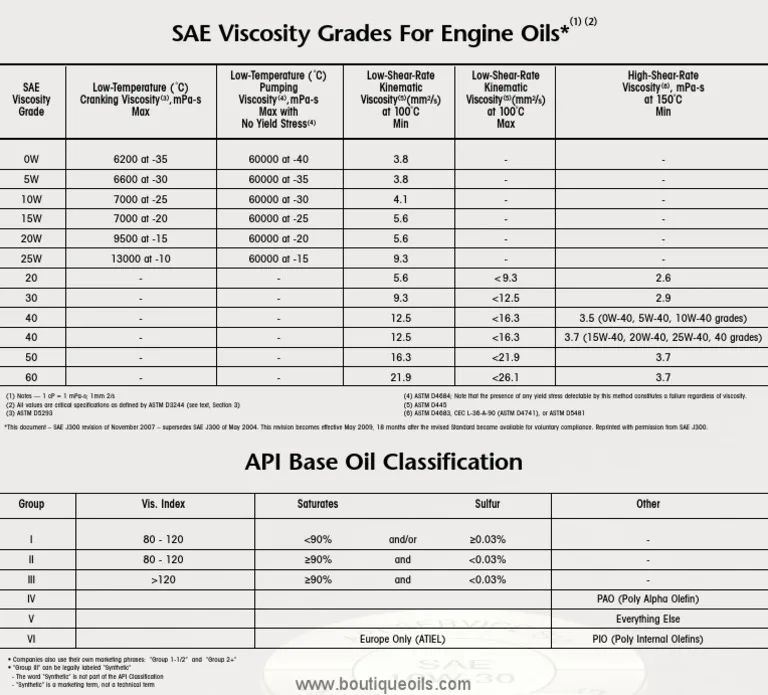
The SAE J300 standard is where every grade number gets its meaning. You can find the full classification through SAE International, and it's the same table your oil manufacturer uses to stamp a "30" or "50" on the jug. The critical number is the minimum kinematic viscosity at 100 °C, measured in mm2/s (also called centistokes).
| SAE Grade | Min. Viscosity at 100 °C (mm2/s) | Max. Viscosity at 100 °C (mm2/s) |
|---|---|---|
| SAE 20 | 5.6 | 9.3 |
| SAE 30 | 9.3 | 12.5 |
| SAE 40 | 12.5 | 18.0 |
| SAE 50 | 18.0 | 24.0 |
| SAE 60 | 24.0 | 30.0 |
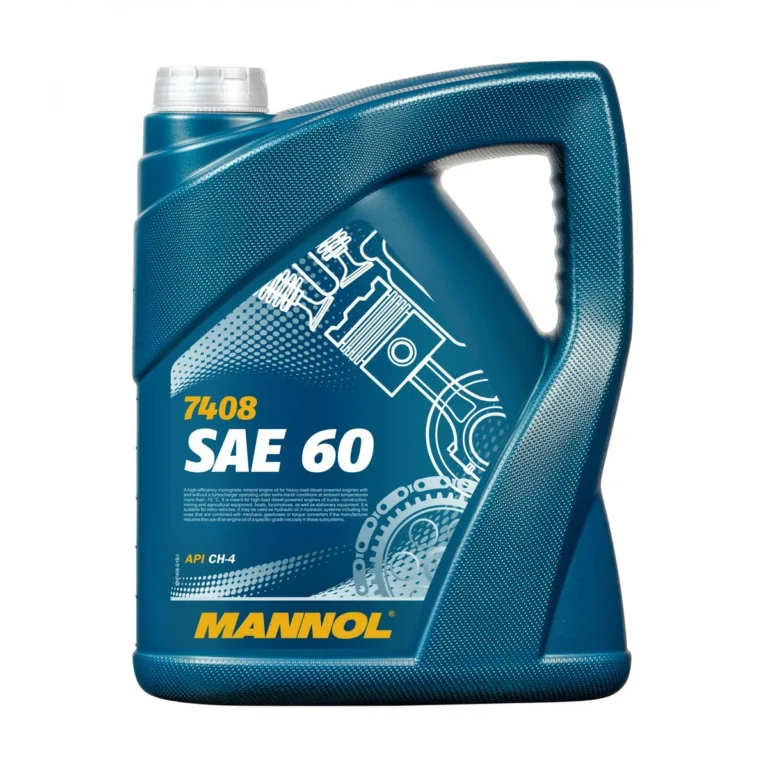
Notice SAE 60 sits right there. It's technically defined in J300. You just won't find it in a motor oil jug at your local auto store.
It shows up in industrial hydraulic systems and heavy gearboxes. For a true engine oil, SAE 50 is the ceiling.
Multi-grade oils add a second layer. The "W" number (say, 20W) tells you the cold-crank viscosity ceiling at minus 40 °C. The non-W number (50, 60) tells you the 100 °C hot-side viscosity.
A 20W-50 means: behaves like a SAE 20 at cold start, behaves like a SAE 50 at 100 °C. A 25W-60 pushes the hot side even thicker, into SAE 60 territory. That's about as close to "thickest motor oil" as a multi-grade gets.
The measurement method behind every one of those numbers is ASTM D445 (kinematic viscosity) and, for the hot-side under load, ASTM D6278 (HTHS). You'll see those references on any serious spec sheet from ASTM International.
Which Thick Oil Fits Your Engine, Climate, and Duty Cycle

Now that you know the numbers, the real question becomes: which of them is actually right for your situation? Here's how the branches work.
Vintage and classic cars (pre-1975, flat-tappet OHC or OHV): You want a SAE 30 or SAE 40 single-grade with high ZDDP (zinc) content, usually 2,000 to 3,000 ppm. A thick, slow-film oil protects the cam lobe from metal-to-metal contact while the lifters are still breaking in. Don't reach for a 0W-20 here.
The zinc levels are too low and the film is too thin for those large-clearance bearings.
Hot-climate diesel or heavy-duty (45 °C+ ambient, sustained towing): A 15W-40 or 20W-50 meeting API CK-4 or SP is the sweet spot. You get enough cold-start flow for a mild morning but a thick enough hot film for the bearing caps under load. In a sub-Saharan or Gulf State summer, 20W-50 is the go-to.
Track-day and race builds pushing 140 °C+ oil temps: A 25W-60 full-synthetic (Group IV PAO or Group V ester base) holds its HTHS past the point where a 10W-40 shears down. This is where "thickest" genuinely helps, because the film has to survive thermal breakdown for 30+ minute race windows.
Modern passenger car, OEM says 0W-20: Stick to 0W-20. The variable-vane timing system, the low-friction piston rings, and the LSPI guard in the ECU all assume a thin, high-VI oil. Swapping in a 20W-50 saves you nothing and risks a warranty dispute.
Marine, agricultural, or construction gear: The "thickest" oil here is often a gear lube (SAE 75W-90, SAE 85W-140) with EP additives. That's a different product class entirely. Don't pour it into the engine block.
If you're still unsure, pull up your owner's manual or the sticker on the oil filler cap. It lists an acceptable SAE range. If your range is 0W-10 to 5W-30, a SAE 40 single-grade is outside it.
Period.
HTHS, Viscosity Index, and Pour Point: The Three Specs Behind Every "Thick" Claim
Saying an oil is "thick" without naming these three numbers is like calling a car "fast" without saying the top speed. Here's why each one matters.
High-Temperature High-Shear (HTHS) viscosity. This is the oil's thickness at 100 °C under the actual shear forces at the bearing journal. A 5W-30 typically sits around 2.6 to 2.9 cP. A 20W-50 runs 3.5 to 4.2 cP.
A 25W-60 can push past 5.0 cP. The test method is ASTM D6278 (Taylor-Valan). If two oils share the same SAE grade but one has a 2.6 cP HTHS and the other has 3.2 cP, the second one carries a thicker film under load.
That's a real, measurable difference.
Viscosity Index (VI). VI tells you how much the oil's thickness changes as temperature swings. A low-VI mineral SAE 30 sits around 95. A Group III hydrotreated 20W-50 runs 155 to 170.
A Group IV PAO 25W-60 can hit 180 to 210. Higher VI means the oil stays "thick" through a wider temperature range without shearing down. That's why a full-synthetic 20W-50 outperforms a conventional 20W-50 in a 45 °C summer.
Pour point. This is the lowest temperature the oil will flow at all. Conventional SAE 50 single-grade pours around minus 9 °C. A full-synthetic 20W-50 pours near minus 35 °C.
If you live somewhere that sees minus 15 °C winters, a conventional SAE 50 is a no-go. It'll be a solid block in the sump by morning.
So when someone says "SAE 50 is the thickest," ask: thick at what temperature, under what shear, with what VI, and at what pour point? The SAE number is just the starting coordinate. These three specs tell you whether that thickness actually survives your conditions.
Five Ways Reaching for a Thicker Oil Backfires
Grabbing the thickest bottle on the shelf feels like the safe move. It usually isn't. Here are the five failure modes we see most often in forums, warranty claims, and post-mortem teardowns.
Cold-start starvation. If your oil's pour point is above your winter temperature, the pump can't get it to the top end in the first second of cranking. Bearings run dry. That's not a gradual wear issue. It's a 2-second seizure risk. A SAE 50 single-grade in a minus 10 °C morning is exactly this scenario.
Fuel-economy drag. Moving from a SAE 30 (or a 10W-40) to a SAE 50 adds 3 to 5 percent parasitic drag on the highway. The engine works harder to spin every component. In a modern 2.0L turbo calibrated for 0W-20, you're fighting the design. The powertrain control module expects a certain oil pressure curve. A thicker oil shifts that curve and can trip a low-oil-pressure code.
Warranty voidance. Most OEMs in the US and UK spell out an acceptable SAE range in the service manual. Fill a 0W-20-specified hybrid with a 20W-50 and the dealer can flag it at the next scheduled service. In a dispute, the onus falls on you to prove the thicker oil was within spec. It's not, and that's your problem.
LSPI in modern GDI engines. Low-speed pre-ignition is a real risk in turbocharged direct-injection engines below 1,500 RPM under heavy load. A thick oil with the wrong ash and sulfur profile can ignite prematurely in the cylinder. API SP was written specifically to guard against this. A SAE 50 that lacks the SP additive package is a recipe for a piston hole.
Confusing gear oil with motor oil. SAE 75W-90 and SAE 85W-140 are "thicker" than any engine oil. But they carry GL-5 molybdenum disulfide and sulfur-phosphorus EP additives that corrode engine bearing alloys. Pouring gear oil into an engine block is not a workaround. It's a teardown waiting to happen.
The rule is simple: "thicker" only helps if the engine, climate, and spec actually call for it. If the manual says 5W-30, the answer isn't SAE 50. It's 5W-30.
Where to Actually Source SAE 40, 50, and Beyond When the Shelf Doesn't Have It
The big auto stores in the US and UK stock single-grades up to SAE 30 at most. SAE 40 is spotty. SAE 50?
You won't find it on a shelf. So where do you actually get it?
- Industrial bulk-oil distributors (CPC, ITW Chemical, regional Fuchs or Total dealers) carry SAE 50 and SAE 60 in 5-gallon and 55-gallon drums. You order by phone or through their B2B portal. No walk-up pickup.
- Marine and agricultural supply houses stock SAE 40 single-grade for vintage tractors and outboard gearboxes. Ask for "straight 40" and they'll pull it from the back wall.
- Racing and vintage specialty shops carry 20W-50 and 25W-60 full-synthetics in 1-liter bottles. Brands like Amsoil, Fuchs Titan, and Total Quinzette show up here.
- Online industrial catalogs list SAE 50 in 1-quart and 1-gallon sizes. Expect $15 to $30+ per quart. Shipping a 55-gallon drum is a very different budget.
If you're in a hot-climate market, SAE 30 and SAE 40 single-grades are the dominant retail product. You'll find them in any hardware or auto parts shop without the specialty run.
The practical rule: if your OEM manual doesn't call for it, you probably don't need it. But if you're running a 1972 flat-tappet Maserati, a high-output diesel, or a two-stroke that sits at 160 °C, the specialty channel is your only path. Plan the order ahead of time.
These products don't restock on a weekly cycle.
FAQs: Thickest Motor Oil Questions That Keep Coming Up
Is SAE 50 the thickest motor oil you can buy?
Per SAE J300, SAE 50 is the thickest grade designated for engine oil. SAE 60 and SAE 70 exist in the standard but are classified for industrial and gear applications, not engine lubrication. You'll find SAE 50 in specialty and industrial channels, not retail shelves.
What's the difference between SAE 40 and SAE 50?
The gap is 5.5 mm2/s at 100 °C. SAE 40 sits at a minimum of 12.5, SAE 50 at 18.0. That's a 44 percent jump in hot-side thickness.
In practice, SAE 50 pours noticeably slower and carries a higher pour point, around minus 9 °C, whereas SAE 40 pours at a lower temperature.
Can I just use a thicker oil to stop oil burning?
Thicker oil can reduce blow-by in a worn-ring engine, but only up to a point. Past the OEM's maximum grade, you risk cold-start damage and fuel-penalty drag. If consumption is over 1 quart per 1,000 miles, the problem is mechanical, not viscosity.
Fix the rings or the valve stems.
Does a higher SAE number always mean better protection?
No. A SAE 50 in a minus 15 °C climate is worse than SAE 30 because it won't flow to the top end during cranking. Protection comes from the right thickness at the right temperature, not the biggest number on the bottle.
What's the thickest multi-grade motor oil available?
A 25W-60 full-synthetic is the thickest multi-grade commonly produced for automotive use. Its hot-side viscosity matches SAE 60 territory, a minimum of 24.0 mm2/s at 100 °C. You'll find it in racing and heavy-duty diesel applications from Fuchs, Total, and similar brands.
Is gear oil thicker than motor oil?
Yes. SAE 75W-90 gear lube sits at 10 to 13.5 mm2/s at 100 °C, and grades extend up to SAE 1000 (96.5 to 156.5 mm2/s). But gear oil carries EP additives that corrode engine bearing alloys.
Never swap one for the other.