What Is in Synthetic Motor Oil: Easy Guide
If you've ever peeled back a can of motor oil and wondered what's actually inside, you're not alone. When people ask what is in synthetic motor oil, they want more than the word "synthetic" printed on the label. It's a blend of engineered base stocks and a carefully balanced additive package.
That combination is what separates a real lubricant from a generic pour-it-in-the-truck product.
Per SAE J300, the viscosity classification used across North America as of 2026, every finished oil must pass cold-cranking and hot-temperature flow thresholds to earn a grade like 0W-20 or 5W-30. Base stocks make up roughly 70 to 90 percent of the finished product by mass. The other 10 to 30 percent is the additive package that does the actual engine protecting.
Let's break down exactly what's in that bottle.
Quick Answer: What's in Synthetic Motor Oil?
What is in synthetic motor oil? It's a blend of synthetic base stocks and an additive package. Base stocks make up 70 to 90 percent of the finished product.
Additives handle wear, cleaning, oxidation, and viscosity control. SAE J300 defines the viscosity grade, not the ingredients.
Why Getting Synthetic Oil Wrong Can Cause Engine Problems
The word "synthetic" on a label doesn't guarantee the oil is right for your engine. What actually protects you is the match between the finished product's viscosity grade, performance standard, and your manufacturer's approval. Get that wrong and the consequences stack up fast.
Here are the most common failure modes we see flagged in service records and OEM technical bulletins:
- Wrong SAE viscosity grade. A 15W-40 in an engine designed for 0W-20 creates excess pumping resistance. The oil film on the camshaft and bearings gets too thick for the clearance the designer chose. You lose fuel economy and stress the oil pump.
- Missing performance standard. An oil that meets SAE J300 viscosity but doesn't carry API SP or API SQ may lack LSPI protection and piston-deposit limits that modern gasoline engines need. Turbocharged and high-revving engines are the most exposed.
- No OEM approval where one is required. Some manufacturers, particularly in Europe and Japan, only approve oils carrying their own specification number. Using a generic API-certified oil can void the powertrain warranty.
- Unsupported additives. Popping a friction-modifier bottle into a modern engine can upset the additive balance. It may also damage a catalytic converter or DPF.
- Excessive drain intervals. "Synthetic" does not mean "never change it." Extended intervals are engine-specific, oil-specific, and duty-cycle-specific. Pushing beyond the approved window lets oxidation and deposit formation outpace the additive reserves.
- Contamination or counterfeit product. A cracked seal, a mislabeled jug, or oil that sat in direct sun for months changes the chemistry. You can't tell by looking at the color.
In our research across manufacturer service manuals and API licensing documents, the single most dangerous gap is between a correct viscosity grade and a missing performance category. Two 5W-30 oils can be functionally very different if one carries API SP and ILSAC GF-6B while the other is an older API SN formulation. The engine runs with less oxidation protection, less LSPI resistance, and weaker deposit control than the designer intended.
Most of these risks are avoidable with a five-minute check of the owner's manual. You just need to know which specification your engine actually requires before you pick up a bottle.
Base Stocks: The Main Liquid in Synthetic Motor Oil
Base stock is the primary liquid in a finished motor oil. It typically makes up 70 to 90 percent of the product by mass. Everything else, the additives, the viscosity polymers, the friction modifiers, gets folded into that base stock.
Understanding which base stock a manufacturer used tells you a lot about the oil's thermal stability, volatility, and cold-flow behavior.
The API Base Oil Group System
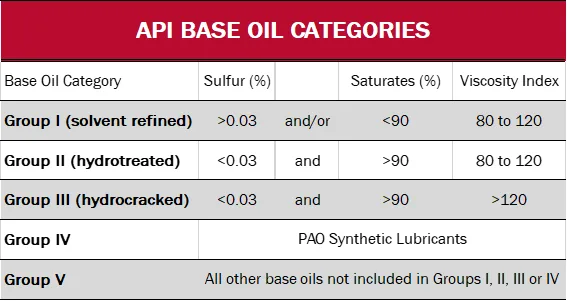
The American Petroleum Institute classifies base oils into five groups based on saturated-hydrocarbon content, sulfur content, and the refining process used. You'll see this system referenced in SAE International's technical library and in most OEM oil-specification documents.
| Group | Common Name | Refining / Source | Key Trait |
|---|---|---|---|
| I | Conventional mineral | Solvent refining, mild hydrotreating | Lower VI, more sulfur, lowest cost |
| II | Refined mineral | Hydrocracking | Higher VI, less sulfur, moderate cost |
| III | Highly refined hydrocarbon | Severely hydrocracked | High VI, low sulfur, 90%+ saturated hydrocarbons |
| IV | PAO (polyalphaolefin) | Synthetic chemistry from natural gas or GTL feedstocks | Very high VI, excellent thermal stability, low volatility |
| V | Esters (diesters, polyol esters) | Synthetic ester chemistry | High solvency, good lubricity, low volatility |
A few things worth flagging:
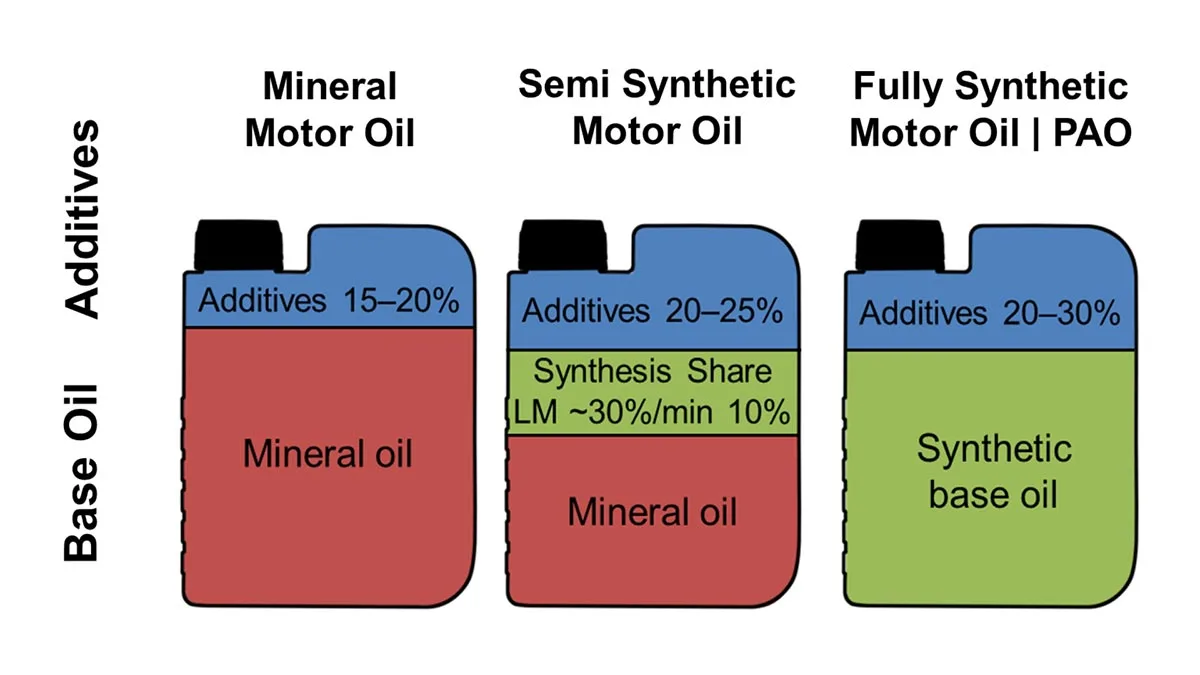
- Group III+ is not an API group. It's a commercial term, especially in the North American market, that describes a blend of highly refined Group III mineral base stock with some PAO or ester. It sits between "refined mineral" and "fully synthetic" in price and performance.
- Fully synthetic is also a market term, not a single API standard. It generally means the base-stock fraction is drawn from Group IV, Group V, or a combination the manufacturer considers entirely synthetic. Some products labeled "fully synthetic" in one market carry a "Group III+" or "highly refined" label in another.
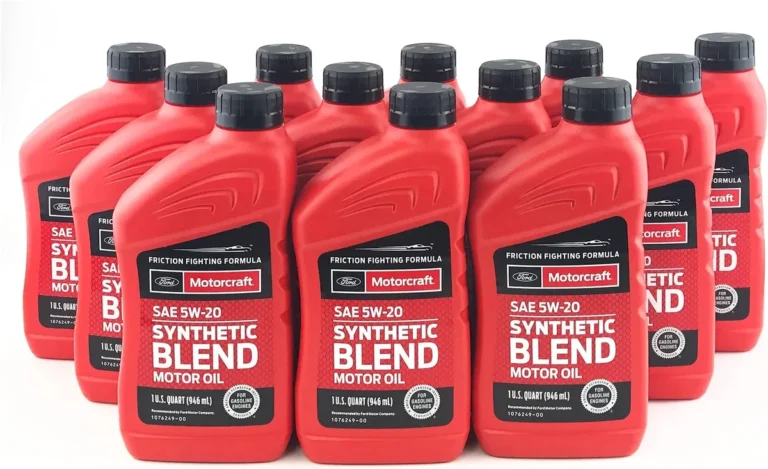
- Synthetic blend means the base-stock fraction mixes synthetic groups (IV, V, sometimes III) with Group I or Group II mineral base stocks. The finished product's performance is judged by its API or OEM certification, not by the word "blend."
What Makes a Base Stock "Synthetic"?
In the simplest technical sense, a synthetic base stock is one that was chemically manufactured or heavily restructured from a feedstock, rather than pulled straight off a solvent-refining unit. PAO is built from olefinic monomers. Esters are made by reacting alcohols with fatty acids.
Gas-to-liquid base stocks, sometimes called Group III in North America, are produced by converting natural gas into hydrocarbons.
You don't need to track every molecule to choose the right oil. What matters to you as a driver or service technician is:
- Does the finished product carry the API or OEM category your engine requires?
- Does the SAE viscosity match the manual?
- Was the product stored properly and is it in-date?
The base-stock type behind the label mostly affects cost, volatility, and how the manufacturer can stretch or tighten the formula. It rarely changes whether the oil is safe for your engine.
The Additive Package: What Keeps the Oil Working
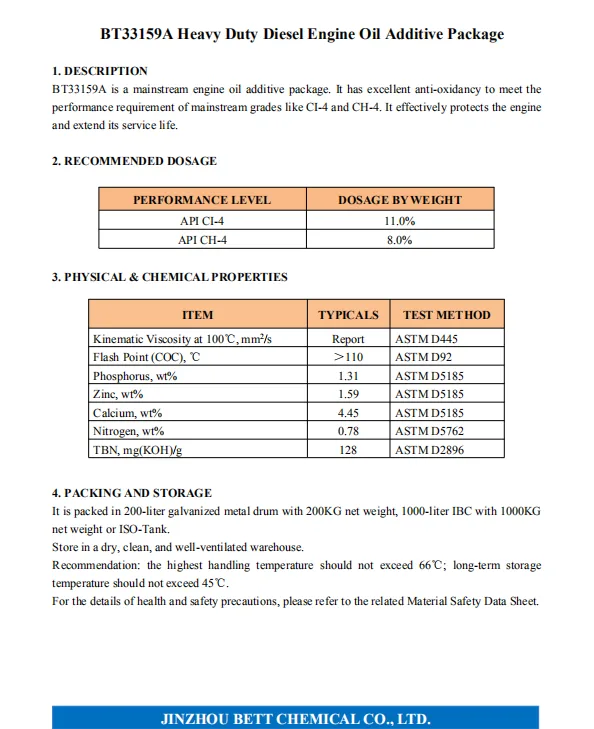
The additive package is the 10 to 30 percent of the bottle that manages wear, deposits, oxidation, and corrosion. A great base stock with no additives is just a thin, flammable liquid. Here's what goes in and what each class does:
| Additive Class | Typical Chemistry | Job in the Engine |
|---|---|---|
| Detergents | Calcium- or magnesium-sulfonates, phenates | Neutralize acidic combustion by-products, keep bearing and cam surfaces clean |
| Dispersants | Succinimide-based polymers | Keep soot, sludge, and oxidation particles suspended so they drain out with the oil |
| Antiwear agents | Zinc dialkyldithiophosphate (ZDDP) or molybdenum organometallics | Form a protective film on metal surfaces under boundary lubrication |
| Antioxidants | Hindered phenols, diarylamines | Slow the oxidation reactions that thicken oil and build acids |
| Viscosity-index improvers | Hydrogenated styrene-butadiene, polyproylene oxide, hydrogenated polyisoprene | Let one multigrade oil stay thin in winter and thick enough in summer |
| Pour-point depressants | Polyacrylates, alkylated naphthenes | Prevent wax crystals from forming a gel at low temperatures |
| Corrosion inhibitors | Organic molybdenum, borates, phosphonates | Protect bearing, cam, and ring surfaces from rust and acidic corrosion |
| Antifoam agents | Polysiloxane (silicone) compounds | Break entrained air bubbles so the oil pump doesn't cavitate |
| Friction modifiers | Organic molybdenum, borates, long-chain compounds | Reduce boundary friction for fuel economy (used in ILSAC and some ACEA C-class oils) |
| Seal-compatibility agents | Ester blends, specific PAO ratios | Keep elastomer seals from shrinking or swelling beyond their design window |
A few practical notes:
- ZDDP and catalysts. Older engines and high-performance applications often need a meaningful ZDDP level for scuff protection. Modern catalytic converters and DPFs have phosphorus limits. API SP and ILSAC GF-6 oils manage this by lowering ZDDP while adding other antiwear chemistry. That's why a "full-ZDDP" racing oil is not the same product you'd pour into a hybrid.
- Viscosity-index improvers are not a single ingredient. They're a family of polymers. The specific polymer, molecular weight, and branching pattern affect shear stability. A polymer that shears badly will lose viscosity over an extended drain interval.
- The package is balanced, not modular. You can't just pour in more detergent or extra ZDDP. The additive chemistries interact. Too much of one agent can increase sludge, upset emulsion, or poison a catalyst.
This is why manufacturers and API engineers test the finished product, not the base stock alone. The base stock and the additive package are a system. Change one piece and the rest of the formula may no longer meet the performance limits.
How Base Stocks and Additives Work Inside an Engine
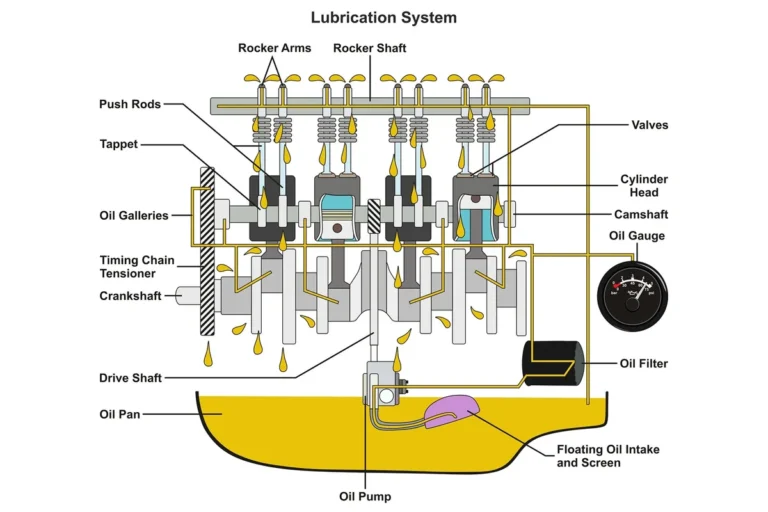
You don't need a chemistry degree to understand what the oil is doing in there, but knowing the sequence helps you see why the spec match matters.
Cold Start: The First 30 Seconds
When you turn the key in freezing weather, the oil has thickened. The base stock's pour-point depressants keep it from gelling into a wax network. The viscosity-index improver, if present, helps the oil stay thin enough to pump.
The cold-cranking simulator test under ASTM D5293 confirms that the oil can be pumped by the oil pump at the designated winter temperature, say -35°C for a 0W grade.
During those first 30 seconds, the oil is at its thickest and the metal surfaces are at their most vulnerable. The antiwear agents, typically ZDDP or an organometallic alternative, form a thin protective layer on the camshaft lobes, bearing surfaces, and piston rings before full hydrodynamic flow arrives. If the oil is too thick for the grade the engine was designed around, that layer forms slower and the wear rate spikes.
Steady-State Running: The Bearing Film
Once the engine is up to operating temperature, the oil thins out. The viscosity-index improver keeps it from thinning too much. The high-temperature high-shear viscosity, measured at 150°C under ASTM D4741, is what keeps a usable film between the main bearing journal and the housing.
If that HTHS value drops too low, metal-to-metal contact starts.
The detergents are constantly neutralizing acidic by-products of combustion that backfire past the rings into the crankcase. The dispersants keep those by-products, along with soot and tiny metal particles, suspended so they wash out at the next drain instead of settling as sludge.
Oxidation, Volatility, and Long-Term Stability
Heat and oxygen attack the base stock over thousands of miles. Antioxidants slow that attack. The base stock type matters here.
A PAO or a well-formulated Group III+ blend resists oxidation and evaporation better than a straight Group I mineral stock. The Noack volatility test, defined in DIN 58000, gives a practical measure of how much oil you'll lose to evaporation at sustained high temperatures. A turbocharged engine running 130°C or more needs that margin.
Foam is a quiet killer. If the oil foams, the pump pulls air instead of liquid, and you get a momentary loss of pressure. Polysiloxane antifoam agents keep the foam collapsing fast enough that the oil returns to the sump as a continuous film.
What This Means for Your Service Schedule
All of the above happens on a timer. Additives deplete. Base stock oxidizes.
Viscosity polymers shear. The manufacturer's drain interval is the point at which the remaining additive reserves and base-stock integrity drop below the performance limits the engine was designed around. That's why "synthetic lasts longer" is only true when the oil, the engine, and the driving pattern are all within the approved window.
The U.S. Department of Energy's FuelEconomy.gov site explains that low-viscosity, properly specified oils can reduce friction losses and support better fuel economy numbers on the EPA test cycle. That gain assumes the oil is the right grade, meets the required performance category, and is changed at the correct interval.
Skip any of those, and the "gain" turns into a risk to the engine's bearing, cam, and seal package.
Fully Synthetic vs. Synthetic Blend vs. Conventional Oil
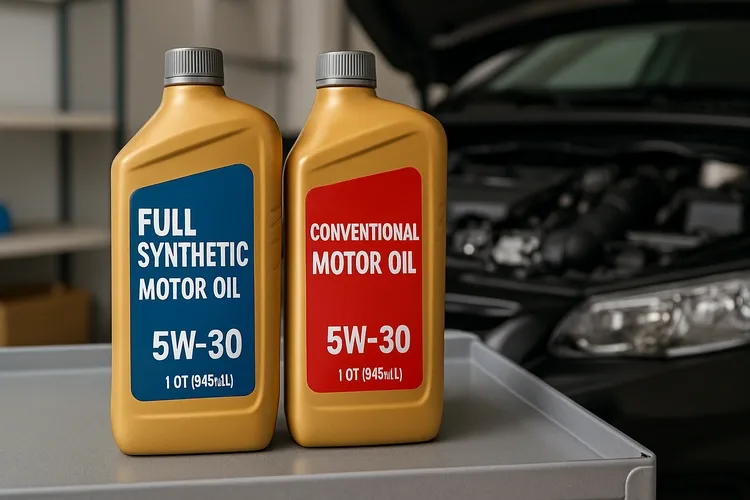
These three labels sit side by side on the shelf, and they mean different things to different people. Let's pin down what each one actually is before you start comparing.
| Category | Base-Stock Composition | Typical Cost Range (per quart, U.S. market) | Common Viscosity Availability |
|---|---|---|---|
| Conventional (Group I) | 90%+ solvent-refined mineral base stock | Lowest | 10W-30, 10W-40, 5W-30, 5W-40 |
| Refined Mineral (Group II) | Hydrocracked mineral base stock, 80%+ saturated hydrocarbons | Mid | 5W-30, 5W-40, 10W-30, 15W-40 |
| Group III+ / Highly Refined | Blend of Group III mineral with small PAO or ester fractions | Mid to high | 0W-20, 0W-30, 5W-20, 5W-30 |
| Synthetic Blend | Mix of Group I or II mineral with Group IV or V synthetic base | Mid | 5W-20, 5W-30, 5W-40, 10W-30 |
| Fully Synthetic (Group IV / IV+V) | Predominantly PAO, ester, or GTL synthetic base stock | Highest | 0W-8, 0W-16, 0W-20, 0W-30, 0W-40, 5W-30 |
A few things to keep straight:
- "Fully synthetic" is a marketing term. The API does not have a single definition that says "this exact base-stock ratio equals synthetic." A product with 80% PAO and 20% Group III is called fully synthetic in the U.S. but may be called "synthetic" or "semi-synthetic" in Europe. The finished product's API or OEM certification is what actually governs whether it's approved for your engine.
- A correctly specified conventional Group I oil can protect a vintage engine just fine. The engine was designed around that viscosity range and that additive load. Pouring in a 0W-20 fully synthetic into a 1985 V8 that wants 10W-40 doesn't make the oil "better." It just changes the chemistry in ways the seals, cam, and bearing clearances weren't built for.
- Synthetic blends fill the gap. They give you a moderate viscosity upgrade and some improved oxidation margin at a price between conventional and fully synthetic. They are not a step below "real synthetic." They're a different product with its own spec match.
The practical takeaway: the label word matters less than the spec match. A "synthetic blend" that carries API SQ and your OEM approval number is the right oil. A "fully synthetic" that doesn't meet your required standard is not.
SAE Viscosity Grades: What 0W-20, 5W-30, and Similar Labels Mean
The SAE J300 standard splits every engine oil grade into two numbers. The first is the cold-temperature pumping rating. The second is the hot-temperature viscosity range.
Here's what each number actually tests.
What the Winter Number Does
The "W" number, like 0W or 5W, tells you how thin the oil is when the engine sits cold and you first crank it. It comes from two tests:
- Cold-Cranking Simulator (CCS), ASTM D5293. Measures viscosity in centipoise at a very low temperature. For a 0W grade, the oil must pass at -35°C. For a 5W, it must pass at -30°C.
- Mini-Rotary Viscosity (MRV), ASTM D3916. Measures flow in a tiny clearance at the same cold temperature. This is critical for very low-viscosity grades (0W-16, 0W-20) where the oil has to reach a tight bearing clearance quickly.
A 0W-20 will pump through the oil gallery on a January morning in Minnesota. A 10W-30 will struggle. That's the whole point of the winter number.
What the Hot Number Does
The second number, 20, 30, or 40, refers to a kinematic viscosity band measured at 100°C.
| SAE Grade | 100°C Kinematic Viscosity Range (cSt) |
|---|---|
| 0W-8 | Below 7.5 |
| 0W-16 | 6.0 to 7.5 |
| 0W-20 / 5W-20 | 7.5 to 12 |
| 5W-30 / 10W-30 | 10.6 to 15 |
| 5W-40 / 10W-40 / 15W-40 | 12.5 to 17 (varies by grade) |
These are broad bands. A 5W-30 oil and a 0W-30 oil can both sit in the same 100°C window. What separates them is the cold-start behavior, the HTHS at 150°C, and the additive package tuned to each application.
The exact thresholds are defined in the current revision of SAE J300.
Why a Higher Viscosity Index Doesn't Automatically Mean Better
A high VI means the oil's viscosity changes less as temperature swings. That sounds good. In practice, an extremely high VI can mean the hot-end viscosity is thinner than you'd like for a large-displacement diesel bearing.
The engine designer chose a specific HTHS target. If your oil's 150°C, 1.45 MPa HTHS value is below that target, the bearing film is too thin. You get metal-to-metal contact at the peak-load moment.
The viscosity index is one input into the formula. It is not the whole story.
Matching the Grade to Your Engine
The owner's manual tells you the grade. That's your starting point and your ending point.
- A 2024 hybrid sedan may require 0W-16 or 0W-20 to hit its EPA fuel-economy target and keep the oil pump from cavitating.
- A heavy-duty diesel may require 0W-40 or 5W-40 to maintain bearing film under 4,000-lb towing loads.
- A classic V8 with loose main-bearing clearances may need 10W-40 or 20W-50 to build enough pressure at idle.
Driving habits, climate, and "what my neighbor uses" do not override the manual. The grade is an engineering spec, not a preference.
API, ILSAC, ACEA, JASO, and OEM Approval Labels
You'll see a stack of acronyms on the back of every oil can. Each one means something specific, and they don't all apply in every market. Let's sort them out.
API Performance Categories
The American Petroleum Institute licenses a specific set of test results that an oil must pass before it can carry an API category. As of 2026, the current gasoline-engine categories are:
- API SP. Introduced in 2020. Added LSPI limits, chain-wear protection, and piston-deposit controls for turbocharged, direct-injection, and high-revving gasoline engines.
- API SQ. Introduced in 2025. Builds on SP with tighter oxidation, deposit, and wear limits. Backward-compatible: an oil licensed under SQ also meets SP.
You'll see a "donut" symbol on the can. The outer ring says "Service" or "Resource Conservation." The inner ring shows the category letter and year. The API also runs a Quality Plus licensing program that adds a fourth element to the donut for select products.
ILSAC GF Specifications
ILSAC (International Lubricant Specification Advisory Committee) co-develops specs with API and the U.S. Department of Energy. They're designed for fuel-economy and catalyst-protection in North American and Japanese gasoline engines.
- ILSAC GF-6A. Backed by API SP. Used for engines where a slightly higher HTHS is acceptable.
- ILSAC GF-6B. Backed by API SP. Requires a lower HTHS minimum (2.6 mPa·s minimum at 150°C vs. 2.9 for GF-6A). Targets the very low-viscosity 0W-16 and 0W-20 grades used in hybrid and efficiency-focused engines.
The distinction matters. A 0W-16 oil for a Toyota hybrid must meet GF-6B, not just GF-6A. The HTHS floor is lower.
The fuel-economy benefit is tighter.
ACEA Sequences (Europe and UK)
The ACEA (European Association of Lubricants, Additives and Base Oils) publishes oil sequences that most European OEMs reference in their service manuals.
- ACEA A1/B1, A5/B5, A3/B4. A-series covers gasoline engines. B-series covers diesel. The numbers indicate the wear and deposit performance level and the allowed viscosity range.
- ACEA C-series (C1 through C9). These are for engines with exhaust after-treatment systems: catalytic converters, gasoline particulate filters, SCR, DPF. The "mid-SAPS" and "low-SAPS" distinction controls how much ash-forming additive (calcium, magnesium, phosphorus, sulfur) the oil can carry.
A European V6 with a DPF wants a C5 or C6 oil. An older BMW with a plain catalytic converter may want an A3/B4. Using the wrong ACEA class can clog a DPF or starve a bearing.
JASO and Japanese OEM Specs
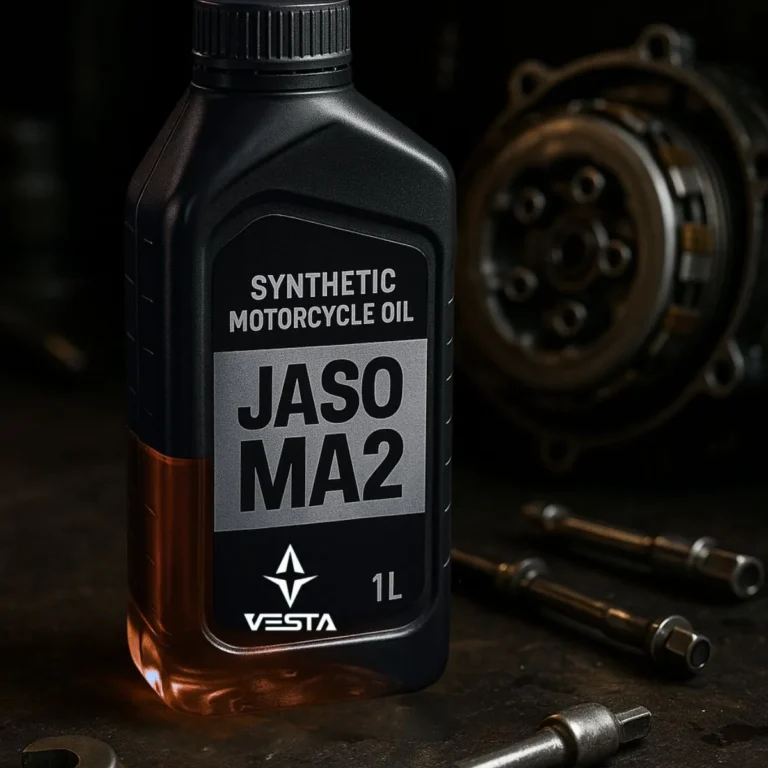
JASO (Japan Automotive Standards Organization) publishes oil-quality classes. You'll see JASO MA, MA-2, and MB designations, mostly on motorcycle and small-engine oils. Japanese car manufacturers (Toyota, Honda, Nissan, Mazda) often list their own approval number on the oil label in addition to API or ILSAC.
OEM Approvals: The Most Specific Check
Some manufacturers publish a numbered specification. For example, a European sedan may list "OEM-Approved: [manufacturer code] 229.51" on the can. That means the oil passed a full engine-test battery specific to that manufacturer's engine architecture.
Here's the hierarchy to follow:
- Check the owner's manual. It names the required grade, performance category, and any OEM approval.
- Match the grade. 0W-20, 5W-30, whatever the manual says.
- Match the performance category. API SP or SQ, ILSAC GF-6A or 6B, ACEA sequence, JASO class, or OEM number.
- Verify the OEM approval if one is required. Not every engine demands a manufacturer-specific label, but some do.
A product can carry the right viscosity and the right API category and still fail the OEM check because it's missing a required seal-compatibility test or a specific HTHS floor. The manual is the tiebreaker.
Benefits, Limits, and Best-Fit Applications
Synthetic and fully synthetic oils are not a universal upgrade. They open doors that conventional mineral stocks can't. They also come with their own constraints.
Here's where they shine and where they hit a wall.
Where Synthetic Oils Earn Their Keep
- Cold-start protection in sub-zero climates. A 0W-20 fully synthetic will pump through a -35°C engine faster than any Group I 5W-30. The bearing and cam surfaces get a protective film in seconds instead of the 20 to 30 seconds a thicker conventional oil needs.
- Turbocharged and supercharged engines. Sustained oil temperatures above 130°C stress oxidation and volatility. PAO and ester base stocks, paired with a modern antioxidant package, hold up longer under that thermal load.
- High-revving gasoline engines. LSPI protection, chain-wear limits, and piston-deposit control under API SP and SQ are designed for engines that spike to 7,000 rpm or higher under boost.
- Very low-viscosity grades for fuel economy. 0W-8, 0W-16, and 0W-20 reduce parasitic pumping losses. The DOE and ILSAC test cycles confirm a measurable MPG gain when the grade is matched to the engine.
- Extended drain intervals where approved. Some OEMs now approve 15,000 to 25,000-mile intervals for specific synthetic products. That's a design decision, not a free pass.
- Hybrid and plug-in hybrid vehicles. The combustion engine runs, stops, and restarts in a way that concentrates short-cycle thermal stress. A stable, oxidation-resistant oil handles that duty better.
Where the "Benefit" Claim Falls Short
- A conventional oil specified by the manufacturer is not "inferior." If your 2003 truck's manual says 5W-30 conventional, a conventional 5W-30 that meets API SP is the correct oil. Swapping to a fully synthetic 5W-30 costs more and doesn't add measurable protection to an engine that was never designed around that chemistry.
- Synthetic does not mean "last forever." Additives deplete. Polymers shear. Base stock oxidizes. The drain interval is the drain interval.
- Very low viscosity isn't always better. A 0W-8 in an engine designed for 5W-30 may not build enough bearing-film pressure at idle, especially in a high-mileage unit with worn bearings. The HTHS floor matters.
- Motorcycle wet-clutch engines need JASO MA-2 or equivalent. A car oil with ILSAC friction modifiers can reduce clutch drag and cause slipping. The friction-modifier chemistry is the problem, not the "synthetic" label.
- Racing or competition oils are not street oils. They often run very low on phosphorus and sulfur for catalyst protection, or very high for scuff protection. Neither is balanced for a daily commuter.
Matching the Oil to the Application
| Application | What to Prioritize |
|---|---|
| Modern turbo gasoline sedan (0W-20) | API SQ or SP, ILSAC GF-6B, correct HTHS |
| European diesel with DPF | ACEA C6/C8, low-SAPS, correct HTHS |
| Heavy-duty diesel (15W-40) | API CI-4 or higher, high TBN, OEM approval |
| Motorcycle with wet clutch | JASO MA-2, correct viscosity, no car friction modifiers |
| Classic V8, high mileage | Higher viscosity (10W-40, 20W-50), seal-compatible base stock, moderate ZDDP |
| Racing / track use | Race-specific oil, correct HTHS, volatility, and ZDDP level for the event |
The pattern is the same every time: start with the manual, match the spec, then consider cost, availability, and convenience.
How to Choose the Right Synthetic Oil Without Guessing
You don't need to be an oil chemist. You need a system. Here's the sequence that removes most of the guesswork, and we've structured it so you can work through it in under five minutes with your owner's manual and the product label in front of you.
Step 1: Pull the Owner's Manual
Open to the maintenance or fluids section. You're looking for:
- The required SAE viscosity grade (e.g., 0W-20, 5W-30).
- The required performance category (e.g., API SP, ILSAC GF-6A, ACEA C3, or an OEM approval number).
- The oil quantity in quarts or liters.
- The drain interval under normal and severe service.
- Any notes about "must not use" oils or specific additive restrictions.
If the manual is lost, most manufacturers publish the fluids specification on their official website under the vehicle's VIN or model year.
Step 2: Confirm the Viscosity Grade
Match the SAE grade exactly. A 0W-20 engine does not accept a 5W-30 as a "thicker, safer" swap. The pump, gallery clearances, and bearing design were built around a specific viscosity band.
Step 3: Confirm the Performance Category
This is the step most people skip. Two 0W-20 oils can look identical on the shelf. One carries API SQ and ILSAC GF-6B.
The other is an older API SN formula. The SQ oil has tighter LSPI limits, better piston-deposit control, and a lower HTHS floor. The SN oil may be fine for a 2008 engine.
It's not fine for a 2025 turbo hybrid.
Step 4: Check for an OEM Approval
Some European, Japanese, and Korean manufacturers require a specific approval number printed on the label. If the manual says "OEM Approval [number] required," then a generic API-certified oil of the same viscosity is not the right product. You need the one that passed the manufacturer's full engine-test battery.
Step 5: Verify the Product and the Source
- The can or jug should be sealed, undented, and in-date. Check the lot number and production date if visible.
- Buy from a dealer, a major auto-parts chain, or a verified online retailer that sources from the manufacturer's distribution channel.
- A $4 quart of "fully synthetic 5W-30" at a discount counter is a red flag. Counterfeit or mislabeled oil is a documented problem in several markets.
- If you're topping off between changes, use the same product and specification as your last full change. A small top-off of a slightly different but spec-matched oil is fine. A large top-off of a different base stock or additive balance is not.
Step 6: Log the Change
Write down the date, mileage, product name, specification, viscosity grade, and drain interval you're using. If you service the vehicle yourself, keep a folder or a phone note. If you go to a shop, ask them to print the receipt with the oil part number.
That log is your insurance. If you're ever in a warranty dispute or a wear investigation, the record of what was poured in and when is the first thing a technician or an OEM goodwill department will ask for.
A Quick Decision Flowchart in Words
- Does the manual specify a grade? Use that grade.
- Does the manual name a performance category or OEM approval? Use a product that carries that exact label.
- Are you in a cold climate? Confirm the winter number (0W or 5W) matches the coldest you'll realistically park outdoors.
- Are you towing, racing, or driving in severe service? Confirm the oil's severe-service or extended-drain qualification and shorten the interval if in doubt.
- Is the engine older, high-mileage, or running a different fuel? Check seal compatibility and consult the manufacturer's guidance before switching base stocks or viscosities.
The whole process is linear. You're not choosing between ten opinions. You're matching three or four data points from the manual to the label in your hand.
When all four match, you've got the right oil. When one doesn't, you don't.
Common Synthetic-Oil Mistakes to Avoid
Most of the damage we see tied to "wrong oil" is not a mystery chemistry problem. It's a specification mismatch, a shortcut, or a bad habit that compounds over time. Here are the ones that show up most often in service records and warranty claims.
Picking Viscosity by Climate or Driving Style Instead of the Manual
A common pattern: someone lives in a hot city and thinks a thicker oil will "protect better." Or they live in a cold state and reach for a thinner grade to "help the engine start." Neither override is valid. The engine's bearing clearances, oil pump displacement, and cam-follower geometry were designed around a specific HTHS window. A 5W-30 in a 0W-20 engine raises pumping loss and can reduce oil flow to the cam at low RPM.
A 0W-8 in a 5W-40 diesel drops the bearing film below the design minimum at idle under load.
The manual's grade is not a suggestion. It is the spec.
Extending Drain Intervals Because "It's Synthetic"
Synthetic technology improves oxidation resistance and additive stability. It does not eliminate them. A manufacturer-approved extended interval (say, 15,000 miles) applies to a specific product, a specific engine, and a specific driving pattern.
Push that same oil to 25,000 miles under towing, short-trip cycling, and heavy idling, and you're past the point where the additive reserves hold. The oil still looks "fine" on the dipstick. The ZDDP is down.
The dispersants are saturated. The sludge is forming on the back of the valve cover before you see it.
If the manual says 10,000 miles normal and 5,000 miles severe, use the severe number when you're actually driving severe.
Mixing Brands or Base-Stock Types Without Checking
Modern oils are formulated to be broadly compatible at the blend level. A small top-off of the same SAE grade and the same API category is usually manageable. What's not manageable is topping off 3 quarts of a different manufacturer's fully synthetic PAO blend into 4 quarts of a Group III+ formula.
The viscosity may still read in range. The additive balance is now unknown. The dispersant-to-detergent ratio is off.
You've created a formula nobody tested.
For a routine drain-and-fill, use one product. For an emergency top-off, use the same product and spec.
Assuming the Correct Viscosity Grade Means the Oil Is Suitable
A 5W-30 that meets SAE J300 is not automatically the right 5W-30 for your engine. It needs to meet the performance category too. An older API SN 5W-30 in a 2025 turbocharged engine with an LSPI-prone direct-injection system is a spec mismatch.
The viscosity is right. The additive chemistry is not.
Adding Standalone "Supercharger Additives" or Friction Modifiers
This one keeps coming back. A bottle of "engine guardian" or "ZDDP booster" poured into a modern engine can:
- Overload the phosphorus and sulfur limits that protect the catalytic converter.
- Upset the detergent-to-dispersant balance and accelerate sludge.
- Change the friction characteristics in a way the engine's oil pump and relief valve were not tuned for.
- Void the powertrain warranty.
The finished oil's additive package is a closed system. The chemist balanced it. Adding a fourth, fifth, or sixth additive source is not "boosting." It's unbalancing.
Judging Oil Quality by Color or Smell
A fresh fully synthetic oil can be pale amber, golden, or nearly clear. A 3,000-mile old sample of the same oil can look dark green or black. That darkening is the detergents doing their job.
They are suspending soot, combustion by-products, and oxidation products. A lighter color after 5,000 miles does not mean the oil is "cleaner." It may mean the detergents are exhausted and the particles are no longer suspended.
Smell is even less useful. A slightly sweet smell can be coolant contamination. A sharp chemical smell can be fuel dilution from a misfiring injector.
Neither tells you the oil is good. They tell you something is wrong upstream.
Using Racing, Motorcycle, or Off-Road Oil in a Street Engine
A 4T motorcycle oil with JASO MA-2 is not a car oil. A 15W-50 racing mineral with heavy ZDDP is not a daily-driver synthetic. An off-road "heavy-duty" oil with a high-TBN detergent load will ash up a gasoline particulate filter in months.
The application determines the formula. The label determines the product. Match them.
Buying From an Unverified Source
Counterfeit and mislabeled oil is a documented problem in several markets, particularly for imported products. In our review of service complaints and OEM goodwill cases, the pattern is consistent: a "brand-name" quart purchased at a discount counter or an unlisted online marketplace, opened, poured in, and followed by a bearing knock or a DPF failure within a few thousand miles. The can looked right.
The contents may not have been.
Buy from a manufacturer-authorized channel. Check the seal. Note the lot number.
If the price is 40 percent below every other retailer, that is your first warning sign, not your first discount.
Oil-Change Intervals and Long-Term Maintenance
The interval question is not "how long does synthetic last?" It is "how long does this specific oil, in this specific engine, under this specific duty cycle, last before it drops below its performance floor?" Three variables drive the answer.
The Three Drivers of Drain Interval
- The engine and its design. A small-displacement turbocharged direct-injection engine with tight bearing clearances and a DPF or GPF has a narrower margin than a large-displacement naturally aspirated V6 with a plain catalytic converter. The former needs the spec-matched oil and the exact interval. The former also punishes you harder for a missed interval.
- The driving pattern. Short trips under 10 minutes keep the oil below full operating temperature. Water and fuel condense in the crankcase and the oil never "cooks off" the dilution. Extended idling in stop-and-go traffic at 60 to 80°C runs the oil hot without the flow rate to cool it. Towing a 7,000-lb trailer in 100°F ambient pushes oil temperatures past 140°C. Each of these shifts the effective drain interval shorter.
- The oil's own degradation curve. Base stock oxidation, polymer shear, additive depletion (ZDDP, detergents, dispersants, antioxidants), and volatility loss all run on a timer that heat accelerates. A Noack volatility of 14% at 145°C means roughly 14 grams of oil per 100 grams evaporates under that test. In a sustained high-heat engine, that number drops fast. The antioxidant reserves drop with it.
Manufacturer Oil-Life Monitoring Systems
Most modern vehicles run a computer-estimated oil-life model. The ECU tracks engine runtime and RPM, intake and oil temperature, coolant temperature, ambient temperature, fuel quality and mixture, and distance traveled. The system calculates an estimated remaining service life and triggers a warning at, say, 10% remaining.
This is a model, not a measurement. It assumes the oil is the spec-matched product, the fuel is clean, the engine is in normal mechanical condition, and no coolant or fuel has contaminated the sump. If any of those assumptions are false, the monitor will tell you to change the oil later than you actually should.
Treat the monitor as a starting point. If you're doing severe service, ignore the "20% remaining" notification and change at the severe-service interval in the manual.
What to Do Between Changes
- Check the dipstick every 500 miles or at every fuel stop if you're towing or driving hard. Top off only with the same product, same spec, same SAE grade.
- Inspect the oil cap and dipstick for milky residue. A small amount of condensation after a cold short trip is normal. A persistent milkshake texture means coolant is entering the crankcase. Stop driving and investigate.
- Note the oil's texture and smell at each fill-up. A fuel-like odor after a long cold-soak in winter is a known issue with modern direct-injection engines. It dilutes the oil and shortens its effective life. The manufacturer's severe-service interval accounts for it.
- Keep a simple log. Date, mileage, product, spec, and interval used. If a warranty question or a wear investigation comes up, that log is the first document anyone will ask for.
When a Used-Oil Analysis Helps
A used-oil analysis (UOA) from a laboratory sends a sample back with a panel of measurements: viscosity at 40°C and 100°C (has it thickened?), TBN (are the detergents depleted?), wear metals (Fe, Cu, Al, Cr, Sn, Na), water and fuel content, and contaminant levels (dirt, ash).
A UOA does not replace a visual inspection of the engine. It tells you the oil's chemistry is degrading faster than the interval expects. It does not tell you which bearing is worn, which ring is letting by compression, or which seal is leaking.
Pair it with the mechanical symptoms and you have a fuller picture.
Long-Term Optimization Tips
- Stick with one product and spec as long as the engine and the specification remain unchanged.
- If the OEM updates the required spec (say, moving from API SP to API SQ), switch to the new product at the next scheduled change.
- If you're adding a turbo, a supercharger, or a high-lift cam, the thermal and shear loads change. Re-check the HTHS requirement and the volatility target with the engine builder or the oil manufacturer.
- For an engine over 150,000 miles with elevated oil consumption, a slightly heavier grade (within the manual's approved range) can slow consumption. Do not go outside the manual's range to "fix" a mechanical leak.
Warning Signs That the Problem May Be the Engine, Not the Oil
This is the section where we separate "the oil is the wrong spec" from "the oil is fine but something mechanical is failing." Swapping oil brands three times in a row because the check-engine light is on or the oil level is dropping will not fix a worn main bearing. It will cost you three drain-and-fill visits and a small mountain of used oil.
Symptoms That Point to the Engine, Not the Oil
| Symptom | Likely Engine Cause | What to Do |
|---|---|---|
| Oil level drops 1 quart or more per 1,000 miles, blue smoke at startup or under load | Worn valve seals, piston rings, or turbo shaft seals | Compression test, smoke test, borescope inspection. Oil change will not fix it. |
| Milkiness on the dipstick or oil cap that does not clear after a long drive | Head gasket failure, cracked head, or weeping water pump | Coolant leak test, pressure test, dye test. Do not keep driving if the milky layer is thick and persistent. |
| Metallic grit or fine silver particles visible on the dipstick or in a drained sample | Worn bearings, cam followers, or piston rings pulling metal | Stop driving. Pull a magnet from the drain plug or run a UOA. Investigate before the next 50 miles. |
| Oil pressure light flickers or stays on at idle | Worn oil pump, low oil level, or failing pressure relief valve | Check level first. If level is correct, pull the pump and inspect. Do not ignore a low-pressure warning. |
| Engine knocks, rattles, or sounds "deep" at warm idle | Bearing wear, broken rod, or failing balancer | Shut the engine down immediately. A running knock is a catastrophic-failure warning. |
| Excessive fuel smell in the oil after short cold trips | Injector leakage or rich-running condition diluting the oil | Check for P0300 or cylinder-specific misfire codes. Run a fuel-dilution UOA. Repair the cause. |
| Overheating followed by dark, thick oil with a burnt smell | Oil starvation from a blocked pickup, failed pump, or lost pressure line | Do not top off and keep driving. The engine may have already scored a bearing or cam. |
When to Stop and Call a Technician
- You hear a knock, rattle, or metallic scrape that is new or getting worse.
- The oil pressure warning light is on or flickering at steady RPM.
- The dipstick shows milky coolant that does not clear after a 30-minute drive.
- A magnet on the drain plug pulls visible iron filings or silver shavings.
- The engine is consuming more than half a quart per 1,000 miles and you have no smoke explanation.
In every one of those cases, changing the oil brand or the viscosity grade is not the fix. The fix is the component that is failing. The oil is the symptom carrier, not the disease.
What a "Bad Oil" Actually Looks Like in the Sump
If the problem is the oil and not the engine, you will typically see:
- Heavy sludge or varnish on the back of the valve cover, the oil-pickup screen, or the cam followers.
- Oil that is very thick, gel-like, or has separated into a layered consistency.
- A strong acid or varnish smell that is not fuel and not coolant.
- A TBN in a UOA that is near zero, meaning the detergents are fully spent.
In that case, a full drain, a filter change, and a flush (or a two-drain sequence with a small amount of fresh oil run for 10 minutes) restores the sump. The new oil, at the correct spec and interval, prevents the recurrence.
FAQs About Synthetic Motor Oil
Is synthetic motor oil made from chemicals or crude oil?
Both, depending on the base stock. PAO (Group IV) is built from olefinic monomers derived from natural gas or gas-to-liquid feedstocks. Esters (Group V) are made by reacting alcohols with fatty acids.
Group III and Group III+ base stocks come from highly refined hydrocarbon feedstocks, often still sourced from crude. The finished product is a blend of whichever base stocks the formula calls for, plus the additive package.
Is fully synthetic oil always better than conventional oil?
No. "Better" means "matched to the engine's design." A conventional Group I 5W-30 that meets API SP is the correct oil for a 2002 engine built around that viscosity and additive load. Pouring in a fully synthetic 0W-20 does not add protection.
It changes the chemistry in ways the seals, cam, and bearings were not tuned for. The right oil is the one that matches the spec, not the one with the fanciest label.
What are PAO and ester base stocks?
PAO (polyalphaolefin) is a Group IV synthetic base stock. It has a very high viscosity index, low volatility, and strong thermal stability. Esters (Group V) include diesters and polyol esters.
They offer high solvency, good low-temperature fluidity, and natural lubricity. Most finished motor oils blend PAO with a smaller ester or Group III fraction rather than running 100 percent of one type. The blend balances cost, pour behavior, and volatility.
What does ZDDP do in engine oil?
ZDDP (zinc dialkyldithiophosphate) is a boundary-lubrication antiwear agent. Under high load and low-speed conditions, such as a cam lobe riding on a follower during startup, ZDDP forms a protective reaction film on the metal surface. That film prevents scuffing and wear.
Modern API SP and ILSAC GF-6 oils reduce ZDDP to protect catalytic converters and DPFs, and they add alternative antiwear chemistry to keep the protection in place.
Does synthetic oil prevent sludge?
It reduces the rate of sludge formation compared to a base stock with weaker oxidation and detergent packages. It does not prevent it. Short drain intervals, fuel dilution, coolant contamination, a low HTHS value, or a depleted additive reserve will still produce sludge in a synthetic oil.
Sludge is a symptom of the oil exceeding its service window or the engine contaminating the sump.
Can you mix synthetic and conventional motor oil?
For a small emergency top-off, yes, if the SAE grade and the performance category match. A quart of conventional 5W-30 API SP into 3 quarts of synthetic 5W-30 API SP is manageable. Do not plan on it.
For a full drain-and-fill, use one product and one specification. Mixing a PAO-based fully synthetic with a Group I conventional product changes the base-stock ratio, additive solubility, and long-term shear behavior in ways no one has validated for your specific engine.
Does synthetic oil last longer between changes?
It lasts longer in the sense that the base stock resists oxidation and the additive package degrades more slowly. That longer life is only valid at the manufacturer's approved interval for that specific product in that specific engine. A "15,000-mile synthetic" in a towing, short-trip, hot-climate duty cycle may need a 7,500-mile change.
The interval is a system property, not a product property.
Final Decision Guide: Match the Specification, Not the Label
You do not need to memorize every base-stock group or every additive class to pick the right oil for your engine. You need four data points, all pulled from the owner's manual, and a label check that takes about 90 seconds.
| Step | What to Check | Where to Find It |
|---|---|---|
| 1 | Required SAE viscosity grade (0W-20, 5W-30, etc.) | Owner's manual, fluids section |
| 2 | Required performance category (API SP/SQ, ILSAC GF-6A/6B, ACEA, JASO) | Owner's manual, fluids section |
| 3 | OEM approval number, if the manufacturer requires one | Owner's manual or manufacturer's website |
| 4 | Drain interval under normal and severe service | Owner's manual, maintenance schedule |
Once you have those four, you walk to the shelf and read the back of the can. The grade is printed large. The API donut is printed below it.
The ILSAC, ACEA, or OEM approval line is printed in smaller type under the performance symbols. If all four match, you have the correct product. If one does not, you do not.
The word "synthetic" on the front is a marketing descriptor. It tells you the base-stock type at a general level. It does not tell you whether the oil meets your engine's HTHS floor, whether the additive package is balanced for your DPF or catalytic converter, or whether the viscosity will pump through your cold engine in the climate you actually live in.
Treat "synthetic," "Group III+," "high mileage," and "extended drain" as supporting labels. They inform your choice. They do not replace the specification.
Start with the manual. Match the four data points. Buy from a verified source.
Log the change. Service at the interval the manual and the driving pattern demand. That is the entire system.
Everything else is noise.