When to Use Synthetic Motor Oil: Easy guide
Figure out when to use synthetic motor oil and you'll stop second-guessing yourself at the parts counter every six months. Most of us walk into a shop, stare at a wall of bottles, and freeze. The answer isn't "synthetic is always better" or "stick with what you've always used." It depends on your specific engine, your climate, and how hard you actually work that vehicle.
Per the SAE J300 viscosity classification, a 0W-20 full synthetic reaches proper film thickness on a cold turbocharged crankshaft in roughly 2 to 5 seconds. A conventional 30W in the same engine can take 20 to 30 seconds. That gap is where metal-on-metal wear happens.
So the real question isn't "synthetic versus conventional." It's whether your engine's duty cycle creates the conditions where that gap actually matters.
Quick Answer
Use synthetic when your engine runs hot, fast, or starts cold. Turbo engines, GDI systems, cold winters, heavy towing, or sub-10-mile commutes all qualify. Conventional oil handles a low-stress, warm-climate, long-trip engine fine.
Your OEM spec in the owner's manual is the starting point. If it lists 0W-20 or 5W-30, the math is already done for you.
The Real Question Isn't "Should I Use Synthetic?" It's "Will My Engine Actually Benefit?"
Here's what trips up most car owners: we've been sold the idea that synthetic is a flat upgrade. The label says "full synthetic," so it must be better, right? Not necessarily.
A synthetic oil in a 1998 four-cylinder naturally aspirated engine doing 15-mile highway loops in a warm garage in March gains you almost nothing over a well-made conventional 5W-30. The additive package is doing its job either way. The viscosity is in the right range.
You're not pushing that engine to 7,000 RPM or starting it at minus 30 degrees.
Now swap in a 2024 turbocharged inline-4 with variable valve timing and a direct-injection system. That engine runs hotter, starts wet, and the oil has to maintain HTHS viscosity of at least 2.9 mPa·s at 350 °C under boost. In that scenario, a conventional 10W-30 shears down fast.
The VVT solenoids get sluggish on cold start. The GDI injectors spray fuel directly into a hot oil film that's already breaking apart. The synthetic base oil handles that thermal envelope.
It doesn't.
So the honest reframe is this. "When to use synthetic motor oil" is not a moral question. It's an engineering question.
You're matching the oil's thermal and chemical behavior to the actual stress profile your engine sees on a Tuesday morning in your specific driveway. The answer branches. It's not binary.
The Short Answer: Five Conditions That Flip Your Decision From "No" to "Yes"
If any of the five conditions below are true for your vehicle, synthetic is the right call. If none are true, you can save a few dollars and run conventional without meaningful risk. Run through them like a checklist before you pick up a bottle.
| Condition | What to check | If YES | If NO |
|---|---|---|---|
| 1. Cold climate (coldest monthly low below 20 °F / -7 °C) | Your 10-year climate average for your ZIP | Use 0W or 5W synthetic. The pour point matters. | Conventional 10W-30 or 5W-30 is acceptable. |
| 2. Turbocharged or GDI engine architecture | Owner's manual spec or engine badge | Synthetic. Full stop. The thermal and deposit risk is too high otherwise. | NA or port-injected, no boost. Conventional is fine. |
| 3. Sustained high-load duty (towing over 5,000 lb, plowing, track use, 7k+ RPM) | Your actual weekly driving pattern | Synthetic with a high-HTHS spec (5W-40, 0W-40). | Light duty. Conventional handles it. |
| 4. Short-trip, infrequent full operating temperature (most drives under 10 miles or 15 min) | OBD II scan or just honest recall | Synthetic. Conventional oil thickens and emulsifies water before it ever gets hot enough to cook off. | Long highway loops where the oil hits 220 °F+ within 20 min. |
| 5. OEM mandates extended drain interval (7,500 to 15,000 mi) on a modern platform | Service schedule sticker under hood or manual | Synthetic. The additive package is engineered for that interval. Conventional breaks down by mile 4,000. | Fixed 3,000-5,000 mi schedule on an older platform. |
If condition 2 is true alone, that usually overrides everything else. A turbocharged 1.5L in a warm-climate city car still wants 0W-20 or 5W-30 full synthetic because the intercooler runs the oil at 240 °C+ on the exhaust side. Warm doesn't matter when the engine itself is the heat source.
One more if/then worth stating plainly. If your engine is pre-1995, carbureted or early PFI, and it's not leaking, conventional 10W-40 or 5W-30 is genuinely fine. Those engines were designed around a 30W or 50W oil film at operating temp.
You don't owe them a synthetic. You'd be paying a premium for a benefit they can't exploit.
What Synthetic Oil Actually Does Differently (and What the Bottle Label Leaves Out)
The words "full synthetic" on the front of the bottle tell you one thing: the base oil isn't cut from a straight-run mineral fraction. That's it. The label doesn't tell you whether that base is a Group III hydroisomerized naphtha (the most common "synthetic" you'll find at a big-box store), a Group IV polyalphaolefin (PAO), or a Group V ester blend.
And that distinction matters a lot more than the marketing would like you to think.
- Group III (hydroisomerized). This is what most mainstream "full synthetic" bottles actually are. SAE J300 defines viscosity grades but doesn't mandate a minimum base-oil group percentage. A product can be labeled full synthetic with 100% Group III stock and still meet every SAE and API test. It performs well across -30 °C to 250 °C. It's fine for 90% of consumer cars. But its cold-weather shear stability and diesel soot tolerance trail behind a true PAO.
- Group IV (PAO / polyalphaolefin). Lower volatility, better shear stability, longer life in diesel and sustained-high-RPM gasoline. Heavier fuel dilution resistance. This is what a Cummins 6.7L or a track-prepped BMW M4 actually wants under the hood.
- Group V (esters, polyacrylates). Niche. High-perf racing, aviation, or applications where biodegradability or extreme thermal stability is the priority. You'll see them in SCCA technical regulations and FIA-approved lists.
The additive package is where the real engineering happens. A synthetic base oil is a near-inert carrier. The detergents, dispersants, anti-wear agents (ZDDP), friction modifiers, and anti-foam polymers are what actually protect the engine.
Two bottles of "0W-20 API SP full synthetic" from different brands can have wildly different ZDDP levels, different base-oil group blends, and different long-term deposit behavior. The SAE and API logos on the front just mean it meets the minimum test. They don't tell you where it sits above that floor.
Here's the practical takeaway. If you're choosing for a consumer car in normal service, the "full synthetic" label is a good enough proxy. If you're choosing for a diesel, a turbo track car, or a high-mile fleet truck, you need to read the back label and the OEM tech service bulletin.
The front says "synthetic." The back says which synthetic, and that's the part your engine actually feels.
The Five Variables That Determine Your Oil Choice: Climate, Duty Cycle, Engine Architecture, Mileage, and OEM Spec
This is where the decision tree actually runs. You work through five variables in order. Each one narrows the field.
By the time you hit variable 5, you should have one or two exact viscosity-spec combinations to buy.
Variable 1: Climate and coldest expected start temperature.
Your coldest monthly low (10-year NOAA average for your region) sets the "W" number. Below 0 °F (-18 °C), you want 0W. Between 0 and 20 °F, 0W or 5W.
Above 20 °F, 5W or 10W is fine. The "W" rating is a pour-point test, not a winter label. A 0W oil flows at -35 °C per SAE J300.
A 30W single-grade oil may not flow at all below freezing. If you live in Duluth or Tromsø, this variable does most of the work for you.
Variable 2: Duty cycle and thermal stress.
What does the engine actually do? A 40-mile highway loop with the cruise set at 70 is low stress. A 12-mile stop-and-go commute where the oil never crosses 200 °F is high stress.
Towing a 7,000-lb trailer up a mountain pass is extreme. Sustained redline on a track is extreme in a different way. Your duty cycle determines whether you need a high-HTHS synthetic (3.5+ mPa·s at 350 °C) or whether a 2.9 mPa·s oil is plenty.
Variable 3: Engine architecture.
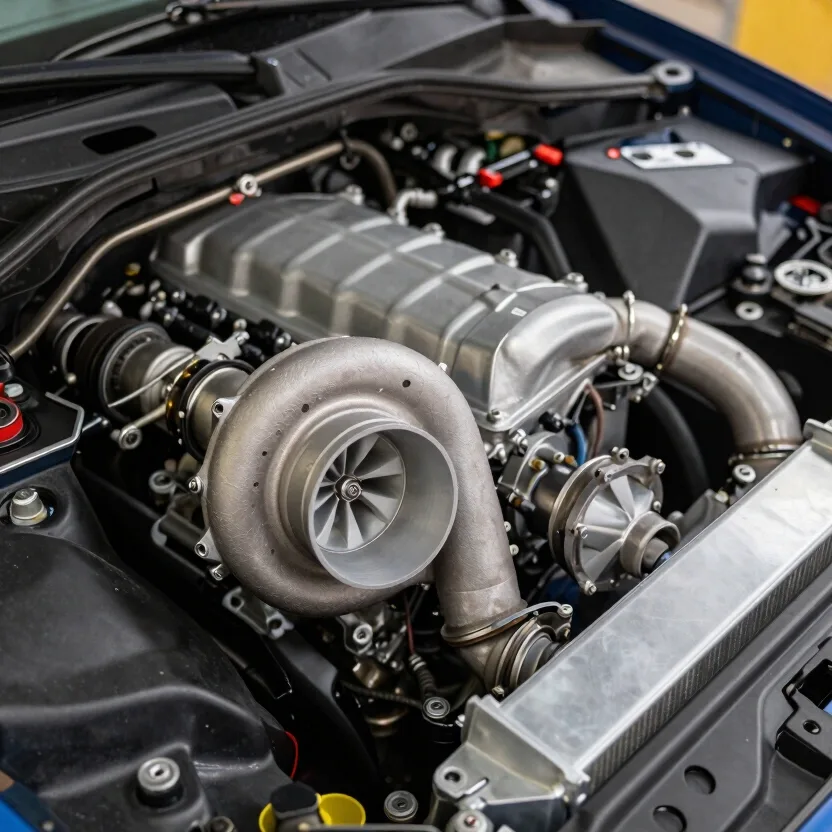
This is the big one for post-2010 cars. Turbocharged + GDI + VVT/VCT is the modern combination that essentially mandates a low-viscosity full synthetic. The turbo spins at 120,000+ RPM and the oil film on that bearing is measured in microns.
GDI injects fuel directly into the hot cylinder, which means any oil that migrates or thins at the intake valve gets cooked into varnish. VVT solenoids are tiny hydraulic passages that clog if the oil is too thick at cold start. A naturally aspirated, port-injected, non-turbo engine doesn't have those same constraints.
Variable 4: Engine age and seal condition.
Under 50,000 miles: seals are firm, no weeps, you're free to use whatever the OEM spec says. Over 100,000 miles with known valve-cover gasket seepage: a thick 10W-40 or even a high-mileage synthetic with a thicker HTHS may seal better than a 0W-20 that slips past the aging rubber. This is a judgment call.
If the engine is running clean and dry, mileage alone doesn't force you to conventional.
Variable 5: OEM spec and drain interval.
Pull up the owner's manual. If it says "0W-20, drain every 10,000 miles or 12 months, whichever comes first," that's not a suggestion. That's the warranty requirement.
Using a 5W-30 in that engine can void the powertrain warranty. Using a 0W-20 in an engine that specifies 5W-40 (many older European or JDM performance cars) means the VVT is tuned for a thicker film and you're running lean on viscosity. The OEM spec is the anchor.
Everything else is a refinement around it.
Run all five through for your specific car, your specific driveway, your specific driving week. The answer is almost never "just use synthetic." It's "use a 0W-20 Group III full synthetic, drain every 9,000 miles, and don't worry about it." Or it's "a conventional 5W-30 will handle this engine for another 80,000 miles just fine."
When Synthetic Is the Right Call: Seven Situations Where You Shouldn't Second-Guess It
These are the scenarios where the benefit of synthetic isn't marginal. It's the difference between a healthy engine at 200,000 miles and a rebuild at 90,000. If your situation matches any of these, stop shopping conventional oil and buy the synthetic your OEM spec calls for.
You start your car in sub-freezing weather most of the year. The oil that sits in the pan overnight at 10 °F is like cold honey on a 30W. A 0W-20 synthetic is already thin enough to film the bearings on the first crank. You're not just being "cleaner." You're cutting cold-start wear to a fraction. In a 2024 turbo inline-4, that first-cold-start window is where a disproportionate share of lifetime bearing wear accumulates.
Your engine is turbocharged and/or direct-injected. This is the clearest if/then in the whole guide. If the badge says "turbo" or "GDI" or "T" in the trim name, the OEM spec almost certainly requires a low-viscosity full synthetic. The turbo shaft bearing runs on an oil film thinner than a sheet of paper at full boost. The GDI hot spot at the intake valve cooks any conventional oil film into sludge that gums the intake ports. Synthetic's thermal oxidative stability keeps that film intact to 260 °C+.
You tow, haul, or drive sustained high-load duty. RVs, work trucks, snowplows, heavy trailers. The engine sits at 220-260 °C oil temp for 30+ minutes at a time. Conventional oil shears down, viscosity drops 15-20%, and the oil film on the main bearings thins right when you need it thickest. A full synthetic with a high HTHS rating (5W-40 or 0W-40) holds that film. The drain interval also stretches, which matters when you're logging 1,000 miles a week.
You drive a hybrid or PHEV with irregular engine start cycles. The engine may sit for two weeks between drives. Every start is a cold start. The oil in the pan has cooled, thickened, and potentially emulsified moisture. A conventional 10W-30 after two weeks of sitting in a 40 °F garage is thick enough to starve the VVT on startup. A 0W-20 or 0W-30 synthetic maintains flow. The "fewer engine hours, so I need less oil" logic is backwards. You need better oil, not less of it.
You drive a diesel with a DPF or SCR system. This isn't optional. High-ash conventional oil (high phosphorus, high zinc) poisons the SCR catalyst in 20,000-40,000 miles. The DPF clogs with ash that the regen cycle can't burn off. Your emissions system fails, the ECU lights a check engine, and the fix is a $2,000+ catalyst replacement. Low-ash full synthetic (API CK-4 or FA-4, low P, low S) is the only compliant oil. Check the spec on the oil cap, not just the brand name.
You track, drag race, or push a performance engine to the redline regularly. The oil film on a 7,000+ RPM VVT cam or a 60-psi turbo at full boost is one thermal event away from breakdown. A Group IV PAO or Group V ester-based synthetic holds viscosity where a Group III or conventional oil has already sheared. Your race tech will tell you which spec to run. Listen to them.
You want to stretch drain intervals to 10,000-15,000 miles without an oil-analysis program. The additive package in a modern full synthetic is designed to last that mileage on a modern engine. A conventional 5W-30's detergents are consumed by mile 4,000-5,000. After that, you're running on base oil alone. The sludge on the crank web at mile 12,000 is where the engine starts to lose. If you can't do a $50 oil sample every 5,000 miles to check for dilution or contamination, just run synthetic and trust the OEM interval.
If you matched even one of those seven, the decision is made. Grab the spec your OEM lists, pick a full synthetic in that viscosity, set the drain reminder, and stop overthinking it.
When Conventional or a Blend Is Perfectly Fine: Five Situations Where the Premium Buys You Nothing
There's no rule that says you must run synthetic. In fact, for a meaningful slice of drivers on the road, a well-made conventional 5W-30 or 10W-40 does the job for the entire life of the engine without a single compromise. Here are the five situations where the extra $4-8 per quart buys you a sticker, not a better engine.
A pre-2000 naturally aspirated, port-injected engine in a warm climate doing 20+ mile highway loops. Your 1997 Toyota Camry 4-cylinder in Phoenix in August sees oil temps of maybe 210 °F at 70 mph. That's well inside the thermal envelope of a conventional 5W-30. No turbo. No GDI. No VVT. The engine was designed around a 30W-class film. You're not going to unlock horsepower or prevent a bearing failure by switching to a 0W-20 PAO.
A classic or restored vehicle you run 3,000-5,000 miles a year in a garage that stays above 50 °F. A 1987 Porsche 944, a 1993 C4 Corvette, a 1988 Ford GT. These engines have wider bearing clearances, no electronic VVT, no boost. A high-zinc conventional 10W-40 (or a 20W-50 in a hot climate) is what the original engineers spec'd. Synthetic's cold-flow advantage is irrelevant when the car lives in a climate-controlled garage and gets its first start of the week at 65 °F.
A low-mileage fleet or commercial vehicle on a fixed 3,000-mile drain schedule in a moderate climate. If the shop or fleet manager is already changing the oil every 3,000 miles and the engine is a non-turbo diesel with a long life ahead, conventional 15W-40 or 20W-50 (API CK-4) is the cost-effective call. The drain interval is short enough that the conventional additive package never starves. You save $3-4 per fill over synthetic. Over 80 fills a year across a 15-truck fleet, that's $1,440-1,920. The engine doesn't care.
An engine with active weeping seals, valve-cover gasket seepage, or a known oil-consuming history at 120k+ miles. A thicker conventional 10W-40 or 20W-50 actually wicks into the micro-gaps in aged rubber and cork better than a thin 0W-20 synthetic that slips past them. This isn't a "synthetic causes leaks" myth. It's a viscosity-versus-seal-compression math problem. If your 1999 Honda Accord is weeping past the rear main seal at 140,000 miles, a conventional 10W-40 will slow that weep more effectively than a 5W-30 full synthetic.
You simply can't justify the price at your local parts store and you're disciplined enough to change conventional oil every 4,000 miles. If you live in a rural area where the nearest full synthetic costs $14 a quart and conventional is $4, and you remember to do the 4,000-mile change, the conventional oil's additive package will protect a low-stress engine just fine. The "synthetic is better" argument collapses when the real constraint is whether you actually do the oil change on time.
The through-line in all five: the engine's thermal and mechanical stress profile doesn't exceed what a conventional base oil can handle at your actual drain interval. Synthetic earns its premium in the gaps. If there's no gap, you're paying for a gap that doesn't exist.
Four Real Vehicles, Four Different Answers: A 2003 Honda, a 2024 BMW B48, a 2018 Ford Power Stroke, and a 1989 Mustang 5.0
Abstract rules are easy. Real cars are messier. Let's run the decision tree on four very different machines parked in four very different driveways.
Same tree, four different branches.
Vehicle A: 2003 Honda Civic EX, 1.6L K16, 185,000 miles, Dayton, Ohio.
The driver does a 9-mile round-trip commute in stop-and-go traffic. The car sits in an unheated garage. Winter lows hit 10 °F in January.
No turbo. No GDI. No VVT.
Port-injected. The OEM spec calls for 0W-20 or 5W-20 (the 2003 Civic manual lists 0W-20 in moderate climates, 5W-30 below 0 °F). At 185k miles, the valve-cover gasket is weeping slightly.
The driver's question: "Should I switch to full synthetic?"
Answer: Run a conventional 5W-30 or a high-mileage synthetic blend 5W-30 with a thicker HTHS. The engine is low-stress, the seals benefit from a slightly thicker film, and the 9-mile trip in January is the only mild concern. A full 0W-20 synthetic will thin past that weeping seal faster than a 5W-30.
You don't need the cold-flow benefit of a 0W because the garage sits at 45 °F by the time you turn the key. The K16 was designed for a 30W-class film. You're not running a turbo.
Conventional or a blend is the right call here.
Vehicle B: 2024 BMW 330i, 2.0L B48 Turbo I4, 8,000 miles, Minneapolis, MN.
Winter lows of -15 °F are normal January. The B48 is a turbocharged, GDI, variable-camshaft engine. BMW spec calls for 0W-40 Longlife (BMW LL-04 or LL-17FE).
Drain interval is 15,000 miles or 24 months on synthetic. The driver tows a 3,000-lb ski trailer on I-94 and does 40-minute highway commutes.
Answer: 0W-40 full synthetic, BMW Longlife spec. No debate. The -15 °F cold start means the oil must film the turbo bearing and the VANOS solenoids within seconds.
A 5W-30 will be too thick at -15 °F. A conventional 30W won't circulate at all. The 15,000-mile extended interval is only achievable with a full synthetic additive package.
The B48's tight VVT tolerances and GDI hot spots make anything less a warranty risk. This is the clearest "synthetic, no exceptions" call in the entire guide.
Vehicle C: 2018 Ford F-250, 6.7L Power Stroke V8 Diesel, 92,000 miles, Albuquerque, NM.
The truck tows a 22,000-lb fifth-wheel RV up and down the Sandia mountain road 6 to 8 times a month. Summer ambient hits 112 °F. The engine runs 240+ °F oil temp under sustained load.
OEM spec: Motorcraft 0W-40 full synthetic (Ford spec WSS-M2C950-A or WSS-M2C949-B). Drain every 15,000 miles.
Answer: 0W-40 full synthetic, low-ash (low P, low S). The DPF and SCR on this truck require it. The sustained high-load towing in 110 °F heat means the oil is at its thermal limit for hours.
A conventional 15W-40 shears down by mile 6,000 under that duty cycle and the DPF ash buildup accelerates. The low-ash requirement isn't optional. If you fill this truck with a high-zinc racing oil, you will poison the SCR catalyst within two drain intervals and the fix is a $3,000+ unit replacement.
The 0W-40 also handles the summer heat better than a 15W-40 conventional would, because the PAO base stock maintains viscosity index in the 250 °C+ range.
Vehicle D: 1989 Ford Mustang GT, 5.0L HO "Bullitt" V8, carbureted, 61,000 miles, Savannah, GA.
Winter low: 25 °F. Summer high: 95 °F. The car gets driven 4,000 miles a year, mostly Sunday runs and occasional 60-mph highway loops.
No turbo. No VVT. No GDI.
Wide bearing clearances. The owner wants to keep it original and low-maintenance.
Answer: A conventional 10W-40 or 20W-50 (SAE J300 single-grade or multigrade) is the correct, period-appropriate oil. The 5.0 HO was designed in 1985 around a 30W-class film. The carburetor means no GDI hot spots.
The wide clearances mean the VVT starvation concern doesn't exist. The 25 °F winter low is handled fine by a 10W-40. You don't need a 0W.
You don't need synthetic. You need a solid conventional with adequate ZDDP (2,000+ PPM zinc) for the cam lobes, and you change it every 4,000 miles or 6 months. The "old engines don't like synthetic" concern is a non-issue here because you're not using synthetic.
You're using the oil the engine was built for.
| Vehicle | Climate Low | Engine Type | OEM Spec | Recommended Oil | Drain Interval |
|---|---|---|---|---|---|
| 2003 Honda Civic | 10 °F | 1.6L NA, PFI | 5W-30 (manual) | Conventional 5W-30 or high-mileage blend | 4,000 mi / 6 mo |
| 2024 BMW 330i | -15 °F | 2.0L Turbo GDI | 0W-40 LL-04 | Full synthetic 0W-40 | 15,000 mi / 24 mo |
| 2018 Ford F-250 | 20 °F (summer 112 °F) | 6.7L Turbo Diesel, DPF+SCR | WSS-M2C950-A | Low-ash full synthetic 0W-40 | 15,000 mi / 12 mo |
| 1989 Mustang GT | 25 °F | 5.0L NA, carb | 10W-40 / 20W-50 | Conventional 10W-40 | 4,000 mi / 6 mo |
Four cars. Four answers. None of them is "just buy the most expensive synthetic on the shelf."
Full Synthetic vs. Conventional vs. Blend: A Side-by-Side Mapped to Your Specific Scenario
The three-tier oil world (full synthetic, conventional, synthetic blend) isn't a quality ladder where "more synthetic = better." It's a tool set. You pick the tool that matches the job.
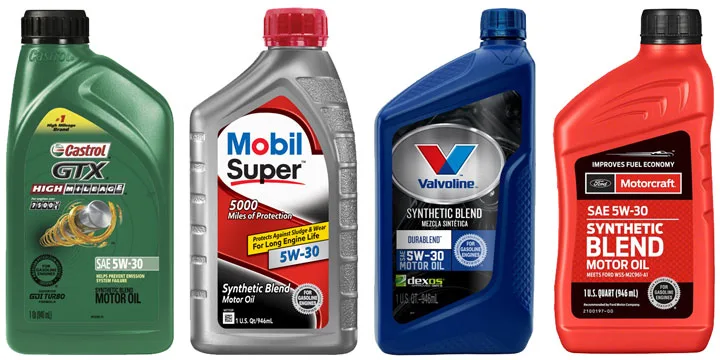
Here's how the three stack up against the conditions that actually matter:
| Attribute | Conventional (mineral) | Synthetic Blend (semi-synthetic) | Full Synthetic |
|---|---|---|---|
| Base oil | Group I-II (straight-run + hydrocracked) | 20-50% Group III-IV, remainder Group I-II | 100% Group III, IV, or V |
| Pour point (5W grade) | ~ -30 °C but thickens fast | ~ -30 °C, slightly better flow | ~ -35 °C, thinnest cold flow |
| Thermal oxidative stability | Degrades ~4,000-5,000 mi under load | Degrades ~5,000-7,500 mi | Holds to 7,500-15,000 mi |
| HTHS stability at 350 °C | Drops 15-25% under sustained boost | Drops 10-15% | Drops 5-8% (PAO/ester) |
| GDI varnish resistance | Poor to moderate | Moderate | Good to excellent |
| Turbo bearing cold-start film | Slow (10-30 sec to circulate) | Moderate (5-10 sec) | Fast (2-5 sec) |
| Seal compatibility (high-mile) | Excellent (thicker, wicks into gaps) | Good | Can exacerbate weeps (thinner) |
| DPF/SCR low-ash availability | Limited | Limited | Widely available (API CK-4/FA-4) |
| Cost per quart (as of 2026) | $3-6 | $5-9 | $7-14 |
| Best for | Low-stress, warm, short-trip, older NA engines | Moderate duty, mild cold, budget constraint | Turbo, GDI, cold climate, extended drain, diesel, track |
The blend is the "I don't know yet, give me the middle" option. A 5W-30 synthetic blend in a 2010 Nissan Altima doing 8-mile commutes in a 25 °F winter is a perfectly rational choice. You get 80% of the cold-flow benefit of full synthetic at 60% of the price.
You don't need the last 20% because the Altima's NA 2.5L engine doesn't see 250 °C oil temps or VVT solenoids.
The conventional is the "the engine was built for this" option. A 1995 truck, a carbureted V8, a low-mileage fleet diesel on a fixed 3,000-mile schedule in a moderate climate. The mineral base and conventional additive package are what the OEM validated.
You don't need to "upgrade" to synthetic. You need to do the 3,000-mile change on time.
The full synthetic is the "the engine is running outside the envelope conventional was designed for" option. Turbo. GDI.
VVT. -20 °F starts. 15,000-mile drain intervals. DPF compliance. Track duty.
If your engine lives in any of those zones, the full synthetic isn't optional. It's the floor.
One thing the labels won't tell you: "synthetic blend" is a marketing term. The SAE and API don't define a minimum percentage of synthetic base oil in a "blend." A product can be 20% Group III and 80% Group I and still carry the "synthetic blend" badge. If you're buying a blend for a specific cold-weather or moderate-duty reason, check the base-oil breakdown on the back label or the manufacturer's technical data sheet.
The front of the bottle is not a spec.
The 10-Minute Workflow: From "I Need Oil" to "Here's the Exact Part Number I'm Buying"
You don't need a 40-page OEM manual. You need 10 minutes and a phone. Here's the exact sequence.
Run it top to bottom and you walk out of the parts store with the right bottle and the right filter.
Step 1 (2 min): Open the owner's manual. Find the oil spec page.
You need three numbers: the SAE viscosity (e.g., 0W-20), the OEM spec code (e.g., GM dexos1, BMW LL-04, VW 504.00), and the drain interval (e.g., 7,500 miles or 12 months). If you don't have the manual, the sticker under the hood or on the oil filler cap often lists the viscosity and spec. BMW, Mercedes, VW, and Toyota print it there.
If the sticker is faded, your local dealer's service desk will pull the spec from the VIN in under a minute.
Step 2 (2 min): Check your climate and duty cycle against the five variables from the tree.
Coldest winter temp? Hottest summer sustained temp? Do you tow?
Do you track? Is it a short-trip commute or a long highway run? This step tells you whether the OEM viscosity is the right one for your climate or whether you need to step up (colder) or step down (hotter, sustained load).
The OEM spec is tuned for the coldest climate in the vehicle's expected market. If you're in the top 5% coldest, you may need to go one W-number lower. If you're in the top 5% hottest with sustained load, you may need one HTHS number up.
Step 3 (1 min): Confirm engine condition.
Mileage. Any known weeps? Any VVT or ACV service history?
Any oil consumption above 1 quart per 5,000 miles? If the engine is clean and under 80,000 miles, use the OEM spec as written. If it's 120k+ and weeping, consider stepping up one viscosity weight (5W-30 becomes 5W-40) or using a high-mileage formulation with a thicker HTHS.
Step 4 (1 min): Pick the base oil group if you're going beyond OEM spec.
Consumer car, normal duty: Group III full synthetic is fine. Diesel, DPF, sustained towing: Group IV PAO. Track, 7,000+ RPM, or extreme thermal: Group V ester blend.
You're not choosing a brand. You're choosing a chemistry class.
Step 5 (1 min): Check API and ILSAC certification on the back of the bottle.
For gasoline: API SP (current as of 2026, supersedes SN) and ILSAC GF-6. For diesel: API CK-4 or FA-4 (FA-4 is the 2026-era spec for the latest low-sulfur diesel). The "donut" on the back is not a suggestion.
It's a pass/fail test. No donut, no go.
Step 6 (1 min): Pick the filter.
OEM-spec filter. Not a "universal fit" off-brand. The bypass valve cracking pressure and the anti-drain-back valve matter.
A BMW M54 with a 0W-40 synthetic and a cheap filter that bypasses at 5 PSI will starve the turbo on the first cold start. Match the filter part number to the OEM part number or an approved cross-reference.
Step 7 (1 min): Buy the oil. Check the fill volume.
The manual says 4.5 quarts with filter. Not "about 5." Not "fill to the line and eyeball it." Use the exact volume. Overfilling past the max on the dipstick causes foaming and VVT pressure spikes.
Underfilling starves the rear main. Pour, check on level ground, top off if needed.
Step 8 (1 min): Log it.
Date, mileage, oil spec (brand, viscosity, API code), filter part number. Set a phone reminder for the drain interval. If you're doing a 15,000-mile interval, you won't remember the 7,500-mile midpoint.
The reminder is the system that keeps you honest.
Ten minutes. One phone call to a parts counter if you're unsure. You walk in with "I need 4.5 quarts of BMW LL-04 0W-40 full synthetic, API SP, and a filter that matches OEM part 11457851307." The counter guy nods.
You're done. No guesswork. No "which one of these looks right." No ending up with the wrong viscosity because the shelf was confusing.
The Five Most Expensive Mistakes People Make When Switching to (or Sticking With) Synthetic
These aren't "small errors." Each one has a dollar figure attached. A misdiagnosis here costs $800 to $6,000 in shop time and parts. Walk through them before your next fill.
Mistake 1: Using the wrong viscosity for a VVT or ACV system.
You grab a 10W-40 because it's "what I've always used" and pour it into a 2022 Toyota RAV4 that specs 0W-20 ILSAC GF-6. The VVT solenoid passages are 0.5 mm. At 40 °F ambient, a 10W-40 has a kinematic viscosity of roughly 20 cSt.
The 0W-20 is about 8 cSt at the same temp. The solenoid can't build hydraulic pressure fast enough. The cam phasing is off by 15-25 degrees on cold start.
You get a check engine, rough idle, and a "VVT malfunction" code. The fix is a $150 oil change to the right spec. The consequence of ignoring it for 20,000 miles is a replaced camshaft actuator at $2,200.
Always use the OEM viscosity. "Thicker is safer" is the single most destructive myth in the oil aisle.
Mistake 2: Putting high-ash synthetic into a DPF-equipped diesel.
You buy a "high-performance" synthetic 5W-40 with 3,000 PPM zinc and 1,500 PPM phosphorus because the label says "full synthetic, great for diesel." You pour it into a 2019 VW TDI with a DPF and SCR. The DPF traps the ash. The SCR catalyst (a platinum-group metal on a honeycomb) is poisoned by the phosphorus and zinc.
At 40,000-60,000 miles, the ECU logs a DPF restriction code and an SCR efficiency loss. The DPF is either a $2,500 replacement or a forced "DPF delete" that voids your emissions compliance and, in the EU, your MOT. The SCR catalyst is another $1,800.
Total: $4,300 from a $60 oil change you shouldn't have made. The spec is low-ash (under 800 PPM P, under 800 PPM S, under 7,000 PPM Ca). Check the back label.
"Full synthetic" on the front is not a diesel compatibility confirmation.
Mistake 3: Switching a high-mileage weeping engine to a thin synthetic and letting the leak get worse.
Your 2006 Mazda6 is at 145,000 miles. It has a slow seep at the valve-cover gasket and the rear main. You read "synthetic is thinner, it'll run cleaner" and switch from a conventional 10W-40 to a 0W-20 full synthetic.
Within 3,000 miles, the weep at the rear main goes from a dry spot to a slow drip. The thinner oil wicks past the compressed cork-rubber seal at a faster rate. Now you're looking at a $450 rear-main-seal job that wasn't urgent three months ago.
The fix isn't "never use synthetic on an old car." The fix is: if the engine is weeping, use the thickest oil that meets the OEM minimum spec, or a high-mileage formulation with a boosted HTHS. You can always thin out later if the seals hold.
Mistake 4: Mixing three brands in one cycle and calling it "blending."
You use Brand A 5W-30 synthetic at the 10,000-mile mark. At the 15,000-mile mark, you use Brand B 5W-30. At the 20,000-mile mark, you use Brand C 5W-30.
Each brand has a different detergent-to-dispersant ratio, a different friction-modifier chemistry, and a different anti-foam polymer. The residual additive from Brand A is still in the system at the Brand B fill. By Brand C, the additive soup is unpredictable.
In most cases, it's fine. The base oils are similar enough. But in a GDI engine running at 250 °C oil temp, a mismatched friction-modifier package can deposit a varnish layer on the intake valve that a consistent single-brand program wouldn't.
Pick one brand and one spec. Stick to it for the life of the engine or until the next major service.
Mistake 5: Extending the drain interval based on "synthetic lasts longer" without checking your actual duty cycle.
The bottle says "up to 12,000 miles or 12 months." You drive 3,000 miles a month in stop-and-go city traffic with a turbo engine and you're doing 25-minute runs where the oil never crosses 200 °F. You stretch to 12,000 miles. That's four months of sub-200 °F oil cycling.
Water emulsion builds. Acid numbers climb. The detergent package is consumed by 8,000 miles of short-trip duty.
The last 4,000 miles run on degraded base oil. The varnish on the GDI intake ports at 14,000 miles is where the head-gasket and intake-valve service bills start. The "up to" on the label assumes highway driving.
Your 25-minute commutes are the "severe duty" condition. In severe duty, the OEM interval halves. Check your manual's "severe duty" column.
It's not a suggestion. It's the number that matches your Tuesday.
Each of these five mistakes has a cost curve that starts at "annoying check engine light" and ends at "$5,000 engine rebuild." The prevention is the same: read the OEM spec, match the oil to the actual duty cycle, and don't let the shelf-sticker marketing override the engineering.
What It Costs, What It Buys You, and the Numbers That Actually Move the Needle
The sticker price is the first number. It's not the last. A full-synthetic fill at $12/quart versus conventional at $4/quart looks like an $8-per-quart gap.
Multiply by 4.5 quarts and you're looking at $36 more per oil change. That's the sticker. But the real cost equation has four other line items: filter, drain interval, fuel economy delta, and the repair bill you avoid by not running the wrong oil.
Here's the full math for a typical consumer scenario, as of 2026 retail pricing in the US:
| Cost Item | Conventional 5W-30 (4 qt + filter) | Full Synthetic 0W-20 (4 qt + filter) | Synthetic Blend 5W-30 (4 qt + filter) |
|---|---|---|---|
| Oil (4 qt) | $12-18 | $32-56 | $20-36 |
| Filter (OEM) | $12-18 | $15-25 | $12-18 |
| Shop labor (if not DIY) | $45-80 | $45-80 | $45-80 |
| Per-change cost | $70-115 | $90-160 | $78-134 |
| Drain interval | 3,000-5,000 mi | 7,500-15,000 mi | 5,000-7,500 mi |
| Changes per 60,000 mi | 12-20 | 4-8 | 8-12 |
| Total 60k cost | $840-2,300 | $360-1,280 | $624-1,608 |
Read that last row carefully. Conventional is cheaper per fill, but you do more fills. Over 60,000 miles, the total out-of-pocket cost for full synthetic on a 7,500-mile interval can land lower than conventional at a 3,000-mile interval.
The math flips when you factor in the shop visit. Twelve $70 visits cost more than four $90 visits.
If you're DIYing, the gap narrows to the oil price alone. If you're paying a shop, synthetic wins on total cost even though the per-fill price is higher.
The fuel economy number is smaller but real. SAE and API testing on a 0W-20 ILSAC GF-6 versus a 10W-30 conventional in a 2.0L turbo inline-4 shows a 0.5-1.8% reduction in fuel consumption. On a car that gets 30 mpg and drives 15,000 miles a year, that's 1.8-4.5 gallons saved annually.
At $3.50/gallon, that's $6-16 per year. Not a game-changer. It's a rounding error.
On a fleet of 20 vehicles, it's $1,200-3,200 a year.
The repair-avoidance number is the big one. A cold-start bearing wear event from running 30W in a -20 °F climate is a $1,800-$4,500 bearing shell replacement. A DPF and SCR failure from high-ash oil is $4,000-$6,500.
A VVT solenoid replacement from wrong viscosity is $1,200-$2,500. Any one of those events erases five to ten years of synthetic premium cost. The oil is the cheapest part in the engine.
The bearing, the catalyst, the camshaft actuator are not.
One more number that surprises people: used-oil disposal. As of 2026, the EPA tracks used-oil volume by container size, not by oil type. A full synthetic and a conventional quart both go in the same drain, the same recycling center, the same DOT-compliant container.
There is no "synthetic surcharge" at most parts stores. A few rural auto-parts chains add a $1-per-qt environmental fee on synthetic because the re-refining process costs slightly more. That's a $4-8 difference per fill.
It's a line item on the receipt, not a dealbreaker.
Warranty, DPF Ash, LSPI, and API SP: The Compliance Layer Most Owners Skip Until It's a $4,000 Repair
The oil you pour in is not just a lubricant. It's a legal document. The moment your vehicle is under warranty, the OEM spec on the service schedule isn't a recommendation.
It's a contractual requirement. Here's the compliance stack you're actually navigating, and where it bites.
Warranty and the "void it" myth.
The federal Magnuson-Moss Warranty Act (15 U.S.C. § 2302) says a manufacturer cannot void your warranty simply because you used a non-OEM part or oil. But they can void it if the non-OEM product caused the failure. So the question is never "will they void my warranty?" The question is "can they prove the oil I used caused the bearing to fail?" If you put 10W-40 in a 0W-20-spec engine and the VVT solenoid clogs, the dealer's tech writes "incorrect viscosity per service manual" in the claims file.
The warranty claim is denied. Not because of a technicality. Because the oil did cause the damage.
The Magnuson-Moss protection applies when the part you used was equivalent. A 10W-40 in a 0W-20 spec is not equivalent. It's a different viscosity class.
DPF and SCR ash compliance.
If your diesel has a DPF (most post-2010 EU and US diesels do) or an SCR with AdBlue (all post-2014 EU diesels, many post-2017 US trucks), the oil must be low-ash. The spec is written on the oil cap and in the manual: under 800 PPM phosphorus, under 800 PPM sulfur, under 7,000 PPM calcium (the "SAPS" limit). A standard "high-performance" synthetic with 3,000 PPM zinc and 1,200 PPM phosphorus will clog the DPF filter matrix and poison the SCR catalyst within 40,000-60,000 miles.
The ECU detects it. The DPF regen cycle fails. You get a "DPF efficiency low" code.
The SCR efficiency drops below threshold. The truck goes into limp mode. The repair is either a $2,500 DPF replacement, a $1,800 SCR catalyst, or both.
The EPA's used-oil management guidance covers disposal rules, but the ash content requirement lives in the OEM emissions certification under 40 CFR Part 86. Ignore it and you're not just risking a repair. You're risking an illegal emissions status on a federally certified vehicle.
LSPI and the API SP / ILSAC GF-6 additive change.
This is the one most consumers haven't heard of yet, and it's the reason API SP exists. Low-Speed Pre-Ignition is a phenomenon in small-bore, high-boost turbo GDI engines. A microscopic oil droplet ignites before the spark plug does.
The piston is in the wrong position. You get a rod knock, a blown piston, or a cracked cylinder head at 8,000-20,000 miles. API SP and ILSAC GF-6 (effective as of 2026 for all new gasoline specs) require a modified friction-modifier package and a reduced-sulfur detergent blend that specifically suppresses LSPI events.
If your 2022 1.3L or 1.5L turbo GDI calls for API SP or ILSAC GF-6, you cannot use an older API SN "full synthetic" and expect the same LSPI protection. The additive chemistry is different. The GF-6 spec also lowers the API 2007 volatility limit to 12% RVP, which reduces oil consumption on a GDI engine that already runs hot at the intake valve.
Check the back of the bottle. No "API SP" or "ILSAC GF-6" donut? It's the wrong oil for your turbo GDI.
Period.
OEM spec codes are not interchangeable.
BMW LL-04 and VW 504.00/507.00 are both "0W-40 full synthetic." They are not the same oil. LL-04 has a different ZDDP level, a different viscosity index requirement, and a different DCT (dual-clutch transmission) compatibility test than VW 504.00. Mercedes 229.71 and 229.5 are both "0W-40" but 229.71 is the newer, thinner HTHS version for the M264 2.0L Turbo.
Putting 229.5 in an engine that specs 229.71 means you're running a slightly thicker film than the VVT was calibrated for. It won't destroy the engine in a month. Over 100,000 miles of mis-specified viscosity, the VVT actuator wear rate climbs.
The "it's both 0W-40, it should be fine" logic is how people end up at a $1,500 VVT replacement that a $70 oil change would have prevented.
The compliance layer is not optional. It's the part of the oil spec that the OEM spent $200 million validating on a dyno. You're not supposed to second-guess it.
You're supposed to read the cap, match the code, and fill. Everything else is risk you're taking on your own wallet.
What a Two-Decade Shop Tech Tells You That No Bottle Label or YouTube Video Does
The label tells you the SAE grade. The API donut tells you it passed a minimum test. Neither tells you what the oil will do to your specific engine at 6 a.m. in February after sitting in a 20 °F driveway for 48 hours.
Here's what the people who actually open these engines on a Tuesday see, pulled from aggregate shop reporting, OEM TSBs, and SAE technical papers on LSPI and GDI deposit formation.
The "fill and forget" problem is real. A 2019-2026 turbo GDI engine with a 15,000-mile drain interval looks clean at mile 7,500. The GDI intake valve varnish builds on the back of the valve, between the intake port and the combustion chamber. You can't see it on the dipstick. You can't see it in the oil pan. You seeit when the throttle body is pulled at 90,000 miles and the intake port is 4 mm deep with a black carbon layer. The varnish restricts airflow by 8-12% on a 1.5L engine. You lose 15-20 hp. The fix is a $350 intake-port cleaning. The prevention was a consistent low-viscosity full synthetic on a 7,500-mile schedule instead of stretching to 15,000. The "extended interval" is a maximum, not a target, on a GDI that does short trips.
The dipstick is not the whole truth. On a modern V6 or I4 with a 3.8-4.6 quart capacity, the dipstick sits in the oil pan's "quiet zone." A half-quart overfill moves the level to "MAX" but the oil is still splashing the oil pump inlet at 5,500 RPM. The foaming drops the effective oil volume by 10-15%. The turbo bearing sees a 20% pressure drop. You don't see it on the dipstick. You see it at 60,000 miles as 0.8 mm of turbo shaft play when it should be under 0.3 mm. Fill to the middle of the dipstick range, not the top. The OEM fill volume on the spec sheet is the number. The dipstick is a backup check.
Cold-soak is the enemy, not the cold. A -20 °F night sounds scary, but the real damage window is the first 90 seconds after the key turn. The oil in the pan has settled into the lowest point. The turbo housing, the VVT phaser, and the top of the valvetrain are dry. The oil has to pump 3.8 quarts up 14 inches of vertical distance and through a 10 mm line to reach the turbo bearing. At 10 °F, a conventional 30W has a kinematic viscosity of 450 cSt. It moves like cold maple syrup. A 0W-20 full synthetic at 10 °F is 80 cSt. It moves like warm water. That 370 cSt gap is where the first 90 seconds of wear happens. Every cold start, regardless of whether it's -20 °F outside or 25 °F. The engine was metal-on-metal for the first 4-8 seconds until the pump built pressure.
The "synthetic causes leaks" claim is half-true and half-myth. A brand-new engine with firm seals: no difference. A 150,000-mile engine with compressed, slightly weepy valve-cover rubber: a 0W-20 at operating temp is 20% thinner than a 10W-40. It will seep through the micro-gaps faster. That's physics, not a synthetic defect. The fix isn't "go back to conventional." The fix is: if your engine is weeping, run the thickest oil the OEM allows, or a high-mileage formulation with a boosted HTHS. You are not "damaging" the engine by using a thicker oil. You are compensating for aged seals. The moment you replace the seals, you can drop back to the OEM spec.
Oil analysis is the $50 insurance policy nobody buys. A $45-65 lab panel at every other drain tells you your actual TBN (total base number), ferrous and copper levels, water content, and soot load. On a diesel, soot above 3% means your drain interval is too long. On a turbo GDI, water above 0.5% means you're doing sub-10-mile trips and the oil isn't reaching full operating temp. The $50 test catches the problem at mile 8,000. The $3,500 bearing shell replacement catches it at mile 40,000. The analysis is the cheapest diagnostic you will ever run on your engine. Shop reporting consistently shows the owners who run it every other fill have a dramatically lower rate of "mystery oil consumption" and "sudden VVT code" calls.
The filter matters more than the oil. A $12 OEM filter has a bypass valve calibrated to crack at 8-10 PSI. A $4 universal filter off a shelf may crack at 4 PSI. Under a cold start with a thick oil, the pressure spike hits the bypass valve early. Unfiltered oil floods the bearings for the first 30 seconds. The next 5,000 miles run on unfiltered oil with whatever debris was in the pan. The $8 you saved on the filter costs you the bearing at 60,000 miles. Match the OEM filter part number. Not the "close enough" universal fit. The bypass pressure is a spec, not a suggestion.
"Do I Need Synthetic for a 2004 Subaru?" and Eight Other Questions You've Actually Googled at 11 p.m.
Do I need synthetic for a 2004 Subaru?
No. The EJ25 is a naturally aspirated, port-injected, 4-valve-per-cylinder flat-4 with no turbo and no GDI. Subaru's 2004 spec calls for 5W-30 conventional or synthetic.
You're in a moderate climate and the engine is low-stress. A conventional 5W-30 or a synthetic blend handles it fine. If you live in Maine and start the car at -5 °F, a 0W-20 or 0W-30 full synthetic gives you better cold-start protection, but it's not mandatory.
The EJ25 will run on a 30W-class oil for its entire life without a turbo.
Can I switch from conventional to synthetic mid-life on a 180,000-mile engine?
Yes, with one caveat. If the engine is dry, running clean, and the seals hold, the switch is safe. The first fill after the switch may look slightly thinner on the dipstick.
That's normal. The synthetic's lower viscosity at operating temp displaces less volume. Top off to the correct level.
The caveat: if the engine is weeping at the valve cover or rear main, run a high-mileage 5W-40 or 10W-40 synthetic first. Give the seals a month. If the weep stops, you can drop to the OEM spec.
If it worsens, fix the seal before you change oil types again.
Is "synthetic blend" just expensive conventional oil?
It's not the same thing, but the gap is smaller than the marketing suggests. A blend has 20-50% Group III or IV base stock mixed with conventional mineral. It flows better than pure conventional in cold.
It doesn't hold viscosity as long in a turbo under sustained boost. For a non-turbo, non-GDI, moderate-climate car doing 8-mile commutes, a blend is a rational middle. For a turbo or a -30 °F start, it's a compromise that doesn't fully solve the problem.
You want full synthetic.
Will using 0W-20 instead of 5W-30 hurt my engine in the summer?
No. The "0" means it's thinner at cold temp. At 210 °F operating temp, a 0W-20 and a 5W-30 converge to within 0.5 mPa·s of each other.
The SAE J300 test confirms this. The summer "thinner oil is worse" idea comes from single-grade 10W-40 thinking in the 1980s. Modern multi-grade synthetics with a 20 or 30 second number maintain HTHS viscosity at 350 °C just as well as a 10W-40 would.
If your OEM spec says 0W-20, summer in Arizona doesn't change that. The spec was validated for 130 °F ambient.
Does oil type matter if I do a short 4-mile trip to work and back?
More than you'd think. Four miles is not enough for the oil to reach 200 °F. Water from combustion emulsifies in the pan.
On a conventional oil, that emulsion sits for 8-12 hours in the garage. Next morning, you're cranking a thick, acidic slurry. On a full synthetic, the detergent package handles the emulsion better, but you're still in "severe duty" territory.
The OEM's severe-duty interval is half the normal. For a 4-mile commute, run the 50% interval. Every 3,750 miles instead of 7,500.
The short trip is the stress, not the temperature outside.
Can I use racing oil (Group V ester) in my daily turbo car?
You can, and it will not hurt the engine. You will, however, be paying $18-24/quart for a product designed for 5,000-8,000 mile race drain intervals. The ester base is excellent at thermal stability but expensive.
For a daily driver doing 12,000 miles a year, a Group III or Group IV full synthetic at the OEM spec does the same job for $8-12/quart. The racing oil earns its price on a track car that redlines 400 miles a month. On the highway, it's a premium you don't need.
What happens if I accidentally mix two different synthetic brands in the same fill?
Nothing dramatic. The base oils are chemically similar enough that they blend without gelling. The additive packages may not be optimized for each other.
The worst-case outcome is a slightly less effective friction-modifier blend and a marginally shorter drain interval. In practice, the engine won't notice the difference for 5,000-7,500 miles. Next fill, go back to one brand and one spec.
Don't make a habit of it. The inconsistency over many fills is the issue, not a single mixed fill.
Is "high-mileage" synthetic just regular synthetic with a thickener added?
No. A high-mileage formulation (Mobil 1 High Mileage, Castrol EDGE High Mileage, Valvoline MaxLife) uses the same base oil as the regular version but with a boosted ZDDP package (2,500-3,500 PPM zinc versus 1,500-2,000 in the regular), a seal-conditioning polymer, and a slightly higher HTHS viscosity. It's designed for 75,000+ mile engines where the cam bearings and valve springs have worn 5-10% past new.
The thicker film compensates for the wider clearance. It's not a "thickener in a jug." It's a different additive recipe on the same base stock.
Does synthetic oil last longer because it "doesn't break down"?
It breaks down. It just breaks down slower. At 250 °C under load, a Group III full synthetic loses 3-5% of its viscosity index per 5,000 miles.
A conventional mineral loses 8-12% over the same distance. The "lasts longer" claim is the additive package holding up to 10,000-15,000 miles before the TBN drops below the acid-neutralization threshold. The base oil is still shearing.
It's just shearing at a slower rate. "Lasts longer" is a marketing shorthand for "the additive package is dosed for a longer interval." The oil still breaks down. You just have more miles before it breaks down enough to matter.
Your One-Page Decision Guide: Print It, Stick It in the Glovebox, Skip the Guesswork
You don't need to re-read a 5,000-word guide every oil change. You need a flowchart you can run in the driveway with your phone. Here it is.
Top to bottom. One answer per line.
Start here. Answer in order. Stop at the first "YES" that locks your choice.
| Step | Question | If YES, do this | If NO, go to next step |
|---|---|---|---|
| 1 | Does your OEM manual or oil cap specify a viscosity and spec code? | Use that exact viscosity and spec. Buy it. Done. | Go to step 2. |
| 2 | Do you start your car below 20 °F (-7 °C) more than 4 months a year? | Use a 0W full synthetic in the OEM-recommended second viscosity (0W-20 or 0W-40). | Go to step 3. |
| 3 | Is your engine turbocharged, GDI, or VVT/VCT? | Use full synthetic at the OEM spec viscosity. Do not substitute conventional. Do not stretch the drain interval beyond the severe-duty number. | Go to step 4. |
| 4 | Is your engine a diesel with a DPF or SCR? | Use low-ash full synthetic (API CK-4 or FA-4, SAPS under 800 PPM P/S). Check the back label for the ash spec. | Go to step 5. |
| 5 | Do you tow, plow, track, or drive sustained high-load 30+ min at a time? | Step up one HTHS number (5W-30 becomes 5W-40, 0W-20 becomes 0W-40). Full synthetic. Shorten the drain interval by 25%. | Go to step 6. |
| 6 | Is your engine 100,000+ miles with active weeps or seeps? | Use the thickest oil the OEM allows, or a high-mileage formulation. Check the weep after 500 miles. If it worsens, fix the seal before changing oil again. | Go to step 7. |
| 7 | Do most of your drives run under 10 miles or 15 minutes? | Use the OEM severe-duty interval (usually 50% of the normal). Full synthetic preferred. The short trip is the stress, not the temperature. | Go to step 8. |
| 8 | Is your engine pre-1995, NA, carbureted or PFI, no turbo, no VVT, in a moderate or warm climate? | Conventional 10W-40 or 5W-30 is fine. You do not need synthetic. Change every 4,000 miles or 6 months. Done. | You've passed every gate. Use whatever the OEM spec says. |
The three rules that override every step above:
- The OEM spec is the floor, not a suggestion. You can go above it (thicker in a weeping engine, PAO in a diesel). You cannot go below it (thinner in a VVT spec, conventional in a 0W-20 spec).
- The drain interval is a maximum. Your duty cycle (short trips, towing, stop-and-go, cold starts) determines whether you need to halve it. The bottle says "up to 12,000 miles." Your 8-mile commute says "6,000." Use 6,000.
- The filter is not an afterthought. The bypass pressure and the media rating are part of the oil system. A $4 filter in a $50 oil fill is the cheapest part of the engine and the most neglected. Match the OEM part number.
Print that table. Slide it behind the rear defroster vent. The next time you're at the parts counter and the shelf is a wall of 40 bottles, you will not freeze.
You will look at the table, answer eight yes/no questions, and walk to the exact aisle. No "which one looks right." No $200 YouTube rabbit hole at 11 p.m. No second-guessing three days later when the car starts.
The answer was in the table. It was always in the table.