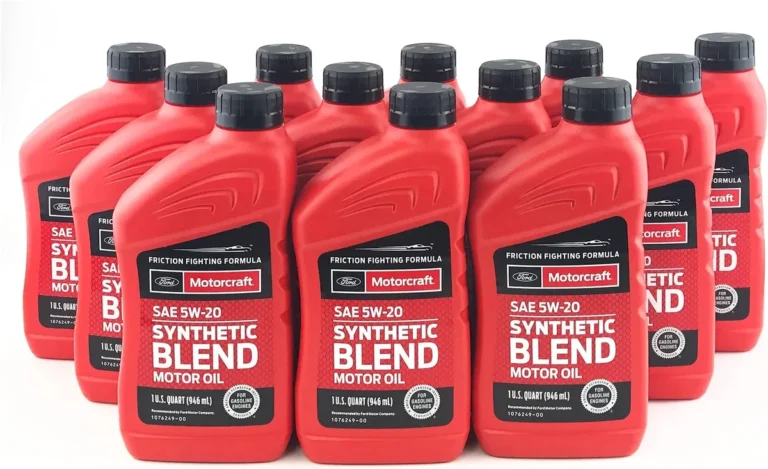
How to Read Motor Oil: Easy guide
Learning how to read motor oil is simpler than most oil-change counters make it seem. Start with the specification your engine requires, not the color, price, or “weight” on the bottle. Then measure the level and inspect the oil already in the engine for useful clues.
Labels such as 5W-30, API SQ, and ACEA C5 describe different parts of the oil’s job. As of 2026, ILSAC has also introduced GF-7A, and many manufacturers still require a specific OEM approval. Here’s how to match a bottle, read a dipstick, and spot signs that need attention.
Quick Answer
To read motor oil, match the bottle to your engine’s required specification. Check SAE viscosity, performance category, and any OEM approval. Then measure the level on level ground.
Finally, inspect used oil for fuel, coolant, soot, or wear.
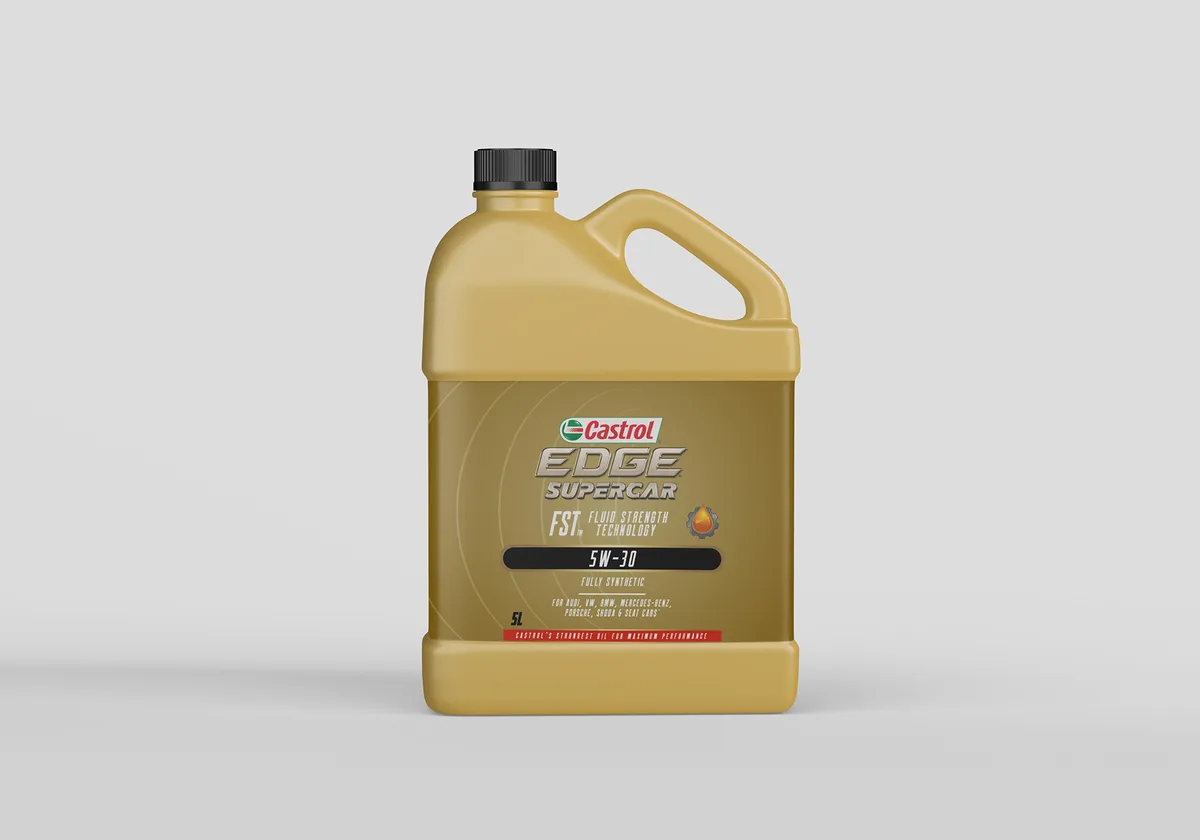
What “Reading Motor Oil” Actually Means
Reading motor oil involves three separate jobs. You may need to identify the correct formula, measure the level, or assess the oil already in the engine.
Each job uses different evidence. A bottle label describes a product. A dipstick measures a physical level.
A used-oil analysis measures what the lubricant collected while doing its job.
| What you need to learn | Main question | Best source |
|---|---|---|
| Which oil to use | What viscosity, category, and approval does this engine require? | Owner’s manual or manufacturer portal |
| How much oil is present | Is the level between MIN and MAX? | Dipstick or approved electronic system |
| What condition the oil is in | Is there fuel, coolant, water, soot, or abnormal wear? | Used-oil analysis and service records |
Choose the Right Oil Before You Open the Bottle
A correct product must satisfy every requirement listed for the engine. That includes the SAE viscosity grade, performance category, and any manufacturer-specific approval.
The owner’s manual remains the best starting point. Don’t assume that a familiar grade, such as 5W-30, is correct for every engine.
The same viscosity can appear in several different formulas. Both 0W-20 and 5W-30 oils may meet the same API category, yet they behave very differently at temperature.
What matters is the exact combination listed for your engine. A higher number isn’t automatically better, and a premium price doesn’t prove compatibility.
Check the Oil Level Correctly
A dipstick measures the oil present in the sump at a particular moment. It doesn’t identify the oil’s viscosity, performance category, or condition.
There is no universal waiting period for checking a dipstick. Some manufacturers specify a cold engine. Others require a warm engine and a set shutdown time.
Follow the procedure for your exact vehicle. A normal reading confirms quantity, but it doesn’t prove that the installed oil is correct.
Assess the Oil Already in the Engine
A visual check can reveal obvious changes in color, clarity, thickness, or odor. It can’t provide a reliable viscosity reading or measure internal engine wear.
Useful clues include:
- Unusual darkening that the service history doesn’t explain
- A milky or opaque appearance
- A strong fuel odor
- Visible coolant in the oil
- Metallic particles or grit
- Repeated low readings
- A rising oil level between services
- Low oil pressure, smoke, leaks, or unusual engine noise
If the oil is contaminated or disappearing quickly, don’t treat the condition as a routine oil change. Find the cause before replacing the oil.
Use the Right Tool for Each Job
You need different evidence for selection, measurement, and diagnosis.
| Tool or reference | What it supports |
|---|---|
| Vehicle owner’s manual | Oil grade, category, approval, capacity, and level procedure |
| Engine-bay information label | Quick viscosity or approval confirmation |
| Clean, lint-free rag | Wiping the dipstick before reading |
| Approved engine oil | Correct top-up or replacement |
| Service records | Oil history, mileage, repairs, and consumption trends |
| Used-oil analysis | Fuel, coolant, soot, water, viscosity, and wear measurements |
Why Oil Specification Errors Cause Problems
The wrong oil doesn’t always cause an obvious failure. That’s what makes specification errors easy to miss. An engine may run normally while receiving less protection than its design requires.
A dangerously low oil level needs faster attention than a bottle choice. A red oil-pressure warning means you should shut the engine off safely as soon as possible.
Viscosity Controls Flow and Film Strength
Viscosity describes how readily oil flows and how strongly it forms a lubricating film. If the grade is too thin for the operating conditions, hot oil pressure and film strength may fall outside the intended range.
If the grade is too thick, it may flow more slowly during cold starts. That can increase startup drag and delay lubrication to surfaces that need oil quickly.
Use this rule:
- If the manual specifies 0W-20, use 0W-20 unless it expressly lists an alternative.
- If the manual allows both 0W-20 and 5W-30, choose an approved option for the stated conditions.
- If the bottle shows 5W-30 but the engine requires 0W-20, a matching API category doesn’t fix the viscosity mismatch.
- If the manual is unavailable, don’t replace it with a generic rule about “light oil” or “thick oil.”
Engine clearances, oil-gallery sizes, bearing design, and operating temperatures all matter. A grade that suits one engine may be unsuitable for another.
Performance Category Covers Different Jobs
A viscosity grade describes flow behavior. A performance category shows that the finished oil passed tests for properties such as deposit control, wear protection, oxidation stability, and emissions-system compatibility.
If the viscosity is correct but the category isn’t, the oil can still be unsuitable. An engine may not receive the additive protection required for its combustion and aftertreatment systems.
This matters with:
- Gasoline direct-injection engines
- Turbocharged engines
- High-load diesel engines
- Engines using particulate filters
- Vehicles with selective catalytic reduction systems
- Older or high-mileage engines with different deposit-control needs
Some diesel engines need a low-SAPS formulation. SAPS stands for sulfated ash, phosphorus, and sulfur.
A low-SAPS oil can help protect sensitive emissions hardware, but it isn’t automatically right for every engine. The complete engine specification still controls.
OEM Approval Adds a Specific Requirement
An OEM approval confirms that a product has been approved for a stated vehicle application. It’s more specific than a general performance category.
An approval may identify:
- One or more permitted SAE viscosity grades
- A required high-temperature high-shear viscosity, or HTHS
- A particular performance standard
- Compatibility with a fuel-injection or emissions system
- A manufacturer-specific test or formula code
If the manual requires an OEM approval, a generic “meets specifications” statement isn’t enough. The required code must appear on the product documentation.
An approval doesn’t automatically extend the oil-change interval. The schedule remains a separate requirement.
What Happens When a Requirement Fails?
A failed specification can affect lubrication, deposits, fuel consumption, emissions hardware, or warranty terms.
| Mismatch | Possible consequence | Correct action |
|---|---|---|
| Correct viscosity, wrong category | Insufficient protection for deposits, wear, or emissions systems | Replace with the listed category |
| Correct category, wrong viscosity | Poor cold flow or inadequate hot-film strength | Use the listed grade |
| Required OEM approval missing | Unverified compatibility with the engine | Don’t use it as the long-term oil |
| Unknown oil already installed | Correct future specification can’t be confirmed | Identify the oil or perform a full change |
| Correct oil used with the wrong filter | Restricted flow, bypass, or contamination | Install the specified filter |
| Unapproved additive | Changed viscosity, foaming, or deposit movement | Remove it through a proper service |
| Extended drain interval | Less remaining protection and additive capacity | Follow the manufacturer’s schedule |
When a Failure Needs Immediate Attention
Stop the engine safely if the red oil-pressure warning comes on. Low pressure can result from low oil, a failed pump, a blocked filter, aeration, or internal mechanical damage.
Don’t treat the warning as a prompt to add oil and keep driving. A top-up won’t correct a failed pump, a severely worn bearing, or a blocked pickup.
Repeated large top-ups also deserve attention. A small amount may fall within the manufacturer’s allowance, but rapid consumption can indicate leaks, worn components, or fuel dilution.
If you find coolant, heavy fuel, metal, or water in the oil, diagnose the engine before replacing the oil. A fresh refill won’t remove the cause.
Decode the Oil Label: Four Checks That Matter
A motor-oil label contains useful technical information, but the largest number usually isn’t the best place to start. Check the complete label before judging the product.
| Check | What to find | What it answers |
|---|---|---|
| SAE viscosity | A grade such as 0W-20 or 5W-30 | How does viscosity change with temperature? |
| Performance category | API, ILSAC, or ACEA classification | Has the oil met a defined performance specification? |
| OEM approval | A manufacturer-specific code | Is it approved for the stated engine application? |
| Supporting claims | Base stock, certification, and marketing statements | Which details are technical, and which are promotional? |
1. Read the SAE Viscosity Grade Correctly
A grade such as 5W-30 describes one multigrade oil across a temperature range. It doesn’t mean the bottle contains 5-weight oil blended with 30-weight oil.
Under the SAE J300 system, the W identifies a winter viscosity grade. The number before it relates to cold-cranking viscosity. The number after it relates to hot, high-shear viscosity.
For 5W-30:
- The oil must meet the SAE 5W cold-cranking limit at the specified temperature.
- It must fall within the SAE 30W HTHS range at 150°C.
- One formulation must satisfy both requirements.
The SAE 5W grade has a maximum cold-cranking viscosity of 6,600 mPa·s at -30°C. The SAE 30W grade has an HTHS viscosity of 12.5 mPa·s up to but not including 17.3 mPa·s.
HTHS means high-temperature high-shear viscosity. It measures oil’s behavior near its normal operating temperature under specified test conditions.
The 30 in 5W-30 doesn’t mean 30W. The 0 in 0W-20 doesn’t mean the oil has zero viscosity. The W doesn’t stand for weight.
| Grade | Common misunderstanding | Actual meaning |
|---|---|---|
| 0W-20 | Zero-weight oil with 20-weight oil | One oil meeting the SAE 0W and 20W limits |
| 5W-30 | A blend of 5W and 30W oils | One multigrade oil meeting both SAE limits |
| 10W-40 | Simply a heavier oil than 5W-30 | A different cold and hot viscosity range |
| 20W-50 | A general warm-weather recommendation | A hot-grade viscosity suitable only where approved |
A multigrade number doesn’t tell you the oil’s base stock or additive performance. Fully synthetic, semi-synthetic, and mineral oils can all be made in 5W-30.
What Doesn’t the Multigrade Number Tell You?
A multigrade number doesn’t identify the exact kinematic viscosity of the formula. It also doesn’t report oxidation performance, deposit control, or wear protection.
| Technical measure | What it tells you |
|---|---|
| Kinematic viscosity | Oil’s flow resistance at 40°C and 100°C |
| HTHS viscosity | Oil’s behavior at high temperature under shear |
| Viscosity index | How quickly viscosity changes with temperature |
| NOACK volatility | Mass lost under a specified evaporation test |
| Pour point | Lowest temperature at which the oil flows under a laboratory test |
| Total base number | Remaining ability to neutralize acidic combustion products |
| Sulfated ash | Residue left by metallic additives, relevant to SAPS limits |
The SAE grade is a classification. A technical data sheet gives the measured values for the actual product.
The pour point also isn’t the same as cold pumpability. An oil can meet a pour-point test while still needing the correct SAE grade for startup lubrication.
2. Find the Performance Category
A performance category confirms that the oil met a defined set of laboratory and engine tests. It provides more information than viscosity, but it doesn’t replace a required OEM approval.
North American gasoline engines commonly use API categories. The API Engine Oil Standards system covers properties such as deposits, wear, oil consumption, and sequenceability.
As of 2026, API SQ is the current top gasoline passenger-vehicle category. Some vehicle specifications still name API SP or an earlier category.
API SQ replaced API SP in the API category sequence, but that doesn’t mean every manufacturer automatically accepts it. Follow the category and approval listed for the exact engine.
ILSAC publishes fuel-economy specifications. GF-7A is its newest broad gasoline specification as of 2026. GF-6B and GF-6C may still appear for particular viscosity and hybrid applications.
European vehicles commonly use ACEA classifications rather than API. The ACEA oil sequences include gasoline, diesel, fuel-economy, and low-SAPS classes.
Common ACEA examples include:
- A classes for certain gasoline engines
- B classes for other gasoline engines
- C classes for some fuel-economy applications
- E classes for diesel applications
- F classes for certain low-SAPS applications
Read the complete class rather than relying on the first letters. A3 and B4, for example, aren’t automatically interchangeable.
API, ILSAC, and ACEA are separate systems. Don’t convert a category from one system into another unless the manufacturer authorizes that comparison.
Diesel Categories Need Extra Care
Diesel engine oils can have different HTHS requirements even when their SAE grades look similar. API CK-4 and API FA-4 are a common example.
| Feature | API CK-4 | API FA-4 |
|---|---|---|
| Typical HTHS range | 3.5 mPa·s or higher | 2.8 mPa·s up to 3.5 mPa·s |
| Common design goal | Greater film strength | Lower viscosity and fuel efficiency |
| Commonly listed grades | 15W-40, 15W-30, 20W-40, 20W-50, and 30W-40 | 8W-16, 5W-20, 5W-30, and 10W-30 |
| Interchangeable | No | No |
A diesel engine that requires CK-4 shouldn’t automatically receive FA-4. The final decision comes from the engine manufacturer’s oil specification, not the viscosity label alone.
3. Look for the Exact OEM Approval
An OEM approval confirms compatibility with a stated application. The code may appear as a long sequence, a manufacturer logo, or a specific statement on the bottle.
European examples can include approvals such as VW 504.00/507.00 or MB 229.51. The exact code matters because another code in the same family may have different requirements.
If the manual requires an approval, match the complete code. A nearby number isn’t automatically equivalent.
An aftermarket engine tune can change lubrication requirements. A modified or high-output engine may need a specification that differs from the factory recommendation.
4. Separate Technical Claims From Promotional Claims
Some label language is technically meaningful. Other language is designed mainly to catch your eye.
A technical statement may identify:
- SAE viscosity grade
- API, ILSAC, or ACEA category
- OEM approval code
- Fully synthetic base stock
- Low-SAPS formulation
- A measured HTHS value
A promotional statement may say:
- Maximum protection
- Premium performance
- Advanced formula
- Engineered to restore performance
- Better than conventional oil
- Ultimate confidence
A high-mileage label doesn’t automatically make an oil correct. It may include a seal conditioner and a viscosity blend intended for certain engines, but the manufacturer still has to specify it.
Use broad claims as supporting information. Never use them instead of a matching viscosity, category, and approval.
Find the Exact Oil Specification for Your Vehicle
Find the specification using the exact model year, engine, fuel type, market, and modifications. A general recommendation for the same brand isn’t enough.
Similar model names can cover different engines. The same generation can also have different oil requirements in different countries.
Identify the Exact Vehicle First
Record every detail that could change the answer.
| Vehicle detail | Why it matters |
|---|---|
| VIN | Identifies the production vehicle and many configuration details |
| Model year | Determines the generation and applicable documentation |
| Engine code | Distinguishes engines that may share one model name |
| Fuel type | Separates gasoline and diesel requirements |
| Output or trim | Can affect calibration and emissions hardware |
| Hybrid version | May use a different powertrain description and oil interval |
| Country or sales market | Can affect grade, category, and approval requirements |
| Engine modifications | May require a different lubricant specification |
Use the dashboard, registration document, build record, or service history if the VIN plate is missing. Don’t rely on the exterior model badge alone.
Use a Clear Source Hierarchy
Use the most specific official information available for your vehicle.
| Priority | Source | What to check |
|---|---|---|
| 1 | Exact owner’s manual | Viscosity, category, approval, capacity, and intervals |
| 2 | Engine-bay information label | Quick viscosity or approval confirmation |
| 3 | Manufacturer maintenance portal | Current information using the VIN |
| 4 | Official approved-oil list | Complete approval code and application |
| 5 | Service records and invoices | Previous oil, repairs, and top-ups |
| 6 | Dealer or qualified technician | Conflicting, unclear, or modified specifications |
An engine-bay sticker is useful, but it may omit the full performance category or approved alternatives. The manual usually provides the complete rule.
An online manufacturer portal may be more current than a printed manual. Use the information tied to your VIN, market, and engine.
Read the Specification as a Set of Rules
A typical oil specification contains several independent fields:
- SAE viscosity grade
- Performance category
- OEM approval, if required
- Permitted alternatives
- Oil capacity
- Normal and severe-service intervals
Capacity doesn’t define the correct formula. The oil-change interval doesn’t authorize a different grade.
A full drain and refill requires less oil than the engine’s total capacity because some oil remains in the filter, cylinder walls, head, and other passages. That remaining quantity is sometimes called make-good oil.
Handle Conflicting Information With a Clear Rule
| Situation | Correct action |
|---|---|
| Manual gives one exact grade, category, and approval | Use that combination |
| Manual lists two approved viscosities | Choose a listed option that fits the stated conditions |
| Retailer listing conflicts with the manual | Follow the vehicle-specific manual |
| Engine-bay label matches the manual | Use the listed specification |
| Same model was sold in different markets | Use the specification for your market and VIN |
| Online guide gives a “recommended” grade | Treat it as secondary to official documentation |
| Existing oil is unknown | Identify it or plan a full change |
| Engine is modified | Confirm the modified vehicle’s lubricant requirement |
| No reliable specification can be found | Use a VIN-based source or qualified technician |
If the manual permits a viscosity range, it doesn’t mean every grade between the endpoints is approved. Use only the grades actually listed.
Record What You Find
Write down the complete specification before shopping or changing the oil. Include the viscosity, category, approval, oil capacity, and service intervals.
For a used vehicle, record what the previous owner used. An unexplained specification change may reveal a repair, modification, or recurring mechanical issue.
Keep invoices and oil records with the vehicle documents. Future technicians will have a clearer lubrication history.
Match the Bottle: A Decision Tree for the Correct Oil
Use the bottle only if it passes every required check. If one field fails, treat the product as a mismatch for that application.
A full change is the best time to return the engine to the exact specified oil.
Step 1: Does the Bottle Match the Required Viscosity?
No, unless the manual expressly lists the bottle’s grade as an alternative.
If the manual requires 5W-30 and the bottle shows 5W-40, the product fails this check. A correct performance category doesn’t cancel the viscosity mismatch.
If the manual allows 0W-20 and 5W-30, either listed grade can pass. Read any conditions attached to those options.
Step 2: Does the Bottle Match the Performance Category?
No, if the category is missing, different, or invalid for the engine type.
A correct viscosity cannot compensate for the wrong category. If the manual names an API, ILSAC, or ACEA requirement, use that complete specification.
For a diesel engine, pay particular attention to CK-4 versus FA-4. Check any low-SAPS requirement as well.
Step 3: Does the Bottle Carry Every Required OEM Approval?
No, if the manual requires an approval that the bottle doesn’t show.
A generic statement such as “meets specifications” doesn’t replace a named OEM approval. A shorter code or nearby code may have different viscosity or emissions-system requirements.
Step 4: Is It a Full Replacement or a Top-Up?
For a full replacement, use oil that matches the complete manufacturer specification. Drain the old oil and refill according to the manual’s procedure.
For a top-up, oil with the same approved specification is the safest choice. It introduces fewer new variables and keeps the service record clear.
If the existing oil is unknown, you may need a complete change. A random top-up doesn’t establish what the engine will continue using between services.
Step 5: Does It Suit the Climate and Driving Pattern?
Use climate and driving conditions only after the specification check. The oil must be approved first.
If the manual offers several approved viscosities, choose among them using local temperatures and service conditions. The severe-service schedule may be more relevant than the grade itself.
If no alternative grade is approved, stay with the listed oil. Follow the stated interval and monitoring guidance.
Step 6: Is the Engine Application Correct?
No, if the product is certified only for another fuel type, region, or emissions system.
Check gasoline versus diesel requirements. Confirm any particulate filter, selective catalytic reduction system, hybrid specification, or low-SAPS requirement.
The same model name sold in different markets may use different calibration or aftertreatment. Use the documentation attached to your VIN.
Step 7: Does Everything Pass?
Use the oil as the specified lubricant only if every required field passes.
| Final check | Pass | Stop |
|---|---|---|
| Viscosity | Listed grade or approved alternative | Unlisted grade |
| Performance category | Correct category for the engine and market | Missing or incompatible category |
| OEM approval | Every required code appears | Required code is absent |
| Engine application | Correct fuel and emissions use | Wrong application |
| Existing oil | Compatible or being fully replaced | Unknown oil retained as the long-term plan |
| Service conditions | Within manufacturer limits | Outside the listed conditions without approval |
If one field fails, the product doesn’t pass. Don’t assume strengths in one field compensate for a failure in another.
If you can’t confirm the specification, use a VIN-based manufacturer source or qualified technician. Protecting the engine matters more than completing an improvised change.
Check the Oil Level With a Dipstick
A dipstick measures the oil present in the sump at a specific moment. It does not identify viscosity, certification, or condition.
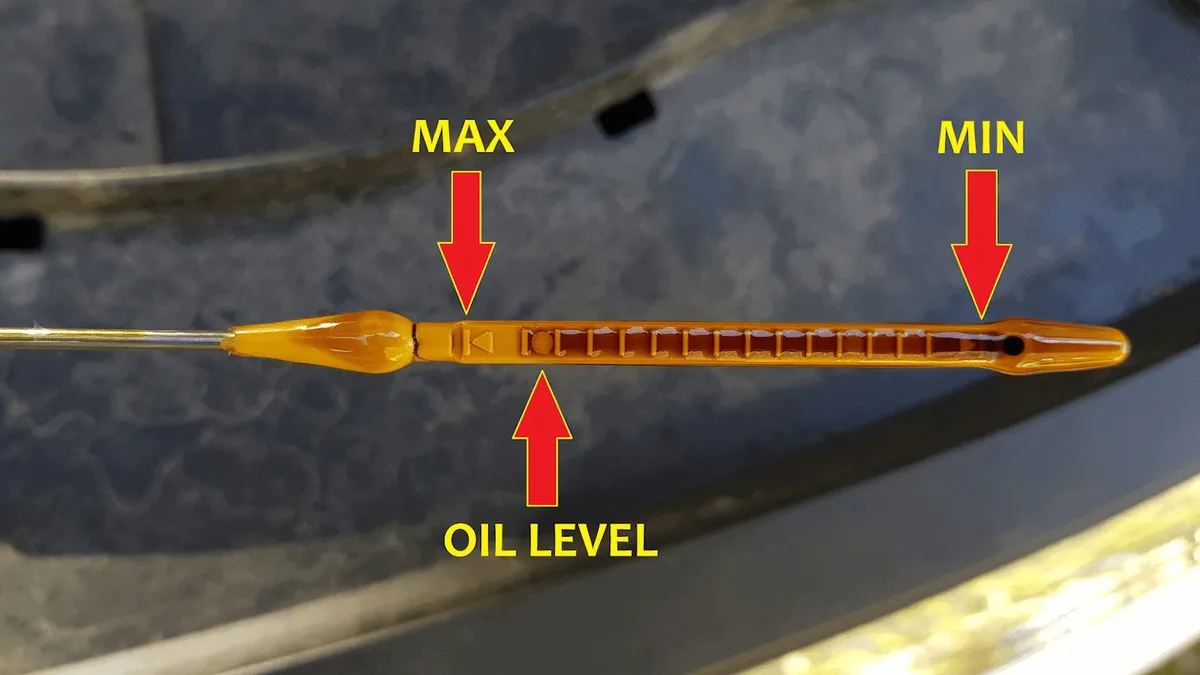
What does a dipstick actually measure?
A dipstick measures the oil height in the sump when the dipstick is fully inserted. That level can change as oil drains back from the cylinder walls, head, and filter.
The MIN and MAX marks generally define an acceptable range. Some dipsticks also include an ADD or FULL mark. Some engines use different ends for a different sump or configuration.
The owner’s manual tells you which procedure and end to use. There is no universal warm, cold, or waiting-time rule for every engine.
How should you prepare the vehicle?
Prepare the vehicle exactly as the manual directs. Most procedures require a level surface, the parking brake, and the engine in a specified state.
| Vehicle condition | Correct action |
|---|---|
| Engine is cold | Check only if the manual gives a cold-engine procedure |
| Engine is warm | Follow the specified shutdown and waiting time |
| Engine must idle | Use a ventilated area and stay clear of moving parts |
| Vehicle is on a slope | Move to level ground before reading |
| Dipstick is too hot to handle | Let it cool enough to handle safely |
| More than one end is fitted | Use the end identified for the engine |
| Access requires going underneath | Use rated support equipment, never a jack alone |
Some manuals specify several minutes after shutdown. Others require a different wait or a running check. Don’t substitute a time from another vehicle.
How do you get an accurate reading?
You’ll get the most accurate reading by using a clean dipstick, the correct engine state, and a complete second reading.
- Park on level ground and secure the vehicle.
- Set the transmission in park or neutral, as directed.
- Follow the manual’s engine-temperature procedure.
- Remove the dipstick and wipe it clean.
- Insert it fully, using the correct end.
- Withdraw it without scraping the tube or sump.
- Hold it upright and read the oil at the lower edge of the consistent band.
- Compare that position with the MIN and MAX marks.
- Add the specified oil only if needed, then recheck.
- Secure the filler cap and record the result.
A clean rag matters because the old oil can leave a film that makes the level appear higher. Pulling the dipstick too early can leave the tip above the bottom of its tube.
What do the MIN and MAX marks mean?
The MIN mark is the lower boundary of the stated range. The MAX mark is the upper boundary.
| Reading | What it usually means | What to do |
|---|---|---|
| Below MIN | Oil level is too low for normal protection | Add the specified oil and investigate the cause |
| Between MIN and MAX | Level is within the stated range | Continue monitoring consumption |
| Near MAX | Level is close to the upper boundary | Don’t add more |
| Above MAX | Engine is overfilled | Correct the level before continued driving |
| No oil visible | The engine may be empty or the procedure may be wrong | Verify before starting |
The range isn’t the same as total oil capacity. A small engine may hold several litres, while a larger engine may use less than one full retail container.
The manual normally gives the total capacity. The dipstick shows the current level. Those measurements serve different purposes.
Some manuals recommend keeping the level near the upper part of the range. Others specify a different point. Follow the exact instructions.
Which mistakes distort a dipstick reading?
A dipstick is simple, but several errors produce misleading results.
- Checking on a slope: Oil shifts toward one side of the sump.
- Pulling it too early: The dipstick may not reach the bottom of the tube.
- Skipping the second reading: Residual oil can make the level appear higher.
- Ignoring the wait time: Oil may still be draining from the engine.
- Running the engine incorrectly: Agitation can make the level unreadable.
- Using the wrong end: It may suit another engine configuration.
- Reading the upper film: Use the lower edge of the consistent band.
- Adding without rechecking: One large addition can move the level above MAX.
- Assuming the level proves the oil is correct: The dipstick says nothing about viscosity or approval.
- Using a damaged tube: An obstruction or gap can affect the reading.
A low result that conflicts with an oil-pressure warning needs further diagnosis. A failed pickup or oil-pressure problem can make a normal-looking dipstick misleading.
What if the vehicle has no dipstick?
Use the electronic level procedure specified by the manufacturer. The system may require a timed engine run, a transmission position, and the vehicle on level ground.
Some systems show an estimated range. Others provide only a low-oil warning. Some vehicles provide no electronic level indication at all.
An oil-pressure warning is not the same as an oil-level estimate. Low pressure can result from a failed pump, blocked filter, aeration, internal leakage, or low oil.
If the pressure warning comes on, shut the engine off. Don’t use the display to decide whether it’s safe to continue.
How often should you check the level?
Use the interval in the owner’s manual. Check sooner if you notice rising consumption, leaks, warning lights, or an incorrect oil change.
A check at each oil change is a useful baseline. Frequent short-trip drivers may need more frequent checks under their manufacturer’s guidance.
Record the date, mileage, reading, and any quantity added. A trend is more useful than one measurement.
If you add one litre over 5,000 kilometres, the consumption rate is 0.20 litres per 1,000 kilometres. Compare that rate with the manufacturer’s allowance.
Read Used Oil: What’s Normal and What Isn’t
Used oil can darken without being unsafe, but some changes deserve investigation. A visual check gives useful clues, while a laboratory analysis provides measurements.
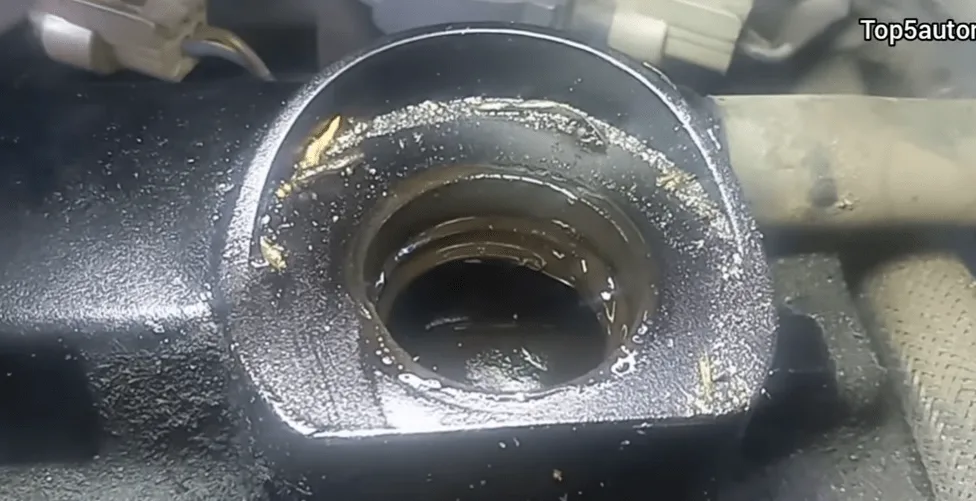
What can a visual check tell you?
A visual check can reveal contamination, abnormal color, opacity, foam, and visible particles. It can’t provide a reliable viscosity grade, oxidation value, or wear-metal measurement.
Check the dipstick and filler neck under good lighting. Look at color, clarity, thickness, odor, bubbles, and grit.
| Appearance or clue | Possible explanation | What to check |
|---|---|---|
| Amber to dark brown | Normal aging, additives, or combustion soot | Service interval and driving pattern |
| Very dark or black | Soot, oxidation, or harsh service | Oil condition and fuel-system operation |
| Milky or opaque appearance | Coolant, water, or emulsified oil | Check for coolant loss |
| Strong gasoline odor | Fuel dilution | Measure fuel percentage |
| Grit or metallic flakes | Abrupt wear or debris | Used-oil analysis and inspection |
| Foam or trapped bubbles | Aeration, water, coolant, or level problems | Oil pressure and pickup operation |
| Water-like droplets | Condensation or cooling-system leakage | Driving pattern and coolant level |
A small amount of condensation can occur after repeated short trips. Persistent water, a recurring milky appearance, or falling coolant needs investigation.
Is dark oil always bad?
No. Used oil commonly darkens as it ages and collects combustion products.
Gasoline direct-injection engines can darken oil faster than older port-injection engines. Diesel engines may accumulate soot, especially when a particulate filter is working hard.
Oil color can also vary because of base-stock type, dye, and additives. You can’t determine viscosity or performance category from color alone.
Investigate darkening when it comes with:
- A sudden change in appearance
- Rising oil consumption
- A fuel odor
- Exhaust smoke
- Low oil pressure
- Metal particles
- An overdue service interval
- A rising oil level
A dark but clean oil at the end of its normal interval may be routine. Fresh oil won’t repair a combustion, fuel, or wear problem that caused unusual contamination.
What does a milky appearance mean?
A milky appearance often means coolant or water has mixed with the oil. A blown head gasket is one possible cause, but it isn’t the only one.
Other possible paths include:
- A cracked engine head or block
- A leaking cylinder liner
- A coolant leak near an oil-wetted gasket
- Internal leakage around a coolant passage
- Water entering through the breather system under unusual conditions
If coolant is disappearing, don’t keep driving just to reach a service interval. Check the cooling system, compression, oil pressure, and used oil promptly.
Can color identify a worn engine?
No. Color is a clue, not a wear measurement.
Metallic particles on the dipstick deserve attention, but a visual inspection cannot tell you which component produced them. A used-oil analysis can identify elements such as iron, copper, aluminum, chromium, lead, tin, or boron.
Different metals can come from different engine areas. Results must be compared with mileage, engine design, filters, and service history.
A clean-looking sample can still miss early wear. A small amount of metal can also come from normal or recently repaired components.
When should a visual finding lead to analysis?
Use used-oil analysis when appearance, consumption, or engine symptoms raise a question that a dipstick can’t answer.
Analysis is especially useful for:
- Unexplained oil consumption
- A rising oil level between services
- Fuel odor or rough running
- Coolant loss with suspected internal leakage
- Metallic particles
- Smoke under load
- Severe turbocharger or engine use
- A recent engine repair
- High mileage with incomplete records
Take the sample according to the laboratory’s instructions. Many conventional engines are sampled near the end of an oil interval.
A sample taken immediately after an oil change tells you little about the oil that was doing the work.
What should you not diagnose from appearance?
Don’t diagnose oil quality, viscosity, contamination level, or engine wear from color alone.
Use the bottle label and installation record to establish what was installed. Use the dipstick to measure quantity. Use analysis or mechanical testing when the condition needs more certainty.
A dark but clean oil may be routine. A light-looking oil with substantial fuel dilution may be more serious.
Appearance starts the investigation. It doesn’t finish it.
Act on a Low, Normal, or High Reading
If the level is low, add the specified oil. If it is high, correct it before continued driving. If the level keeps changing, find the cause.
What should you do if the level is below MIN?
Add the correct oil before the level drops into the engine’s warning range. Use the required viscosity, performance category, and approval.
- Repeat the level check on level ground.
- Confirm the manual’s engine-state procedure.
- Check for visible leaks or a pressure warning.
- Add a small, measured amount.
- Recheck the dipstick.
- Repeat until the level is within range.
Don’t empty a full container into the engine. The MAX mark is an upper boundary, not a target.
If the engine has no oil, don’t start it repeatedly. A low-oil-pressure warning means you should stop the engine safely and obtain qualified help.
What if the level is normal?
Some manuals recommend keeping the level near the upper part of the range. Follow the exact procedure rather than choosing a target yourself.
A normal level doesn’t prove that the installed oil is correct. You still need the product specification, installation record, and condition checks.
Record the reading so you have a baseline for later. If the engine starts needing oil, the trend will matter more than one dipstick result.
What if the level is above MAX?
An above-MAX reading means the engine is overfilled. Don’t add more oil.
Excess oil can interfere with rotating components and contribute to aeration or foaming. That may reduce lubrication, create unstable pressure, or cause leakage.
To correct an overfill:
- Follow the owner’s manual for the approved removal method.
- Use a qualified technician if access or draining is uncertain.
- Collect removed oil in a labeled container.
- Recycle it through an approved program.
- Recheck the level after the correction.
Don’t wait for symptoms and don’t try to burn off the excess. Correct it promptly.
If an oil-pressure warning appears after a top-up, shut the engine off. Check the level before restarting. A bad reading or overfill may be causing aeration.
What if the oil level keeps falling?
Track both the amount added and the distance driven. A consumption trend is more useful than one dipstick reading.
Suppose you add 1.0 litre over 10, 000 km, that works out to 0.10 litres per 1,000 km. If the manufacturer's allowance is 0.50 litres per 1,000 km, the rate is within normal range.
If the allowance is not listed in the manual, compare the trend over several intervals rather than one measurement. A slow, steady rate that stays the same is different from a rate that doubles after a repair.
| Pattern | Likely cause | What to check |
|---|---|---|
| Gradual fall between services | Normal consumption or a small external leak | Visual inspection and service records |
| Rapid fall | Major leak, worn component, or severe dilution | Oil pressure, leak inspection, and analysis |
| Level stays near MIN despite additions | Loss exceeds what you're adding | Stop and inspect before driving further |
| Level rises between changes | Fuel dilution, combustion issue, or overfill | Fuel-system and oil analysis |
| Correct level but low pressure | Pump, filter, aeration, or internal leakage | Pressure test and mechanical diagnosis |
| Sudden drop after a recent repair | Gasket, seal, or filter installation issue | Ask the repairer about the work performed |
A rising level can be more concerning than a falling one. It often points to fuel entering the sump. Don't assume a fresh oil change will fix the underlying cause.
Should you trust an electronic oil-level reading?
Trust it the way the manufacturer describes it. Many electronic systems estimate a range rather than measuring an exact quantity.
The display may show a low-oil condition, an oil-pressure warning, or a service reminder. Each message means something different. Don't treat a low-level icon as permission to ignore a pressure warning.
If the electronic system fails, the manual may still specify a dipstick or service procedure. Don't pour oil into the filler until the actual level is confirmed.
What should you record after a top-up?
Record the date, mileage, quantity, and oil specification. Note whether the level returned to the same position on the dipstick.
| Record item | Why it helps |
|---|---|
| Odometer reading | Establishes consumption over distance |
| Quantity added in litres or quarts | Shows whether the engine uses oil unusually fast |
| Oil brand, grade, and approval | Confirms what was installed |
| Level before and after | Reveals whether the top-up was effective |
| Warning lights or symptoms | Connects consumption with engine behavior |
| Recent repairs or modifications | Separates normal aging from post-repair issues |
Bring the record to the next service. A clear trend helps a technician choose the right diagnostic step.
Can You Mix Motor Oils?
You can often add a small amount of compatible oil, but mixing doesn't make a mismatched oil correct. The required viscosity, performance category, and OEM approval still control the choice.
Can different oil brands be mixed?
Usually yes, if both oils meet the same approved viscosity and performance standard. The safest long-term choice is still the exact specified product.
If the manual names a particular OEM approval, both products should carry it. A mixture that includes an unapproved product isn't covered by the manufacturer's approval, even if one of the two bottles was approved.
Use this rule:
- If both oils share the same grade and required standard, a small top-up is usually acceptable.
- If one oil lacks the required approval, don't keep it as the long-term lubricant.
- If the existing oil's origin is unknown, plan a full change.
- If contamination is present, don't add fresh oil and call the problem solved.
Some manuals permit a specific alternative grade for emergency use. If yours doesn't, use the exact oil whenever possible.
Can 0W-20 and 5W-30 be mixed?
You can physically blend them, but the result won't meet either SAE viscosity grade. A blend of 0W-20 and 5W-30 is not automatically equivalent to 5W-30.
If the manual requires 0W-20, adding 5W-30 changes the oil's hot-flow behavior. If the manual allows 5W-30 as an alternative, a temporary blend may be acceptable under the manufacturer's stated conditions.
| Situation | Best action |
|---|---|
| Manual allows both grades | Use one listed grade, not an improvised blend |
| Manual requires 0W-20 and you have 5W-30 | Avoid the mix unless the manual permits an emergency alternative |
| Existing oil is unknown | Identify it or plan a full replacement |
| Engine needs a small top-up to reach a shop | Use the closest specified product, then change fully |
| Oil is severely low or contaminated | Get help rather than mixing blindly |
A blended oil also makes the service record harder to read. If the engine later consumes oil, you won't know whether the result came from one product, the other, or the combination.
Does synthetic oil have to match mineral oil?
Base stock type matters less than the approved specification. A synthetic and a mineral oil can share the same viscosity and performance category.
If both products meet the engine's required specification, the base-stock difference alone doesn't make a short top-up unsafe. The manufacturer may still specify a particular formulation, so check the manual.
A "semi-synthetic" label doesn't guarantee better protection than a full-synthetic label. The performance category and approval carry more weight.
| Comparison | What matters most |
|---|---|
| Synthetic versus mineral | Required viscosity, category, and OEM approval |
| Different brands | Exact specification match |
| Different colors | Dye and base stock, not proof of quality |
| Different additive packages | Confirm the required performance standard |
| Fresh versus retained oil | Existing condition, age, and service history |
What is the safest top-up rule?
Use oil that exactly matches the existing specification, then recheck the level. If that product isn't available, follow the manual's emergency guidance and schedule a full change.
| Condition | What to do |
|---|---|
| Same grade, category, and approval | Top up as needed and monitor consumption |
| Same grade and category, different brand | Acceptable if the product is approved for the engine |
| Different approved grade | Use only if the manual permits it, then return to the listed oil |
| Missing OEM approval | Don't use it as the long-term oil |
| Unknown existing oil | Arrange identification or a complete change |
| Fuel, coolant, metal, or water contamination | Diagnose the engine before adding more oil |
| Low-oil-pressure warning | Stop the engine and inspect the lubrication system |
Don't add a large quantity just because the container is partly full. Add enough to reach the appropriate level, then check again.
What if I already mixed the wrong oil?
Don't add more oil to try to dilute it. Record what you added, how much, and which products were already in the engine.
If the engine is running normally, follow the manufacturer's procedure for replacing the oil. A drain and refill with the correct specification is the cleanest way to restore a known oil state.
If the pressure warning is on, the oil is contaminated, or the level is dangerously low, stop using the engine. Those conditions need diagnosis before another improvised blend.
Are oil additives safe to mix in?
Don't add a detergent, thickener, flush, or conditioner unless the oil or engine manufacturer approves it. Unapproved additives can change viscosity, foam the oil, upset emissions systems, or make a later analysis harder to interpret.
Seal conditioners don't replace a correct viscosity. Oil thickeners don't fix consumption caused by worn rings, valves, bearings, or leaks.
If a shop recommends an additive, ask for the approval reference and the reason it's needed. A written explanation is more useful than a verbal assurance.
Adjust for Climate, Driving, and Engine Type
Climate and driving conditions affect which approved oil you choose and how often you service it. They don't override the manufacturer's viscosity or approval requirements.
How does cold weather change the choice?
Cold weather makes the W-grade behavior more important. The 0 in 0W-20 means the oil must meet a colder cranking test than the 5 in 5W-30.
If the manual allows 0W-20 and 5W-30, the 0W-20 often provides easier flow during very cold starts. The 5W-30 may be the approved alternative for milder climates or higher-load use.
Cold weather doesn't make an unapproved grade acceptable. It does make the correct oil more critical during the first seconds after startup, when oil reaches the upper engine components.
The SAE J300 standard defines the cold-cranking limit for each W grade. A 0W oil must meet 6,200 mPa·s at -35°C. A 5W oil must meet 6,600 mPa·s at -30°C.
Those numbers are testing limits, not real-world guarantees, but they show why the grade matters.
What counts as severe service?
Severe service includes patterns that place extra heat, contamination, fuel dilution, or cold-start stress on the oil. The exact definition belongs to the vehicle manufacturer.
Common examples include:
- Frequent short trips that don't fully warm the engine
- Extended idling or towing
- Stop-and-go city traffic
- Heavy or sustained loads
- Track or competition driving
- Dusty or off-road roads
- Repeated short cold starts
- Sustained extreme heat or cold
If your driving matches the manual's severe-service definition, use its shorter interval. Don't assume a long highway interval applies because the oil is a premium product.
| Driving pattern | What the manufacturer may require | What you can control |
|---|---|---|
| Long highway trips | Normal interval in most manuals | Follow the oil-change schedule and check level |
| Repeated short trips | Shorter interval in some manuals | Combine trips and avoid unnecessary idling |
| Towing or heavy loads | More frequent service in some applications | Use the exact approved oil and avoid overloading |
| Track use | Competition-specific interval or lubricant | Follow the engine builder's or manufacturer's guidance |
| Dusty driving | More frequent inspection | Check the air filter and oil condition |
| Extreme cold | Approved low-temperature grade | Use the correct grade and avoid hard cold starts |
The oil grade may stay the same while the interval changes. Severe service doesn't automatically mean you need a thicker oil.
Do turbocharged and direct-injection engines need special oil?
They often need a specific performance category because they run with higher heat, tighter deposits, and more demanding lubrication conditions.
Use the category and approval printed for the exact engine. A conventional oil with the right viscosity may still lack the required deposit or emissions protection.
Turbocharger oil feeds are sensitive to restriction and contamination. A blocked filter, failed cooler line, or incorrect filter can affect more than ordinary engine wear.
Direct injection can contribute to fuel dilution and carbon deposits, especially with frequent short trips. If the oil level rises or the oil smells strongly of fuel, investigate the fuel system.
Follow the manufacturer's warm-up and cooldown guidance. Don't assume a thicker oil compensates for aggressive driving.
Do hybrid engines need a different oil?
Hybrids still use engine oil in the gasoline engine, and that oil must meet the exact engine specification. Don't substitute automatic-transmission fluid or a generic low-friction product.
Because a hybrid may shut off the engine during short trips, the engine can accumulate fuel, water, or condensation differently from a conventional vehicle. The manual's oil procedure still controls.
If the engine runs infrequently, follow its time and mileage limits. Don't assume the oil change interval is based on driving distance alone.
The oil-life monitor estimates remaining useful life. It doesn't replace a physical level check when the vehicle has a dipstick.
What about diesel engines and low-SAPS oil?
Diesel engines need the exact viscosity, performance category, fuel specification, and emissions-system approval stated in the manual.
API CK-4 and API FA-4 are not interchangeable in every application. FA-4 uses a lower HTHS range, so an engine requiring CK-4 shouldn't automatically receive FA-4.
ACEA diesel classes may carry low-SAPS, fuel-economy, or aftertreatment requirements. Read the complete class rather than relying on the first letters.
| Engine type | Critical check | Common mistake |
|---|---|---|
| Turbocharged gasoline | Exact category and OEM approval | Choosing only by viscosity |
| Gasoline direct injection | Deposit performance and fuel dilution | Assuming clear oil proves correct condition |
| Hybrid gasoline | Exact gasoline-engine oil and short-trip interval | Using transmission fluid or ignoring time limits |
| Diesel with DPF | CK-4 or FA-4 as specified, plus low-SAPS | Treating CK-4 and FA-4 as interchangeable |
| Diesel with SCR | Low-SAPS and aftertreatment compatibility | Choosing oil solely for fuel economy |
| Older or modified engine | Vehicle-specific or builder-specific guidance | Using a modern universal oil without checking clearance |
Does altitude or extreme heat justify a thicker oil?
Usually, no. Use the exact approved viscosity, then investigate overheating, high consumption, or low oil pressure.
A hot climate can increase oil oxidation and evaporation, but it doesn't automatically make a thicker grade correct. A thicker oil may also flow more slowly during startup.
At high altitude, some manufacturers provide specific guidance for lubrication, warm-up, and oil pressure. Don't change grade based on elevation alone.
If the engine overheats, leaks oil, or shows a pressure warning, a viscosity change won't correct the underlying fault. Check the cooling system, oil circulation, air filtration, and mechanical condition.
How do conditions shape a service plan?
Start with the approved oil, then apply the manufacturer's severe-service interval and monitoring guidance.
| Condition | Oil decision | Service decision |
|---|---|---|
| Mild climate, normal use | Use the exact specified grade and category | Follow the normal interval |
| Very cold starts | Use an approved grade with suitable W viscosity | Follow cold-start guidance and check level |
| Sustained heat or towing | Keep the specified oil unless an alternative is listed | Use the manufacturer's load interval |
| Frequent short trips | Keep the specified oil | Shorten the interval if the manual says to |
| High-load or track use | Use the specified lubricant for that use | Follow the dedicated service schedule |
| Diesel with aftertreatment | Use the exact low-SAPS or emissions-compatible category | Monitor soot, consumption, and service condition |
| Unknown oil or modification | Identify the requirement before changing the formula | Document the oil and obtain a proper service |
If you can't determine which rule applies, use the exact vehicle manual or ask a qualified technician. The manufacturer's approved oil and interval are more reliable than a generic climate or driving-style rule.
Common Mistakes to Avoid
Most oil mistakes are ordinary, repeatable errors. A wrong viscosity or missing approval can leave an engine running smoothly while reducing protection where it matters.
What is the most common oil-label mistake?
Treating the viscosity number as the complete specification. A 5W-30 bottle tells you about flow behavior, not the performance category, OEM approval, or emissions compatibility.
| Common assumption | What the label actually proves | What still needs checking |
|---|---|---|
| "5W-30 is the right oil" | SAE viscosity classification | The exact grade required by the engine |
| "API SQ means it fits every engine" | It passed a defined performance category | Viscosity, OEM approval, and application |
| "Synthetic is always better" | The base-stock type | The required specification and approval |
| "Premium means correct" | A marketing claim | The vehicle-specific documentation |
| "Heavier is safer" | Higher hot viscosity within the grade | Whether that grade suits the engine and climate |
If the viscosity matches but the category doesn't, stop at the bottle. If the category matches but the required approval is missing, treat the product as a mismatch.
Can a thicker oil fix a problem?
No. A thicker approved grade may be correct for a particular engine, but extra viscosity doesn't repair low oil, leaks, worn components, or a failed pump.
If an engine consumes oil, a heavier formula may mask the symptom for a short time. It can also delay cold-start lubrication or produce a pressure reading that doesn't match the engine's design.
| Tempting fix | Why it can backfire |
|---|---|
| Use heavier oil to stop consumption | Consumption may come from worn rings, valves, or leaks |
| Use thicker oil because the engine is noisy | Noise can indicate low pressure, aeration, or internal wear |
| Use heavy oil in freezing weather | Cold flow may be slower than the system expects |
| Add a thickener to an approved oil | The blend may no longer match the specification |
| Keep driving after a pressure warning | Added oil may not correct a pump or bearing fault |
Use a heavier grade only when the manual lists it. If the correct grade is already installed, investigate the low level instead of reaching for a thicker bottle.
Does changing the oil correct a previous wrong-oil problem?
A proper drain and refill can restore the specified lubricant, but it won't repair damage caused by an earlier mismatch.
If you added a small amount of the wrong oil recently, record the product and quantity. Follow the owner's manual for the next drain and refill.
If the pressure warning came on, the engine may need diagnosis before another start. If the oil contains fuel, coolant, metal, or water, a fresh refill won't remove the source.
Don't add a solvent, flush, or corrective additive unless the engine or oil manufacturer approves it. A flush can loosen deposits and expose an existing leak.
How do people misread the dipstick?
A dipstick is commonly misread because the engine state, parking surface, or insertion method is wrong.
| Mistake | Possible result | Correction |
|---|---|---|
| Check on a slope | Oil shifts toward one side of the sump | Move to level ground |
| Pull the dipstick too early | The tip may not reach the bottom | Insert it fully |
| Skip the second reading | Old oil leaves a misleading film | Wipe, reinsert, then read |
| Check immediately after shutdown | Oil is still draining from the engine | Follow the manual's wait time |
| Use the wrong end | A second end may suit another configuration | Follow the manual's diagram |
| Read the top of the oil film | Overestimates the level | Use the lower edge of the band |
| Add oil without rechecking | May move the level above MAX | Repeat the procedure |
| Assume a normal reading proves correct oil | Viscosity and approval are unconfirmed | Check the specification separately |
A low result that conflicts with a pressure warning needs further diagnosis. A failed pickup or pressure problem can make a normal-looking dipstick misleading.
Why is overfilling a common mistake?
It happens when people treat the dipstick range as a target and pour until the bottle is empty. The MAX mark is the upper boundary, not a goal.
Excess oil can contribute to aeration, foaming, unstable pressure, and leakage. In extreme cases, it can cause crankcase seal failure.
If the level is above MAX, don't add more oil. Don't try to burn off the excess. Follow the manual's approved removal method or have a qualified technician correct it.
A small overfill should be handled promptly. A large overfill deserves the same care as a major spill.
What should you do if the oil level rises?
Don't add oil when the level rises between services. Treat it as a possible fuel-dilution, combustion, or service problem.
A rising level can happen when:
- Unburned fuel enters the oil after repeated short trips.
- An injector or fuel-pressure fault sends more fuel into the sump.
- The previous service used too much oil.
- A drain or refill was incomplete and a second top-up was added.
- The installed oil doesn't match the engine specification.
If the rise follows a recent oil change, check the amount added and the product used first. If it comes with fuel odor, smoke, or a pending engine code, arrange a fuel-system inspection.
A rising level with a low-oil-pressure warning is not a top-up problem. Stop the engine safely and get qualified help.
Do oil filters matter as much as the oil?
Yes. A correct oil can still underperform if the filter is wrong, blocked, or installed incorrectly.
Use the filter specified for the exact engine and oil system. A filter with the wrong thread, bypass setting, or sealing surface can affect flow and contaminant control.
A new filter doesn't remove the need for a correct drain interval. It also doesn't make a mismatched oil acceptable.
Are additives and oil-life monitors safe shortcuts?
Neither replaces the specified oil and service interval. Use an additive only when the engine or oil manufacturer approves it.
Common additives can alter viscosity, foam the oil, upset emissions systems, or mask a leak. A thickener isn't a repair for excessive consumption.
An oil-life monitor estimates remaining useful life from time, mileage, temperature, and driving patterns. It doesn't measure current viscosity, contamination, or wear-metal load.
Resetting the monitor doesn't remove old oil or restore the correct service history. Follow the manufacturer's interval and inspect the oil when symptoms call for it.
A quick pre-drive check
Run this check before leaving the vehicle after a top-up or oil change.
- Confirm the exact vehicle specification.
- Match viscosity, category, and approval.
- Verify the level with the correct procedure.
- Look for leaks, foam, fuel odor, or coolant.
- Record the mileage and amount added.
- Keep the specification with the service record.
- Recycle replaced oil and filter through an approved program.
If one item remains uncertain, the safest next step is confirmation. A few minutes of checking can prevent a much longer repair.
When Used-Oil Analysis and Service Records Matter
A used-oil analysis measures what the oil collected during service. Service records explain how the engine, oil, and driving conditions produced those results.
Together they give a fuller picture than either one alone. A metal reading without mileage, interval, and repair history is just a number.
When is analysis worth it?
Used-oil analysis is worth it when a visual check, consumption trend, or warning suggests something may be changing inside the engine.
| Situation | Why analysis helps |
|---|---|
| Oil consumption is rising | Measures fuel dilution, viscosity change, and wear metals |
| Oil level rises between services | Detects fuel, water, or other contamination |
| Fuel odor in the sump | Quantifies unburned fuel |
| Coolant is disappearing | Checks for coolant indicators |
| Metal particles appear | Identifies and trends specific wear elements |
| Engine smokes under load | Assesses fuel, combustion, and wear patterns |
| Turbocharged engine is used hard | Tracks lubricant condition and metal transfer |
| Service history is incomplete | Establishes a baseline for future comparisons |
| Recent engine repair was done | Distinguishes old wear from new contamination |
| Oil looks normal but consumption is high | Finds problems that color can't show |
Many laboratories request a sample near the end of an oil interval. Follow the lab's instructions, especially for vehicles without a standard drain plug or with an oil cooler.
Take the sample before adding fresh oil. A sample taken immediately after a change tells you little about the oil that was doing the work.
What should a useful report contain?
A useful report identifies the vehicle, oil, service conditions, test methods, and numerical results.
Check for these details:
- Vehicle identification, including year, make, model, engine, and VIN
- Mileage at the sample date
- Oil brand, viscosity, performance category, and OEM approval
- Date of the last oil change and the interval length
- Fuel type and known short-trip, towing, or idling use
- Recent repairs, coolant loss, codes, or fuel-system work
- Laboratory test methods, units, and reference ranges
- Sample collection point and handling instructions
If the report gives only "pass" or "fail," request the actual values. A numerical trend is easier to compare with the next sample.
How do you read the key measurements?
Numerical results are meaningful only when you have the units, reference range, and service context.
| Measurement | What it can show | What it cannot prove alone |
|---|---|---|
| Kinematic viscosity at 40°C and 100°C | Thickening, thinning, or contamination | The exact SAE grade installed |
| Fuel dilution percentage | Unburned fuel in the sump | The exact injector or fuel-system fault |
| Coolant indicators | Evidence of coolant in the oil | The precise leak path |
| Water content | Moisture, condensation, or possible leak | Whether a small amount is normal for the pattern |
| Iron, copper, aluminum, chromium | Wear transfer from several engine areas | Which specific component is failing |
| Soot percentage | Incomplete combustion or exhaust loading | The exact emissions-system fault |
| Total base number | Remaining acid-neutralizing reserve | Direct proof of engine wear |
| Oxidation or nitration | Thermal stress on the oil | The cause of that stress |
Viscosity results need care. Fuel dilution can lower viscosity. Water, soot, or oxidation can change it in other ways.
Compare the result with the product's technical data sheet.
A small water reading after repeated short trips may reflect condensation. The same reading on a diesel with a suspected head-gasket problem needs a different response.
What do wear metals mean?
Wear metals show that some material reached the oil. They may come from normal surfaces, a known repair, or abnormal wear.
A sudden increase matters more than a stable baseline. A small iron reading after a long interval may be expected. A sharp rise after a rebuild deserves comparison with the previous report.
| Wear-metal pattern | Possible source | Useful follow-up |
|---|---|---|
| Iron with aluminum | Cylinder, piston, or block-area wear | Compression, leakdown, and pressure checks |
| Copper | Bearing, bushing, or turbo transfer | Inspect the affected lubrication path |
| Chromium | Ring, liner, or emissions-related wear | Evaluate combustion and exhaust operation |
| Several metals rising together | General lubrication or bearing stress | Review oil, pressure, temperature, and repairs |
Don't diagnose from a metal list alone. Oil type, mileage, filters, coolant contamination, and engine design all affect the result.
How do you use a trend instead of one result?
One sample raises a question. A series of comparable samples gives context.
Compare reports when the oil, service interval, laboratory, and sampling method are reasonably consistent. Record mileage at each sample.
A useful trend looks like this:
- The first sample establishes a baseline.
- A later sample shows a gradual change.
- A sudden increase follows a repair, fault, or extended interval.
- Symptoms and mechanical tests confirm or narrow the explanation.
| Trend | Likely interpretation | Action |
|---|---|---|
| Stable results over several intervals | Normal pattern for the engine | Continue the approved schedule |
| Gradual rise in wear metals | Increasing wear or harsher service | Increase monitoring and inspect at next service |
| Sudden jump after a repair | New component, debris, or break-in | Ask the repairer for context and retest |
| Fuel dilution repeatedly present | Short trips or fuel-system issue | Review driving and run a fuel diagnosis |
| Coolant appears, then returns | Possible unresolved leak | Investigate before another long interval |
| Viscosity falls sharply | Fuel dilution or wrong oil | Stop and inspect |
A laboratory's reference range is a guide, not a universal pass-or-fail line. Engines differ, and test methods vary.
How do service records change the result?
Service records determine whether a result is reasonable for the engine and how much attention it needs.
The most useful record includes:
- Oil-change dates and mileage
- Oil quantity and specification
- Oil filter part number
- Top-up dates and amounts
- Short trips, towing, idling, and track use
- Fuel-system repairs
- Coolant loss or pressure repairs
- Engine codes and warning-light events
- Smoke, noise, or consumption complaints
- Emissions-system work
- Recent head, gasket, turbocharger, or engine repairs
If the oil was changed early because of a warning, that interval isn't comparable to a full-service sample. If the vehicle sat for months, calendar aging matters too.
For a used vehicle, missing records increase uncertainty. A fresh oil change can hide the condition of the old oil, so a baseline sample soon after service is still useful.
Keep invoices, receipts, and the oil specification together. A warranty provider or technician can then see exactly what was installed and when.
How do you calculate an oil-consumption rate?
Divide the quantity added by the distance driven, then report the result in a consistent unit.
Use this calculation:
Consumption rate = oil added ÷ distance × 1,000
| Record | Calculation | Result |
|---|---|---|
| 1.0 L over 10,000 km | 1.0 ÷ 10,000 × 1,000 | 0.10 L per 1,000 km |
| 0.5 qt over 2,500 miles | 0.5 ÷ 2,500 × 1,000 | 0.20 qt per 1,000 miles |
| 2.0 L over 5,000 km | 2.0 ÷ 5,000 × 1,000 | 0.40 L per 1,000 km |
Don't count the oil installed during a planned full service as consumption. Record only the oil added between services.
If the manual doesn't list an allowance, a rising trend still deserves attention. It may indicate a leak, worn component, fuel dilution, or an incorrect earlier oil change.
What can used-oil analysis miss?
Analysis can't prove the engine is healthy or identify every failure. It samples what was circulating at one moment.
A clean sample may miss intermittent leaks, localized bearing wear, or a problem outside the lubrication path. A worn component can release little metal until damage is advanced.
One sample can also be distorted by a contaminated drain plug, a leaking cooler, a failed filter, or fluid entering after collection. Use the result with pressure tests, compression checks, leakdown tests, and fuel analysis when symptoms justify them.
The right conclusion is usually not "good" or "bad." It's "this trend is stable," "this result needs confirmation," or "this engine needs a diagnosis before the next service."
Safety, Warranty, and Used-Oil Disposal
Oil checks are simple when the engine is in good condition. Safety gets harder when the engine is hot, contaminated, low on oil, or already showing a warning.
Follow the owner's manual, protect yourself from hot oil, and stop if the lubrication system gives you a reason to question the engine.
What should you do before touching the oil?
Follow the manual's engine-state and temperature instructions before opening the filler neck or removing the dipstick.
In many cases, that means parking on level ground, securing the vehicle, switching the engine off, and allowing parts to cool enough to handle.
| Preparation step | Why it matters |
|---|---|
| Park on level ground | A slope changes the apparent level |
| Apply the parking brake | Prevents vehicle movement |
| Use the specified transmission position | Meets the manufacturer's safety procedure |
| Check engine temperature and state | Some procedures require a warm engine or timed wait |
| Use gloves and eye protection | Protects against hot oil and additives |
| Keep a clean rag and catch container ready | Makes top-ups and cleanup safer |
| Use rated support equipment if going underneath | A jack alone isn't a safe working platform |
Keep children and pets away from the engine bay and used oil. Don't run the engine in a closed garage.
A hybrid vehicle can still contain high-voltage components when the engine is off. Follow its service instructions and don't touch orange high-voltage cables or connectors.
Which warnings mean stop now?
Stop the engine safely if the red oil-pressure warning comes on, especially with a low or rising oil level.
| Warning or symptom | Why it matters | What to do |
|---|---|---|
| Red oil-pressure warning | Oil may not be reaching protected parts | Shut the engine off and arrange service |
| Level below MIN with a pressure warning | Possible starvation or failed circulation | Don't restart or keep driving |
| Rapidly rising oil level | Fuel dilution or combustion fault | Don't add oil; investigate |
| Milky oil with low coolant | Possible coolant entry into the oil | Stop and check the cooling system |
| Strong fuel odor | Unburned fuel may be thinning the oil | Arrange a fuel and oil analysis |
| Pressure warning after a top-up | Possible overfill, aeration, or pickup problem | Check the level before restarting |
| Loud metallic noise with a pressure warning | Possible internal damage | Don't continue driving |
If the vehicle is stopped in traffic, switch on hazard lights and move to a safe location if possible. Don't run the engine to reach a shop.
How do you add oil without creating another problem?
Add only the specified oil, in small measured amounts, and recheck after each addition.
| Step | Good practice | Avoid |
|---|---|---|
| Product | Exact viscosity, category, and approval | Random oil from an unmarked container |
| Quantity | Small additions followed by a check | Pouring a full container |
| Filler cap | Clean and securely replaced | Leaving it loose or cross-threaded |
| Spills | Wipe immediately and contain the mess | Washing oil into a drain |
| Level | Recheck after the oil settles | Assuming the first reading is final |
| Existing oil | Confirm compatibility | Using a different grade as a permanent blend |
If the engine is seriously low, a small top-up may be necessary to reach a service location. That doesn't mean the underlying fault is fixed.
A low-oil-pressure warning takes priority over convenience. Don't keep topping up a pump, filter, or bearing problem.
How should used oil and filters be disposed of?
Take used oil to an approved collection or recycling facility. Follow the facility's instructions for filters and oily materials.
Never pour engine oil into a storm drain, onto soil, or into a body of water. Don't put oily liquid in household trash unless your local authority explicitly allows it.
The U.S. Environmental Protection Agency and the UK Environment Agency both provide used-oil handling guidance. Follow your local or national authority's rules.
| Material | Proper handling |
|---|---|
| Used engine oil | Sealed container or approved collection point |
| Oil filter | Follow the recycling center or local service rules |
| Oily rags | Bag or contain them for approved cleanup |
| Absorbent material from a spill | Treat as contaminated waste |
| Oil-contaminated parts | Ask the service facility how it handles them |
| Empty oil bottles | Seal the cap and label if the site requires it |
A small drip around the drain plug can be wiped up before it spreads. A larger leak needs containment and proper disposal of every contaminated surface.
How should an oil spill be cleaned?
Contain the spill immediately, keep it away from drains, and place oily waste in an approved container.
- Switch off the engine and let hot parts cool.
- Place absorbent material around the spill to stop spreading.
- Wipe or scoop up the oil from the hard surface.
- Put oily rags and absorbent material into a sealed bag.
- Wash the surface with a suitable cleaner, following local rules.
- Take the waste to an approved collection point.
- Wash your hands and clean any tools that touched the oil.
Don't wash oil into a storm drain, soil, or watercourse. A relatively small quantity can harm fish and groundwater.
If the spill is large, has reached a drain, or has entered surface water, contact the relevant local environmental authority. The cleanup may need to be documented.
Oil on a hot exhaust component can ignite. Don't pour water onto hot oil. Don't use a vacuum that isn't rated for oily liquids.
Can the wrong oil affect warranty?
Yes. An oil that doesn't meet the manufacturer's specification can complicate a warranty claim if it contributes to damage.
Warranty terms vary by market, vehicle, and contract. A technical service bulletin, court decision, or consumer law can change how a claim is handled.
You can protect your position by keeping:
- The owner's manual or printed specification
- The oil container and technical data sheet
- The purchase receipt
- The service invoice
- Mileage at each oil change
- Records of any top-ups or additives
- Notes about warnings, leaks, and repairs
If the wrong oil was added recently, record the product, grade, category, approval, and quantity. Contact a dealer or qualified technician while the service history is still clear.
Correcting the oil promptly limits further exposure. It doesn't automatically repair damage or remove the record of the mismatch.
Can oil additives affect warranty?
Yes. An unapproved additive can create a warranty concern, especially if it causes foaming, deposit movement, leaks, or emissions-system problems.
Common additions include thickeners, engine flushes, oil conditioners, detergent additives, and friction modifiers. Some manufacturers permit specific additives under defined conditions. Others prohibit unapproved products.
Don't assume a seal conditioner can compensate for the wrong viscosity. Don't add a solvent because the oil looks dark.
If a repair shop proposes an additive, ask for the approval reference and the reason it's needed. A written explanation is more useful than a verbal assurance.
What do the oil warning lights mean?
They are not interchangeable. A low-oil message, oil-pressure warning, and oil-life reminder each communicate something different.
| Display or light | Likely meaning | Action |
|---|---|---|
| Yellow oil-can warning | Oil level is low or due for a check | Check the level and add specified oil |
| Red oil-can or pressure warning | Oil pressure may be dangerously low | Shut the engine off safely |
| Rising oil-level indication | Possible fuel dilution | Don't add oil; investigate |
| Oil-life service reminder | The calculated interval is ending | Follow the service procedure |
| Check-engine or maintenance light | A stored fault needs diagnosis | Review the message and service info |
Colors and symbols vary by vehicle. Read the owner's manual rather than relying on the icon alone.
An oil-life reminder isn't proof that the oil is still healthy. The monitor estimates use and doesn't detect every leak, contamination, or mechanical issue.
How should you store new engine oil?
Store sealed oil in a cool, dry, well-ventilated place, away from heat and direct sunlight.
Keep the container upright and protect the label from dirt or damage. Don't store oil above a furnace, beside a heater, or in a vehicle exposed to extreme heat.
A container that has been opened should remain clean and closed. Avoid using a storage container that previously held coolant, solvent, brake fluid, or another chemical.
Record the product's viscosity, category, and approval before putting it into a vehicle. A loose bottle with a partly worn label isn't enough to confirm a full replacement.
What legal and environmental rules matter most?
The practical rules are consistent across many regions. Use the specified oil, manage spills, recycle used oil, and don't discharge it into the environment.
Local requirements may affect approved collection sites, hazardous-waste handling, spill reporting, and filter disposal.
| Rule | Why it matters |
|---|---|
| Don't pour oil into a storm drain or sewer | Protects waterways and wildlife |
| Keep oily rags and absorbents in closed containers | Reduces fire risk and environmental release |
| Recycle used oil through an approved program | Keeps oil out of soil and surface water |
| Follow local filter and oily-part disposal rules | Meets municipal or national regulations |
| Report a large spill or environmental release when required | Complies with environmental law |
| Keep disposal receipts with service records | Documents responsible handling |
If you're unsure where to take a container, contact your local authority or an accredited oil-collection service. Don't place oil in household trash by default.
Frequently Asked Questions
What oil does my car need?
Your car needs the exact viscosity, performance category, and any OEM approval listed for its engine. Use the owner's manual for the correct model year, market, and powertrain. An engine-bay label can confirm a grade, but it may omit some requirements.
If documentation conflicts, use a VIN-based manufacturer source or a qualified technician.
Can I mix 0W-20 and 5W-30 engine oil?
Only as a temporary measure when your manufacturer permits a compatible alternative. A blend usually won't meet either listed viscosity grade, even when both oils carry the same performance category. If you can't confirm compatibility, use the exact specified oil or arrange a full change.
An improvised blend also makes the service record harder to interpret.
Is dark engine oil automatically bad?
No. Motor oil commonly darkens with age, additives, soot, and normal combustion exposure. Color alone doesn't prove incorrect viscosity, low quality, or engine damage.
Investigate darkening if it comes with rising consumption, a fuel odor, a milky appearance, metal particles, smoke, or an overdue service interval. Used-oil analysis can provide useful measurements.
Can I use any oil with the correct viscosity grade?
No. Viscosity is only one part of the specification. The oil must also carry the required performance category, fuel application, emissions-system compatibility, and OEM approval where specified.
A matching grade cannot compensate for missing protection or approval. Check every required field on the bottle before using it.
How do I read an oil dipstick correctly?
Park on level ground, secure the vehicle, and follow the manual's engine-state and temperature instructions. Remove and wipe the dipstick, insert it fully, then withdraw it for a second reading. Compare the lower edge of the oil band with MIN and MAX.
Don't check on a slope, pull it too early, or add oil without repeating the procedure.
What should I do if my oil level rises between services?
Don't add oil unless a level check proves it is low. A rising level can indicate unburned fuel entering the sump after short trips or a fuel-system fault. It can also follow an overfilled service.
Record the mileage, inspect the oil for fuel odor, and arrange a fuel-dilution analysis. Don't keep driving if warning lights, overheating, or low oil pressure are present.
Final Decision Guide: Match, Check, Add, or Investigate
Use the oil specification to match the product, the manufacturer's procedure to measure the level, and the service history to interpret the result.
If any step remains uncertain, pause before adding oil. The correct sequence takes less time than diagnosing a lubrication fault later.
Step 1: Identify the Exact Vehicle Requirement
Start with the VIN, model year, engine code, fuel type, and sales market. The same vehicle name can cover several engines or regional specifications.
Record these five items from the owner's manual:
- SAE viscosity grade
- Performance category
- OEM approval, if required
- Oil capacity
- Normal and severe-service intervals
| Source | Use it for | Limitation |
|---|---|---|
| Owner's manual | Full vehicle specification | May list several approved alternatives |
| Engine-bay label | Quick viscosity or approval check | May not show the full requirement |
| VIN-based portal | Current vehicle-specific data | Can be hard to find without the VIN |
| Official approved-oil list | Bottle approval verification | Limited to listed applications |
| Service records | Previous oil and repairs | May be incomplete on a used vehicle |
| Qualified technician | Unclear or conflicting specs | Costs more than checking the manual |
If the engine has been modified, the original factory specification may no longer be the final answer. Use the builder's or modifier's documented lubricant requirement where it exists.
Step 2: Match Every Required Oil Field
Compare the bottle with the specification, not with another bottle in the same aisle.
| Check | Pass condition | If it fails |
|---|---|---|
| Viscosity | Listed grade or approved alternative | Don't use it long-term |
| Performance category | Correct API, ILSAC, or ACEA requirement | Don't rely on viscosity alone |
| OEM approval | Every required code appears | Don't assume "meets" is equivalent |
| Engine application | Correct fuel and emissions use | Find a product listed for that engine |
| Region | Specification applies to your market | Check the market-specific manual |
| Modifications | Oil is approved for the modified engine | Confirm the modified vehicle's requirement |
If one field fails, the product doesn't pass. A strong result in another field doesn't compensate for a required failure.
For an emergency top-up, use the safest specified product available and arrange a full change soon. An unapproved blend can be a short-term necessity, but it shouldn't become the engine's normal lubricant.
Step 3: Check the Quantity Correctly
Use the dipstick or electronic procedure specified for the vehicle. The level check answers one question: how much oil is present right now?
- If the level is between MIN and MAX, continue the service plan.
- If it is below MIN, add the correct oil and recheck.
- If it is above MAX, remove the excess according to the manual.
- If the level rises between services, investigate fuel dilution.
- If it falls repeatedly, calculate the consumption rate.
- If pressure is low, stop the engine and diagnose the cause.
A reading between the marks doesn't prove the oil has the right viscosity or approval. That evidence comes from the specification and service records.
Step 4: Add Only the Specified Oil
Add oil in small amounts. Let it reach the level-check point, then repeat the measurement.
A full container isn't a refill instruction. Capacity and dipstick range serve different purposes. The engine may need more than one container or less than one.
If the level is near MAX, don't add anything. Excess oil can contribute to aeration, foaming, and unstable pressure.
If the existing oil is unknown, use a compatible product only when you must reach a service location. Then perform a full change with the exact specified oil.
Step 5: Investigate Abnormal Signs
Treat quantity, appearance, consumption, and pressure as separate clues. Connect them through the engine's service history.
| Finding | First question | Likely next step |
|---|---|---|
| Oil falls quickly | Is the engine leaking or consuming it? | Measure the rate and inspect |
| Oil rises | Is fuel entering the sump? | Analyze fuel dilution |
| Milky appearance | Is coolant entering the oil? | Check the cooling system and compression |
| Fuel odor | Is the oil being diluted? | Quantify fuel in a sample |
| Metallic particles | Is wear metal increasing? | Compare analysis and inspect |
| Dark oil | Is the interval or driving pattern explaining it? | Review records and analyze if concerned |
| Low pressure | Is the pump, filter, pickup, or level at fault? | Shut down and test pressure |
| Pressure warning after a top-up | Is the engine overfilled or aerated? | Check the level before restarting |
A used-oil analysis helps when a visual check leaves an important question unanswered. Send a properly collected sample to a laboratory that reports its methods, units, and reference ranges.
Step 6: Protect the Engine and the Record
Store the specification and service evidence with the vehicle. Record the date, mileage, quantity, viscosity, category, and OEM approval for every full change.
Keep the top-up information too. The amount added and the distance between additions create a consumption trend that a single dipstick reading can't provide.
For safety and environmental care, recycle used oil and filters through an approved program. Keep spills out of drains, soil, and water. If you must improvise a top-up, do the smallest safe correction, record it, and return the engine to the exact specified oil.