What are the primary functions of motor oil: Easy guide
If you've ever cracked the oil filler cap and wondered what are the primary functions of motor oil beyond "keeps the engine from seizing," you're not alone. Most people treat it like a top-off fluid. Pour, drive, forget.
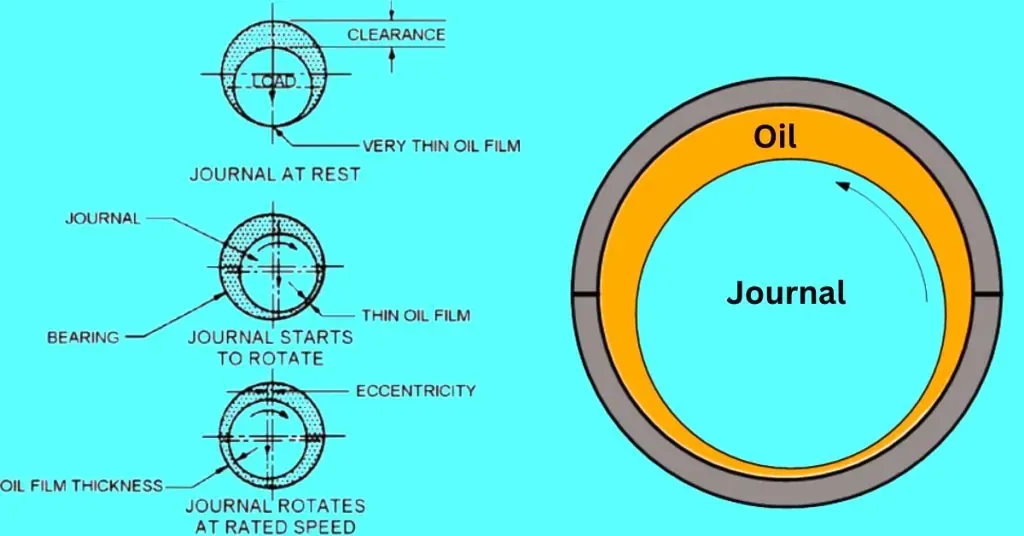
But that 5-to-10-micron film between a spinning crank journal and its bearing shell is doing five distinct jobs at once. Miss one, and you're not dealing with a check engine light. You're dealing with a four-thousand-dollar rebuild.
As of 2026, the API SP engine test sequence now screens for low-speed pre-ignition damage, something the older API SN spec never covered. That shift shows how much the formula behind the bottle has evolved. Here's what that formula actually does, where it breaks down, and why the first thirty seconds after you turn the key matter more than anything else.
Quick Answer
Motor oil's primary functions are lubrication, heat transfer, contamination control, corrosion inhibition, and seal conditioning. The hydrodynamic film sits 5 to 10 microns thick between moving parts. Detergent additives suspend soot and metal fines for the filter to trap.
Anti-wear compounds like ZDDP protect cam lobes at high RPM. The oil carries roughly 25 to 35 percent of total engine heat load.
Why Not Understanding What Oil Does Costs More Than the Oil Itself
A five-quart synthetic fill runs $35 to $50. A complete short-block rebuild on a modern four-cylinder runs $2,200 to $4,500 at your local shop's labor rate. That's the actual math sitting behind every oil change.
When you skip a drain because "the light hasn't come on yet," or you pour a high-SAPS racing oil into a GPF-equipped commuter, you're not saving money. You're borrowing against a very expensive invoice. The wrong viscosity, the wrong spec, or a missed interval doesn't just "reduce efficiency." It creates a specific mechanical failure cascade.
The film collapses. Metal contacts metal. The journal and shell spall.
The engine seizes at the worst possible moment, like a highway merge at 75 mph.
Understanding what the oil is actually doing is the cheapest insurance you'll ever buy for the drivetrain. It tells you which failures are preventable, which ones are ticking clocks, and which "myth" your buddy at the parts store is pushing.
The Five Primary Functions: What Oil Actually Does at the Bearing, Ring, and Cam Level
Motor oil isn't one thing doing one job. It's a working system hitting five targets simultaneously, each with a distinct mechanism and a distinct additive that drives it.
| Function | What it does | Primary driver in the bottle |
|---|---|---|
| Lubrication | Maintains a 5–10 micron separating film at bearing and ring interfaces | Base oil + VI improvers |
| Heat transfer | Carries 25–35% of total thermal load away from cylinders and bearings | Base oil thermal conductivity |
| Contamination control | Suspends soot, metal fines, and acid byproducts so the filter traps them | Dispersants (SUL / AMINE) |
| Corrosion inhibition | Neutralizes sulfuric and nitric acids; coats exposed metal | Detergents (alkylphenolates, salicylates) |
| Seal conditioning | Keeps elastomer seals pliant at 100–130°C | Resin-based conditioners |
Lubrication: The Three Regimes You Actually Experience
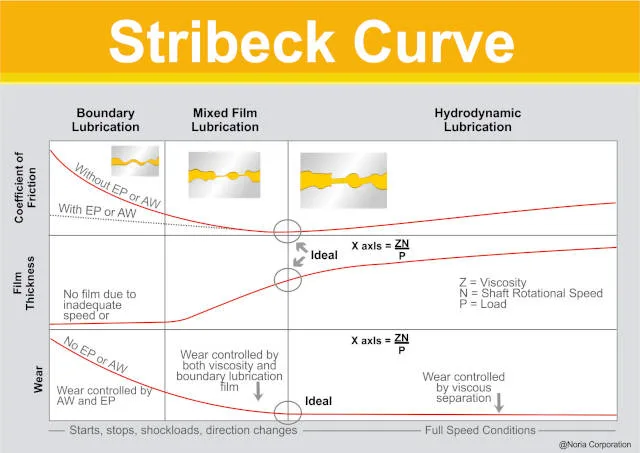
"Lubrication" breaks into three physical regimes, and you cycle through all of them in a single drive.
In hydrodynamic lubrication, the oil film is thick enough that the two surfaces never touch. The bearing floats on a pressurized wedge of fluid. This is your highway cruise.
In elastohydrodynamic (EHL) contact, you're looking at rolling pairs like the cam lobe and its follower. The film is thinner, local pressure is enormous, and the oil's viscosity under that pressure is what prevents scoring. In boundary lubrication, the film is sub-micron.
Asperities on each surface actually make contact. This is where ZDDP and molybdenum additives form a sacrificial layer on the metal.
Cold start is boundary. Highway cruise is hydrodynamic. The cam at 6,000 RPM is EHL.
The oil has to perform in all three zones at once.
Heat Dissipation: The 25 to 35 Percent You Don't Feel
The coolant loop handles the bulk of engine heat, but oil does the part the coolant can't reach. It picks up thermal energy from the piston crowns, cylinder walls, and bearing interfaces, then carries it to the oil cooler (if your engine has one) or dissipates it at the sump. Without that 25-to-35-percent contribution, hot-spot temperatures in the chamber spike past what the alloy can tolerate.
You get premature ring distortion, accelerated cam wear, and a head gasket that starts weeping on the next heat cycle.
Contamination Control: Suspension, Not Scrubbing
Oil doesn't "clean" the engine the way you'd scrub a pan. It suspends. Dispersant additives (SUL and AMINE types) hold soot particles, unburned fuel residue, and fine metal wear debris in solution so they don't clump and plate onto a wall.
The oil filter then traps that suspended load before it recirculates and grinds on a crank pin. The filter is the wiper. The oil keeps the grit off the windshield.
Corrosion and Acid Neutralization
Every combustion cycle produces trace acids. Sulfur in the fuel becomes sulfuric acid. NOx becomes nitric acid.
The detergent package neutralizes those acids and holds the oil's Total Base Number (TBN) reserve in check. When TBN drops below roughly 6 mg KOH/g on an oil analysis, your acid buffer is gone. After that, corrosion on bearing journals, valve seats, and the gasket face accelerates fast.
Seal Conditioning
This one gets overlooked. Elastomer seals around the crank, cam, and valve covers sit in oil at 100 to 130°C for thousands of hours. Without resin-based conditioners in the additive package, those seals harden, shrink, and weep.
You'll see slow oil loss, a faint burning smell on hot starts, and eventually a compression leak that shows up as a low-pressure reading. The "high mileage" formulas on the shelf add extra conditioner for exactly this reason.
What's Inside the Bottle: Base-Stock Groups and the Additive Package That Drives Each Function
Strip away the marketing label and you've got two things. The base oil (75 to 90 percent of the volume) and the additive package (10 to 25 percent). The base oil sets your viscosity window.
The additives do the targeted chemistry.
Base oils are classified by the API into five groups:
- Group I (mineral): Solvent-refined. Cheapest. Fine for older, wider-tolerance engines.
- Group II (hydro-treated): Shorter, cleaner molecules. Better oxidation stability than Group I.
- Group III (hydrocracked): Gasoline-like hydrocarbon backbone. The base for most "full synthetic" 0W-20 and 5W-30 oils on the shelf.
- Group IV (PAO): Polyalphaolefin. Flat viscosity-temperature curve. Excellent for -35°C cold soaks.
- Group V (esters, polyglycols): Specialty stocks used in small percentages for friction modification and seal compatibility.
Per SAE J300, the SAE grade on the label ("0W-20," "5W-40") is defined entirely by the base oil's kinematic viscosity at the cold reference point and at 100°C. The additive package then tailors TBN, high-temperature high-shear (HTHS) viscosity, and anti-wear chemistry to meet a specific API or ACEA sequence.
This is why a "5W-30" from one brand and a "5W-30" from another can behave differently in the same engine. Same SAE grade. Different TBN.
Different ZDDP level. Different dispersant type. The number on the bottle is just the viscosity window.
The spec underneath (API SP, ACEA C3, an OEM approval) is what governs how the oil actually performs under load.
What Happens When a Function Fails: Failure Modes Mapped to Real Engine Damage
This is where the stakes get concrete. Each function has a distinct failure signature. Knowing it tells you what to look for on an oil analysis or what to listen for when the engine starts sounding "off."
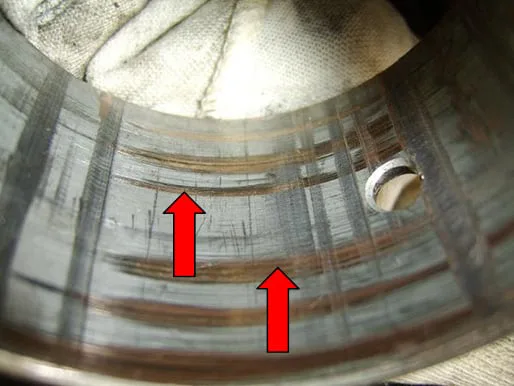
- Lubrication failure (film collapse): Journal and shell make direct metal contact. You hear a deep knock or rattle from the lower block. On an analysis, iron and copper spike above 250 ppm. The bearing shell shows a shiny "smear" track. This is a short-block scenario.
- Heat transfer failure (thermal breakdown): Sustained oil temps past 150°C shear the VI polymers. The oil thins. HTHS viscosity drops below the SAE minimum. Thinner film, more boundary contact, more debris, more heat. A low-oil-pressure code triggers before you ever hear the knock.
- Contamination control failure (filter clogged or bypassed): Soot and fines recirculate like sandpaper on the ring land. Compression drops. You see blue smoke on decel. Al and Si spike on the analysis.
- Corrosion failure (TBN depletion): Sulfuric and nitric acid eat the journal, valve seat, and gasket face. Slow weep, slight compression loss on one cylinder, rust-colored residue on the drain plug magnet.
- Seal failure (hardened elastomer): The crank main seal or cam seal weeps. Oil loss is slow. A quart over 2,000 miles. Fresh puddle under the car every morning. Compression is fine. The level just keeps dropping.
Warning: If you hear a low-end knock at idle or see oil pressure read under 10 psi at operating temperature, pull over. Don't "drive it to the shop." You have minutes, not miles, before the bearing wipes out completely and the crank throws itself into the block.
The 30-Second Cold-Start Window: Where 80 Percent of Bearing Wear Actually Happens
Here's the number that should make you idle the engine for a moment before you floor it: roughly 80 percent of total bearing wear in a typical engine's life happens in the first 30 seconds after a cold start.
At -5°C, a 0W-20 oil is still 40 to 60 times more viscous than it is at 100°C. That thick oil gravity-seeps off the bearing journal while the car sits in the driveway. By the time you turn the key, the hydrodynamic film hasn't reformed.
The crank rotates through boundary lubrication for the first few revolutions. The ZDDP layer on the shell takes the hit. That's a sacrificial, non-recoverable loss of metal, every single morning.
The Stribeck curve maps friction coefficient against the ratio of speed times viscosity to load. At cold start, you're parked in the leftmost boundary zone. As the oil warms and the mechanical pump builds pressure, you slide right into the hydrodynamic zone where friction drops an order of magnitude.
Synthetic oils (Group III and IV bases) reach that transition faster because their viscosity-temperature curve is flatter. They thin more predictably as the sump heats up.
Practical takeaway: don't redline a cold engine. Let it idle 30 to 60 seconds. Drive gently for the first couple of minutes.
You're waiting for the film to build. It's not superstition. It's tribology, and it's the single cheapest way to add ten thousand miles to the bearing set already in your engine.
Viscosity, API/ACEA Spec, and SAPS Level: How to Match the Right Oil to Your Engine
Start with the owner's manual. It names a SAE grade (0W-20, 5W-30, 10W-40) and an API or ACEA service level. That's your floor.
You can go above, but not below, or you risk voiding the powertrain warranty.
The SAPS (sulfur, ash, phosphorus) level is the one most people skip. Here's why it matters:
| Engine type | SAPS constraint | Why |
|---|---|---|
| GPF or DPF equipped (most 2018+ EU cars, many US models) | Low-SAPS, ACEA C2/C3 or C6, ZDDP P < 600 ppm | High phosphorus clogs the particulate filter in 3–5 k miles |
| Turbo GDI small-displacement (1.0–1.5 L) | API SP (adds LSPI test) | Older SP oils don't screen for low-speed pre-ignition |
| Older, wider-tolerance engines (pre-2000, naturally aspirated) | API SN or ACEA C4 is fine | No GPF, no tight-bore tolerance, no LSPI risk |
| Wet-clutch motorcycle | JASO MA/MA2 (high-friction modifier) | A car-spec "fuel economy" oil will slip the clutch |
Manufacturer specs confirm: BMW LL-17FE, VW 507.00, and MB 229.71 all demand low-SAPS below 6,000 ppm total. Pour a mid-SAPS "racing" oil into any of those and you've got a clogged GPF and a limp-mode within a year.
Common Mistakes That Silently Undermine Every One of These Functions
- Overfilling by a quart. A spinning crank dips into the free oil, whips it into the intake as aerofeed, dilutes the film on the rings, and foams the sump. Oil pressure drops. Bearing wear spikes.
- Running a "fuel economy" 0W-16 on a 190 k-mile engine with 0.010-inch bearing clearances. The film is too thin. The bearing runs boundary at highway speed. You'll never hear the knock until you do.
- Mixing two different ZDDP sources. A top-off of conventional into a full-synthetic sump doesn't "ruin" the oil overnight. But two detergent systems fight each other, TBN drops faster, and your drain interval silently shortens by 20 to 30 percent.
- Ignoring the fuel-dilution alarm. Modern Ford, GM, and VW turbo GDI engines log "Fuel dilution of oil" fault codes. A 15 percent fuel-in-oil reading means your oil's viscosity has dropped 20 percent before you've even hit the drain interval.
- Letting the filter bypass valve open. Soot-loaded diesel or a GPF-clogged car will eventually open the filter's bypass poppet. From that point, unfiltered sludge recirculates on every revolution. The filter is no longer protecting anything.
Numbers That Matter: Film Thickness, Oil Pressure, and Viscosity Benchmarks You Can Actually Use
You don't need a lab to spot a problem. These are the thresholds to check against on any oil analysis or shop reading:
- Bearing clearance (typical 4-cylinder): 0.02 to 0.04 mm. The hydrodynamic film sits at 5 to 10 microns under full load. If the oil's HTHS viscosity at 150°C drops below the SAE J300 minimum for its grade, that film thins below contact distance.
- Operating oil pressure: 20 to 60 psi at 2,000 RPM and 100°C. Under 10 psi at operating temp means the pump or a bearing is gone. Check within minutes, not hours.
- TBN floor: 6 mg KOH/g. Below that, your acid buffer is spent. Corrosion starts on the next hot-soak cycle.
- Wear-element flags on ICP-OES: Iron above 250 ppm, aluminum above 250 ppm, silicon above 500 ppm, overall TBN below 6. Any one of those means pull the sump bolt, inspect the filter element, and book the next drain early.
When to Run an Oil Analysis and What the Numbers Tell You
You don't need one every 5,000 miles. But if you're running an extended drain (10 k+ miles), towing regularly, or the engine has passed 150 k miles, a $45 ICP sample every other fill is cheaper than a bearing.
Pull the dipstick at operating temperature (about 25°C, not cold). Let it drain into the vial for 30 seconds. Mail it to any lab that reports TBN, TAN, viscosity at 40/100°C, soot (mg/L), and full elemental breakdown.
What to watch for between samples:
- TBN trending down 2 mg KOH/g per fill: your acid load is outpacing the detergent. Shorten the drain.
- Soot above 40 mg/L (diesel) or above 10 mg/L (gasoline): the engine is running rich or the GPF is failing. The soot is also catalyzing base-oil oxidation, so viscosity will drop next fill.
- Viscosity at 100°C dropping more than 15% between consecutive fills: the VI polymers are shearing. You're past the safe extended-drain window.
Real Scenarios: Towing in Heat, -35 °C Cold Soaks, GPF Cars, and 200 k-Mile Engines
Towing an RV in 45°C ambient (Phoenix, Tucson, Death Valley). Oil temps sit at 140 to 160°C for hours. A 5W-30 with a standard HTHS of 2.9 mPa·s is borderline. Step up to a 10W-40 or 15W-40 with HTHS at 3.5 mPa·s or higher.
Shorten the drain to 5 k miles under load. The soot and thermal load eat the base oil in half the time.
-35°C cold soak (Alaska, northern Minnesota, Swedish highway). A 5W-30 pours at -30°C but sits too thick at -35°C for the first 10 seconds of cranking. Go to 0W-20 or 0W-16. The pour point per SAE J300 is -40°C for the 0W grade, so the pump is moving fluid by the time the bearings spin.
GPF-equipped 2022 compact (ACEA C6, 0W-16). You cannot swap in a "high-performance" 10W-60 mid-SAPS oil and drive 40 k miles. The phosphorus deposits in the GPF substrate within 2,000 to 3,000 miles. You'll see a regen-fail code and a $1,200 filter replacement.
Stay in spec.
200 k-mile engine, mild leak, no oil analysis ever. The seals are borderline. A "high-mileage" additive package with extra resin conditioner and a slightly thicker 5W-30 (rather than the original 0W-20) buys you 20 to 40 k more miles of seal life. Run a TBN check at the next drain.
If it's under 8, you're already in the acid zone and need to cut the interval to 4 k miles.
Used Oil Disposal, Warranty Compliance, and the Safety Stuff Nobody Mentions
Under 40 CFR Part 279, used oil is RCRA hazardous waste. One liter contaminates roughly one million liters of water, so drop it at a licensed recycler, not a storm drain. On the warranty front, OEMs are tightening spec language as of 2026.
Pouring an unapproved high-SAPS oil into a GPF-equipped car can void the powertrain cover, especially in EU markets.
Quick Answers to the Questions People Actually Ask at the Dipstick
Can I mix conventional and synthetic oil in the same sump?
A one-time top-off is fine. You lose some oxidative stability. Treat it as a fix, not a habit.
Does oil color tell me anything about engine health?
Dark brown is normal. Black means soot suspension is working. Milky white means coolant intrusion.
Metallic glitter means wear debris. See the last two, pull an ICP sample within the week.
What does "high mileage" oil actually add?
Extra resin seal conditioners and a slightly thicker base stock. Not magic. On a healthy 80 k-mile engine, standard synthetic works.
On a 180 k-mile car with a slow seep, the conditioner buys you time.
How do I tell if my oil is running too thin?
Check the HTHS value on the bottle against the SAE J300 minimum for your grade. If your 0W-20 pulls like water on the dipstick in a 50°C climate under load, step up to 5W-30.
Your Oil Decision Cheat Sheet: From Spec to Drain Interval in One Page
OEM manual names the grade. API or ACEA spec sets the SAPS floor. SAE J300 defines the viscosity window.
Your climate, load profile, and mileage set the drain interval. Write those four numbers on a sticky note before you buy. They protect the engine far more than any brand name on the shelf.