How Much Motor Oil to Add: Best guide

You pull the dipstick and the oil sits below the MIN mark. Or you just finished a drain-and-refill and the filler neck is open, waiting for fresh oil. Either way, the question is the same: how much motor oil to add, and how do you know you got it right?
The answer depends on your engine. A 4-cylinder sump holds roughly 3 to 4 liters as of 2026, while a V8 pushes closer to 6 to 8 liters. And if you are just topping off, you might only need half a quart.
Here is how to figure out your exact number without guessing.
Quick Answer
The amount of motor oil to add depends on two things. A top-off usually needs 0.25 to 1 quart. A full drain refill needs your total sump capacity minus filter drain-back.
Most 4-cylinder engines take 3 to 4 quarts total. Most V6 and V8 engines take 5 to 8 quarts.
So the Dipstick Says Low: Exactly How Many Quarts Do I Pour In?
The honest answer is this: you cannot know the exact number until you check the dipstick. No single volume works for every car, because sump capacity varies by engine. But there is a reliable method that covers every scenario.
Here is the logic we follow in the shop. If you are topping off and the dipstick reads below the MIN mark, you are most likely short 0.25 to 0.5 quart. That is the most common situation, and it means you pour in one quart, wait 30 seconds, and recheck.
If you just did a full drain, the number changes. You need to add your engine's total sump capacity, then subtract about 0.5 quart for the oil still trapped in the old filter. Manufacturer service manuals list this total in liters, while US bottles are labeled in quarts.
The conversion is simple: 1 liter equals roughly 1.057 quarts.
The golden rule: never pour more than one quart at a time when topping off. One quart on a typical 4-cylinder moves the dipstick about 0.25 to 0.375 inch. That is enough to blow past the MAX mark if you are not watching.
The 4 Variables That Change Your Number
Before you grab a bottle, four things determine your exact fill amount. Get any of these wrong and you will either underfill or overfill.
1. Engine displacement. This is the biggest factor. A 1.5-liter 4-cylinder sump holds about 3 liters (roughly 3.2 quarts).
A 5.7-liter V8 holds closer to 7.5 liters (about 7.9 quarts). Your owner's manual lists the precise number.
2. Cold vs. hot engine. Hot oil expands by 2 to 4 percent compared to cold. That means a dipstick reading on a warm engine looks slightly higher than the same actual volume on a cold one.
Always check at the same temperature state you recorded before.
3. Top-off vs. full drain. A top-off fills only the gap between where the level sits and MIN. A full drain requires the entire sump capacity.
These are very different volumes.
4. Filter drain-back. The old oil filter holds 0.25 to 0.5 quart of oil after you drain the pan. If you are doing a full refill and swapping the filter, subtract that amount from your total.
| Scenario | Volume to Add |
|---|---|
| Top-off, level at MIN | 0.25 to 0.5 quart |
| Top-off, level well below MIN | 0.5 to 1 quart |
| Full drain, 4-cylinder | 3 to 4 quarts (minus filter drain-back) |
| Full drain, V6 | 4.5 to 5.5 quarts |
| Full drain, V8 | 5.5 to 8 quarts |
These ranges shift slightly depending on whether you use full synthetic or conventional oil. Per SAE J300 viscosity testing, synthetic oils drain more completely from the filter, so your drain-back loss runs a touch smaller. You can verify the spec on the SAE International standards page.
Top-Off: The 8-Step Process for When the Level Is Below MIN
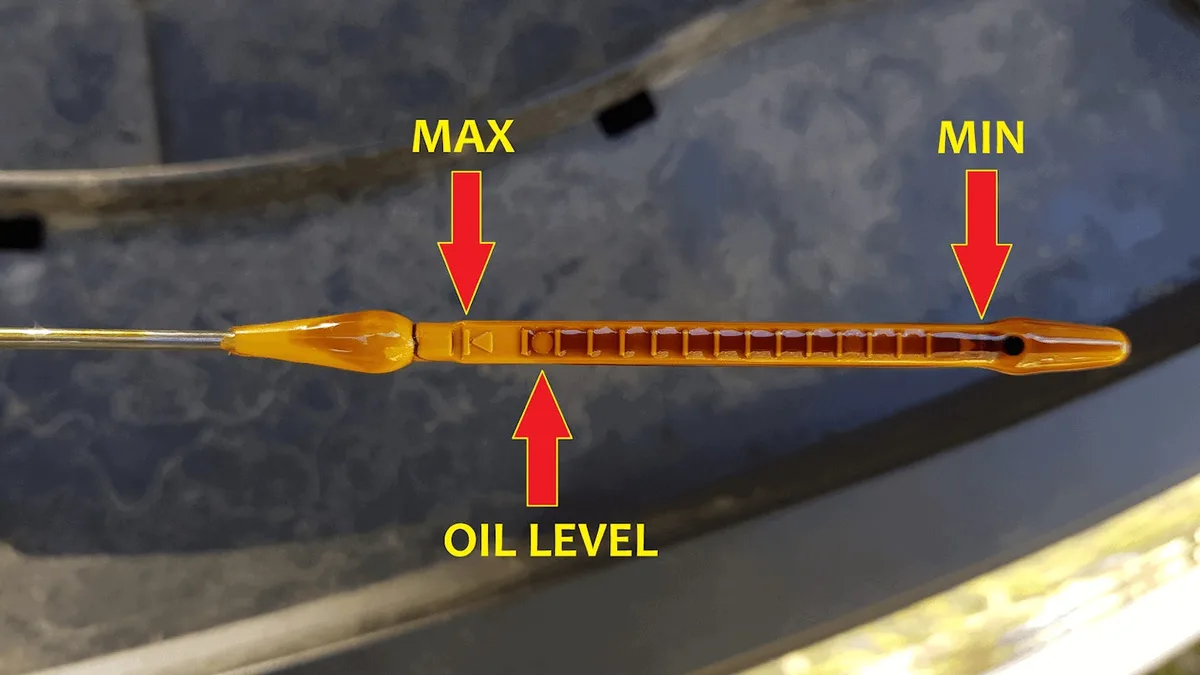
This is the most common scenario. You check the oil, it is below MIN, and you need to top it off without guessing. Here is the exact sequence.
- Park on level ground. A driveway slope tilts the oil in the sump and throws off your reading.
- Shut the engine off and wait 10 to 15 minutes. You need the oil to settle back into the pan.
- Pull the dipstick and wipe it clean with a shop rag.
- Reinsert the dipstick fully into the tube. Push it until it stops.
- Pull it out and read the level. Is it below the MIN mark or inside the crosshatch window?
- Estimate your need. Each 1/8 inch of dipstick travel equals roughly 0.25 quart on most passenger cars.
- Pour slowly through the filler neck using a funnel. Add no more than one quart at a time.
- Wait 30 seconds, re-pull the dipstick, wipe, reinsert, and recheck. Stop at the upper edge of the crosshatch or the MAX mark.
If the level is still below MIN after one quart, repeat steps 7 and 8. If it creeps above MAX, you have overfilled. Pull a small amount with a turkey baster or a small suction pump before you start the engine.
Full Drain-and-Refill: The 10-Step Process After an Oil Change
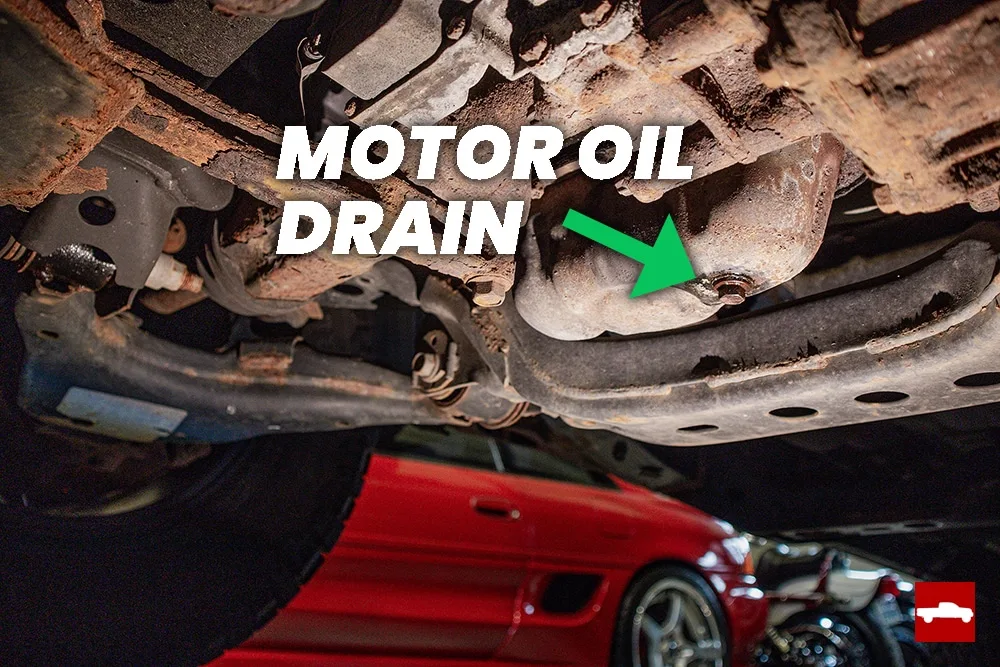
You just drained the old oil and swapped the filter. Now you need to get the correct fresh volume in. Follow this sequence.
- Warm the engine for 2 to 3 minutes, then shut it off. Thin oil drains faster and more completely.
- Place your catch pan under the drain plug. Remove the plug and let it drain fully.
- Remove the old oil filter. Oil the new filter's O-ring with a thin coat of fresh oil.
- Thread the new filter on by hand until the gasket contacts the housing. Add 3/4 turn with a filter wrench.
- Install a new crush gasket on the drain plug and torque to OEM spec (usually 15 to 20 ft-lb).
- Look up your engine's total sump capacity in the owner's manual. Subtract 0.5 quart for filter drain-back.
- Pour the calculated amount through the filler neck. Use a funnel to avoid splashing.
- Start the engine and let it idle 30 seconds. Shut it off.
- Wait 5 minutes, then check for leaks at the filter and drain plug.
- Pull the dipstick and verify the level. Top off a few ounces if needed, then reset the oil-service light on the dash.
When you are done, take the used oil to a parts store or county transfer station. The EPA's used oil management guidance notes that 1 quart of used oil can contaminate roughly 425,000 gallons of water if dumped illegally. Always recycle.
Overfilling Is the Bigger Sin: 5 Mistakes That'll Actually Ruin Your Engine
Most people fear underfilling, and they should. But in our research, overfilling causes more real damage than most drivers realize. Here are the five mistakes that show up most often in the shop.
Pouring the full bottle without checking. You buy a 5-quart jug, drain a 4-cylinder that only needs 3.5 quarts, and dump the whole thing in. That is 1.5 quarts over. The crankshaft now slaps through the oil pool, aeration kills your oil pressure, and the bearings starve at the next redline.
Not accounting for filter drain-back on a refill. You calculate 4 quarts for a full sump but forget the old filter held half a quart. Your new fill lands 0.5 quart above MAX and the PCV valve starts spitting oil into the intake.
Ignoring the dipstick after pouring. You add oil, close the cap, and drive off. You never recheck. Twenty minutes later the level is above MAX and you have no idea.
Mixing the wrong viscosity. You top off a 0W-20 spec engine with 10W-40 because that is all the garage had. The thicker oil changes the sump's flow dynamics and pushes the level reading artificially high.
Overfilling and then "fixing" it by draining from the bottom. You crack the drain plug to let a quart out, but you have now lost your crush gasket seal and introduced a slow seep. The correct fix is to extract oil from the top with a suction pump or a long turkey baster.
None of these mistakes are reversible in a single service visit. Aeration from overfill can coat the catalytic converter and foul the MAF sensor. Blown crank seals run $300 to $800 in parts and labor.
Catch it early, and it is a 5-minute fix with a baster.
Oil Capacity Cheat Sheet: Quarts and Liters by Engine Displacement
Your exact sump capacity is printed in the owner's manual under "Fluid Capacities" or "Engine Oil." If you do not have the manual handy, the table below covers the most common passenger-car and light-truck engines. As of 2026, OEM service documents from Ford, GM, Toyota, Honda, BMW, Mercedes, and VW all list total capacity in liters. The quarts column is our conversion for US buyers who work with bottle sizes.
| Engine Size | Sump Capacity (L) | Quarts (approx.) | Filter Drain-Back | Pour After Full Drain |
|---|---|---|---|---|
| 1.5 to 2.0 L 4-cyl | 3.0 to 3.8 | 3.2 to 4.0 | 0.25 to 0.5 qt | Total minus drain-back |
| 2.5 to 3.5 L V6 | 4.2 to 5.5 | 4.4 to 5.8 | 0.5 qt | Total minus drain-back |
| 4.6 to 5.7 L V8 | 5.5 to 7.5 | 5.8 to 7.9 | 0.5 qt | Total minus drain-back |
| 6.0 to 6.2 L V8 | 7.0 to 8.0 | 7.4 to 8.5 | 0.5 qt | Total minus drain-back |
A few practical notes to keep in mind.
- If your manual says "with filter" or "without filter," read that line carefully. "With filter" means the number already accounts for the 0.5 quart trapped in the housing. "Without filter" means you subtract the drain-back yourself.
- Turbocharged and direct-injection engines (common on 2020+ Ford EcoBoost, GM Ecotec, and VW EA888 units) tend to run smaller sumps. A 2.0L turbo 4-cylinder may only need 3.5 to 3.8 liters total.
- Converting from a liter spec to quarts? Multiply by 1.057. A 4.5-liter sump equals about 4.76 quarts. Round up to the nearest 0.25 quart when grabbing bottles at the store.
When in doubt, pour in 1-quart increments and recheck the dipstick between pours. That is the safest way to land between MIN and MAX without doing math at the filler neck.
FAQs: "What If I Don't Have a Dipstick?" and the Other Questions That Keep Coming Up
What if my car has no dipstick, just an electronic oil level sensor?
You are not alone. BMW, Mercedes, Audi, and several Toyota hybrids use a digital sensor in the sump instead of a physical stick. Park on level ground, shut the engine off, and open the oil-level menu on the instrument cluster.
The screen will show "FULL," "ADD 1 L," or "LOW." Pour oil in 1-liter increments through the filler neck and reset the sensor between pours per your OEM's procedure.
How much oil can I safely overfill before it matters?
Most engine designers tolerate about 1/8 inch above the MAX mark without immediate harm. Beyond that, the crankshaft starts slapping through the oil pool, aerating it and dropping your pump pressure. One to two quarts over on a 4-cylinder is enough to blow the rear main seal or foul the catalytic converter.
If you overfill, extract the excess from the top with a suction pump before starting the engine.
Can I mix synthetic and conventional oil in the same top-off?
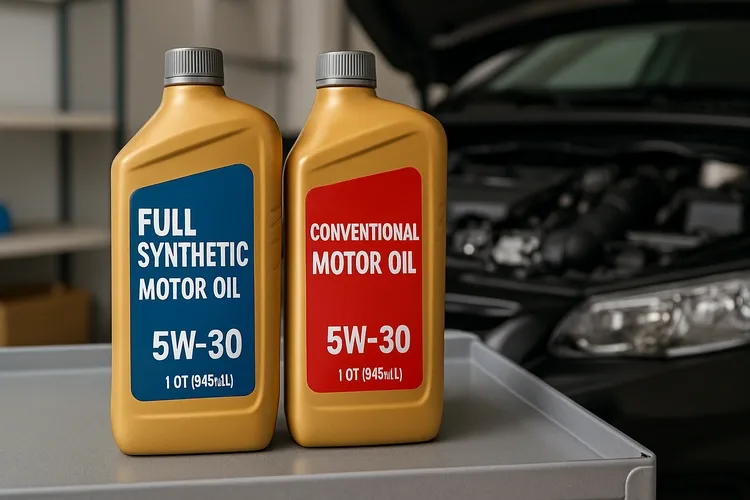
Short answer: yes, in an emergency. Blending a quart of conventional 5W-30 into a full-synthetic 0W-20 sump will not seize the engine. However, the conventional oil dilutes the high-temperature protection the synthetic provides.
Treat it as a stopgap. At your next full drain, replace the entire sump with the correct synthetic spec from your manual.
Why does my oil level drop by a full quart every 500 miles?
That is not normal consumption. A healthy engine burns under 1 quart per 5,000 to 7,500 miles. If you are losing a quart every 500 miles, you likely have a slow leak at the valve cover gasket, oil filter housing, or rear main seal.
A PCV system fault can also pull oil vapor into the intake. Have a tech inspect for leaks before your next fill.
Do I need to change my oil spec when the weather switches from summer to winter?
You do not need to swap bottles. A 0W-20 or 5W-30 rated oil performs across the temperature range its SAE grade covers. What changes is how often you check.
Cold starts stress the oil film more, so a quick dipstick pull every morning in January is smart. The "0W" or "5W" number on the label already accounts for cold-weather flow per SAE J300 testing.